Some Problems Have to Disappear
Campaign 4 stops merely showing us how power works and starts showing us what happens to people who get in its way.

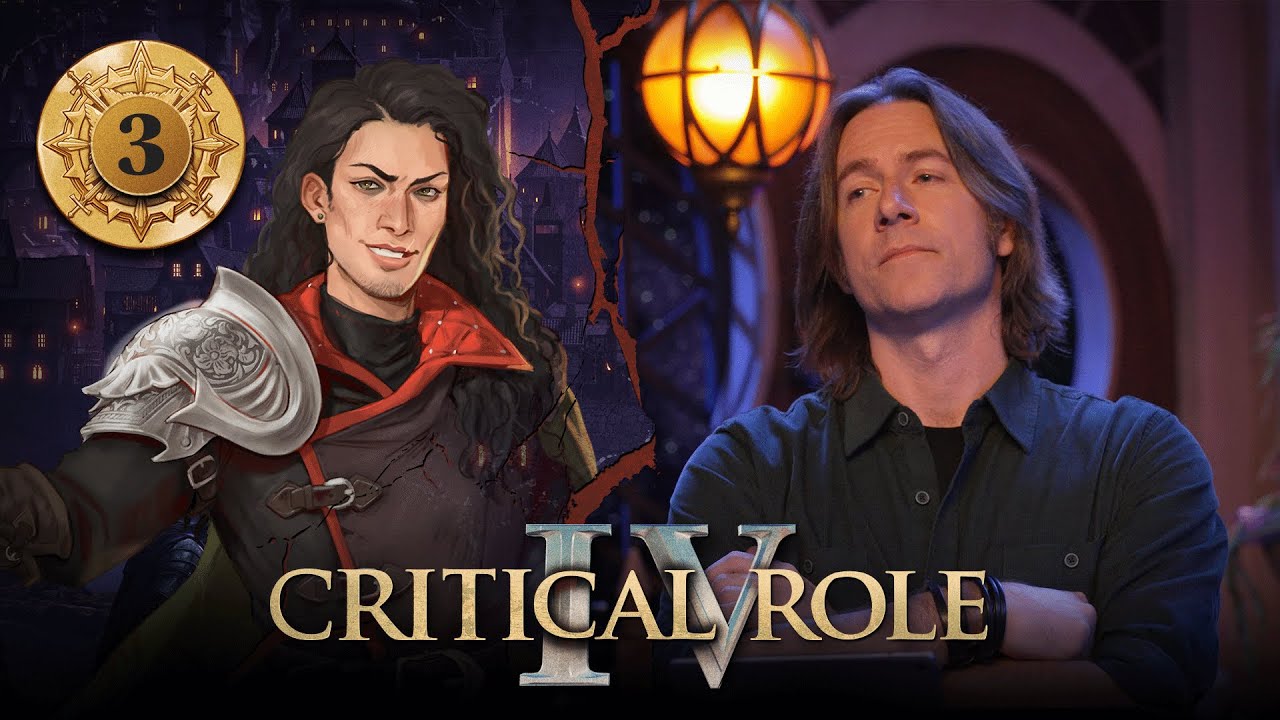
Campaign 4’s most propulsive episode yet turns political pressure into attempted disappearance, betrayal and open supernatural violence. The enormous ensemble still creates some unevenness, but its separate stories are finally beginning to collide.
What worked & what held it back
- Wicander and Tyranny turn House Halovar’s deception into meaningful character action
- Teor’s Couturier sequence makes institutional violence feel chillingly procedural
- Thimble’s Crow Keeper investigation finally gives the Casimir mystery a concrete direction
- The Hallowed Round provides a strong thematic counterpoint through reclamation rather than erasure
- The Tachonis climax collides several mysteries in one of Campaign 4’s strongest cliffhangers
- The enormous ensemble still creates abrupt transitions and uneven focus
- Several simultaneous mysteries continue to demand close attention
Spoiler warning: This review discusses Critical Role Campaign 4 Episode 3, The Snipping of Shears, in full.
House Halovar has a tailor shop.
This would not normally be cause for alarm.
Unfortunately, the Mercanaud Couturier appears to specialise in alterations of the permanent kind.
By the end of Episode 3, Teor has nearly been disappeared by House Halovar, the Crow Keepers have tried to put Thimble in a sack, Murray has been targeted by a mysterious curse during her confrontation with Lord Primus Tachonis, General Raimond Davinos has had his skull and upper spine ripped from his body, and Occtis is surrounded by ghouls preparing to cut him open.
Campaign 4 has finished introducing its systems of power.
Now those systems are becoming operational.
Episode 2 showed us what the Sundered Houses believe they are entitled to inherit.
Episode 3 shows us what happens when somebody gets in the way.
Wicander Learns the Rules Are for Other People
Episode 2 destroyed Wicander Halovar’s understanding of the Candescent Creed.
Episode 3 explains what that misunderstanding was for.
Photarch Yanessa does not simply tell him that the Creed was manufactured.
She explains the logic behind manufacturing it.
People need something to believe in.
Rules give ordinary people stability.
Faith gives House Halovar influence.
And the family responsible for writing those rules does not necessarily need to follow them.
Her analogy about poaching fish is almost comically revealing: the rule works best when everyone else obeys it.
Wicander has spent his life treating doctrine as morality.
Yanessa treats doctrine as a tool.
That explains why House Halovar can preach forgiveness while allowing Thjazi to die for political convenience.
It explains why the Creed can speak about universal Light while House Halovar secretly controls its source.
It explains why Wicander’s arranged marriage is presented as spiritual destiny when the real objective is access to vineyards capable of increasing Filament production.
And eventually Yanessa tells him what she actually needs from him:
stop believing.
His sincerity was useful while it made him convincing.
Now it is becoming inconvenient.
Sam Riegel plays the response beautifully because Wicander does not suddenly become a revolutionary.
He agrees.
He nods.
He tells his grandmother he understands.
Then he leaves.
That restraint makes what happens next much more important.
Wicander’s First Act of Faith Is Disobedience
The conversation with Tyranny is where Wicander finally begins deciding what any of this means.
Tyranny knew the Creed was fraudulent.
She knew House Halovar’s arrangements with demons, Filament and religious authority were not what Wicander believed them to be.
She also knew her own role beside him was partly performance.
Wicander is understandably furious.
But Tyranny does something his family has avoided doing for his entire life.
She tells him he has a choice.
She does not offer another comforting lie.
Wicander thought he could save her.
Tyranny tells him he cannot.
She is still a demon.
Her maker, Ksha’aravi, still benefits from House Halovar’s arrangements.
Her sisters are actively involved in manipulating crowds and spreading the family’s influence.
But Tyranny also tells him that her contract is with him, not House Halovar.
And she has begun making choices that do not align neatly with what the people who placed her beside Wicander expected.
That symmetry matters.
Wicander discovers his family is not what he thought.
Tyranny admits she is not what he thought.
Removing both illusions somehow makes their friendship more real.
Then Wicander remembers Yanessa’s casual statement about Teor.
He asks whether his grandmother meant that Teor should be “dealt with.”
Her answer is worse.
It has already been done.
That gives Wicander his first meaningful decision after learning that his faith is built on lies.
He does not begin with theology.
He tries to save someone.
Teor Discovers What House Halovar Means by Tailoring
Teor begins Episode 3 believing his infiltration is going remarkably well.
House Halovar gives him money.
They make him Wicander’s guardian.
They send him to be properly outfitted.
He even suggests acting as covert security, which is a reasonable idea until the Halovar servant explains that discretion apparently means wearing the Candescent Creed’s symbols more visibly.
Then Julien sees where Teor is headed.
He recognises the significance before Teor does.
The Mercanaud family has long worked for House Halovar.
Their respectable businesses are only part of what they do.
They have a reputation for making problems disappear.
That dramatic irony hangs over Teor’s entire visit.
Inside the Couturier, small details begin turning wrong.
Teor’s initial Divine Sense does not simply reveal a pair of fiends standing in front of him. The Mercanauds themselves do not register that way.
Instead, their sapphire-orchid incense triggers a disturbing memory: the smell connects Teor back to a nine-pointed star burned into a battlefield during the Falconer’s Rebellion.
Then the trap closes.
Hold Person takes away his ability to act.
Powerful fiendish magic surrounds him.
And eventually Teor finds himself restrained while Calastro Mercanaud begins using a pair of shears to cut pieces from his shadow.
We still do not know precisely what the completed procedure would have done.
Calastro’s promise that Teor would have had “quite a ride come sunrise” is not especially reassuring.
We know enough.
House Halovar does not need its public leaders to kill or remove troublesome people themselves.
It has infrastructure.
A pouch of gold.
A respectable storefront.
An appointment.
A disappearance.
That is what makes Halovar frightening.
Its violence is administrative.
Which makes Wicander and Tyranny arriving to stop it feel like more than a rescue.
It is Wicander’s first rejection of the machinery his family expected him to inherit.
Casimir Is Becoming More Than a Missing Man
The Crow Keeper sequence gives the Thjazi investigation its first real present-day explosion.
Thimble enters the Guard Tower looking for information.
Then she says Casimir’s name.
Someone immediately tries to put her in a sack.
There are subtler ways to indicate that a conversation has become sensitive.
The fight that follows is appropriately chaotic.
Thimble is trying not to start a war with an entire thieves’ guild while simultaneously making it very clear that putting her in a sack would be medically unwise.
Kattigan and Occtis scramble to support her.
Vaelus eventually enters with fewer concerns about diplomatic restraint.
But the important result is information.
Thimble learns that Casimir had his own private group within the Crow Keepers.
He had been skimming money.
He was deeply in debt.
Then, suddenly, he had enough wealth to settle what he owed and a deed to a stronghouse in Gormalay.
That is suspicious enough.
Cyd makes it worse for Casimir — and considerably better for himself.
He arrives demanding:
“Where’s the wagon? We’re already too late.”
Then he sees Casimir’s sudden wealth, grabs the deed and runs.
Casimir and his people pursue him.
That separates two men who Episode 2 left sitting beside one another in the suspicion column.
Cyd now looks much less like somebody participating in the same arrangement.
Casimir looks considerably worse.
And the evidence increasingly points toward Casimir’s private Crow Keeper crew as the people behind the attack that prevented Thimble from delivering the escape glyph.
That is not quite the same as proof.
Episode 3 has not given us a masked attacker removing their disguise and identifying themselves as one of Casimir’s people.
But Thimble now has strong reason to believe that people loyal to Casimir may have helped ensure Thjazi could not escape execution.
That makes Episode 2’s battlefield flashback considerably more painful.
We have seen Casimir run into magical bombardment and carry Thjazi to safety.
Now the evidence is beginning to point toward his circle being involved in stopping another rescue years later.
The interesting question is no longer simply whether Casimir betrayed him.
It is:
What happened between the man who once saved Thjazi Fang and the man now sitting at the centre of so much suspicion?
Hal Does Not Erase the Past. He Changes Who Gets to Use It.
In an episode dominated by attempts to remove people, Hal is doing almost the opposite.
He is building a theatre.
The Hallowed Round was once the dithyramb of Azgra, a vast site where a god appeared above the city while the orcs created to serve him performed below.
Now Hal and his troupe are turning it into somewhere people can perform on their own terms.
Thaisha cannot ignore what the site used to mean.
Hal cannot ignore what it might become.
Then Uli, one of the few surviving orcs old enough to remember the world before the Shapers’ War, gives the transformation its weight.
He remembers a people raised for conquest.
Azgra taught them to fear nothing, march toward violence and dominate what stood before them.
Eventually, they turned what he taught them against their own god.
What came afterward was finally theirs to decide.
That makes the Hallowed Round more than a nice piece of urban redevelopment.
It is reclamation.
And it provides the episode with a quiet counterargument to everything House Halovar represents.
Yanessa believes the past remains useful because old grievances justify present power.
Hal does something different.
He accepts that the past happened without allowing it permanent ownership of the space.
House Halovar makes inconvenient people disappear.
Hal takes an inconvenient history and refuses to let it disappear.
He simply changes who gets to speak there.
That may be one of Campaign 4’s most important distinctions.
Even here, Thjazi refuses to stay out of the story.
Bolaire arrives carrying the paint Thjazi arranged for Hal, another piece of the dead man’s apparently deliberate web of instructions arriving precisely as everyone else is trying to decide what comes next.
Murray Protects a Student She Barely Likes
Lord Primus Tachonis arriving at the Penteveral gives Murray one of her strongest scenes so far.
He comes looking for Occtis.
He insults Murray.
He insults the school.
He insults his own son.
And when Murray refuses to cooperate, a powerful unseen curse attempts to lock her down.
She resists.
Primus does not cast it.
More disturbingly, Brennan makes clear that Primus does not appear to be its source.
Something else in the room is capable of reaching for Murray without revealing itself.
But the important part of the scene is why Murray refuses him.
She does not particularly like Occtis.
That is hardly a secret.
But Occtis came to the Penteveral without the sorcerous gifts House Tachonis expected him to possess and found another way to become powerful.
For Murray, that matters.
The Penteveral represents the idea that somebody can become more than what birth assigned them.
Primus sees Occtis as failed family property that needs to be retrieved.
Murray sees a student who earned something his family did not give him.
That is enough.
Dean Tallbarrel protects her in his own strange way.
He secretly uses Message to tell Murray to leave.
He Counterspells her attempt to investigate the mysterious magic around Primus.
Then he publicly performs contempt toward her loudly enough that Primus lets her go.
Murray walks away thinking Tallbarrel has betrayed her.
The audience has considerably more reason to suspect he just protected her.
Again, Episode 3 keeps finding different versions of the same question:
what looks like loyalty, and what does loyalty actually require?
The Ensemble Is Finally Becoming Smaller on Purpose
Campaign 4’s thirteen-character structure starts making more sense once it stops pretending everyone needs to remain one party.
Episode 3 begins formalising smaller groups around shared problems.
Thimble wants Casimir.
Kattigan has a trail north.
Teor needs answers about Cyd.
Wicander needs distance from House Halovar.
Tyranny has chosen Wicander over simply carrying out the role assigned to her.
They do not announce themselves as an adventuring party.
They simply reach a point where travelling together makes sense.
That is a much better solution.
Meanwhile, Hal, Murray and Azune have reasons to remain in Dol-Makjar.
The campaign is beginning to organise itself around story groups rather than thirteen people waiting for every scene to include them.
The fragmentation is still there.
It is finally becoming intentional.
House Tachonis Stops Being Subtle
The final sequence at Palazzo Davinos is where Episode 3 stops implying that House Tachonis is dangerous.
Occtis agrees to speak with Aranessa.
Vaelus becomes increasingly interested in what Occtis has accomplished with death magic.
Aranessa explains that the crisis surrounding death and Faerie is becoming worse.
The Royce castle associated with the passage toward Faerie is weakening.
The Tachonis stronghold associated with death is becoming stronger as the dead accumulate.
Then Vaelus senses hundreds of restless spirits clustered beyond the veil around the palazzo.
She also discovers something else.
Julien is cursed.
That quietly pulls one of Episode 1’s strangest loose threads back into view.
Bolaire saw a shadow-like presence following Julien after he violated the protections around Thjazi’s corpse.
Now the campaign has given that unease a name.
Before anyone can properly investigate it, Julien realises something else is wrong.
An invisible attacker appears behind General Raimond Davinos.
There is no duel.
No speech.
No warning.
His skull and upper spine are ripped from his body.
That is the difference between Halovar and Tachonis.
Halovar makes people disappear behind polished doors.
Tachonis leaves the remains in the room.
Upstairs, things get worse.
A Silence spell drops around Aranessa and Occtis.
Six Tachonis ghouls arrive.
Then Ethrand Tachonis enters carrying the Stone of Nightsong.
The artefact stolen from Thimble.
The artefact Vaelus came to recover.
The artefact now in the hands of the family hunting Occtis.
And Ethrand gives the order:
put Occtis on the table.
Open him up.
Put the stone where it belongs.
Cut.
That is Campaign 4’s best cliffhanger so far.
Not simply because it is grotesque.
Because several stories suddenly stop being separate.
The Stone of Nightsong.
Occtis.
House Tachonis.
Death magic.
Faerie.
The attack on Thimble.
Julien’s curse.
Thjazi’s execution.
For three episodes, Campaign 4 has scattered pieces across Dol-Makjar.
House Tachonis just dropped several of them into the same room.
Verdict
The Snipping of Shears is the episode where Campaign 4’s politics become physical.
House Halovar does not merely possess influence.
It has respectable businesses capable of turning a fitting appointment into an attempted disappearance.
House Tachonis does not merely intimidate institutions.
It hunts its own son, attacks a home already surrounded by hundreds of restless dead and kills a general before he can draw a weapon.
The Crow Keepers do not merely know something about Casimir.
They try to bag Thimble the moment she asks the wrong question.
Power in Episode 3 increasingly means the ability to decide what — and who — gets removed.
But that is only half the episode.
Wicander learns his faith was constructed and chooses to save Teor anyway.
Tyranny refuses to let the people who positioned her beside Wicander determine every choice she makes.
Murray protects a student she does not even particularly like because she believes people should be allowed to become more than their birth.
Hal takes a site associated with domination and turns it into somewhere people can tell their own stories.
That is the episode’s more interesting argument.
Halovar erases discreetly.
Tachonis erases violently.
Hal does not erase the past at all. He changes who gets to use it.
Episode 2 established that history never really goes away.
Episode 3 asks the harder question:
Who gets to decide what survives it?
For most of the episode, the Sundered Houses believe the answer is obvious.
Then people start saying no.
And House Tachonis responds by ripping somebody’s spine out.
9/10
Sources
- Critical Role Campaign 4, Episode 3Critical Role
Enjoyed this article?
Supporting Rolling Realm helps fund more independent reviews, lore guides and spoiler-aware coverage. Every article remains free.
Critical Role Campaign 4 Episode 4 Review: What We Were Made For
The Overture ends with a massacre, an impossible return from death and Campaign 4's clearest argument yet that origin does not have to become destiny.
House Tachonis destroys Palazzo Davinos, Occtis dies and returns, and Bolaire reveals what they are as the Overture turns inheritance into a fight over ownership and choice.
Critical Role Campaign 4 Episode 7 Review: Power, Betrayal and One Terrible Castle
“On the Scent” turns a hunt through Timmony into a study of borrowed authority, as Wicander wrestles with inherited status and Casimir discovers how little respect betrayal actually bought him.
A slow-burning but rewarding episode that uses Timmony, the Candescent Creed and Castle Sloak to explore power, legitimacy and the humiliating limits of Casimir Gavendale’s new status.
Critical Role Campaign 4 Episode 9 Review: The Oath Still Stands
The Soldiers follow Cyd into Tybry’s Lea and discover that when gods, revolutions and institutions fail, what matters is not preserving their old shape — but deciding which promises still deserve to survive.
A dense but rewarding episode that uses Timmony’s Hounds, the Candescent Creed and House Tachonis to ask what deserves to survive when old systems fail.
Critical Role Campaign 4 Episode 2 Review: There Are No Bygones
Campaign 4 starts digging beneath family, faith and old loyalties — and discovers that nothing inherited comes without a history.
Episode 2 turns old loyalties, inherited authority and House Halovar’s hidden machinery into active threats as Thjazi’s sabotaged escape begins to take shape.
What We Learned from Critical Role Campaign 4, Episode 3
Cut threads, quiet threats and the shadow behind the shears
Episode 3 exposes the manufactured Candescent Creed, sends a new party towards Gormalay and ends with House Tachonis tearing its way into Palazzo Davinos.
Critical Role Campaign 4 Episode 4 Review: What We Were Made For
The Overture ends with a massacre, an impossible return from death and Campaign 4's clearest argument yet that origin does not have to become destiny.
House Tachonis destroys Palazzo Davinos, Occtis dies and returns, and Bolaire reveals what they are as the Overture turns inheritance into a fight over ownership and choice.