There Are No Bygones
Campaign 4 starts digging beneath family, faith and old loyalties — and discovers that nothing inherited comes without a history.

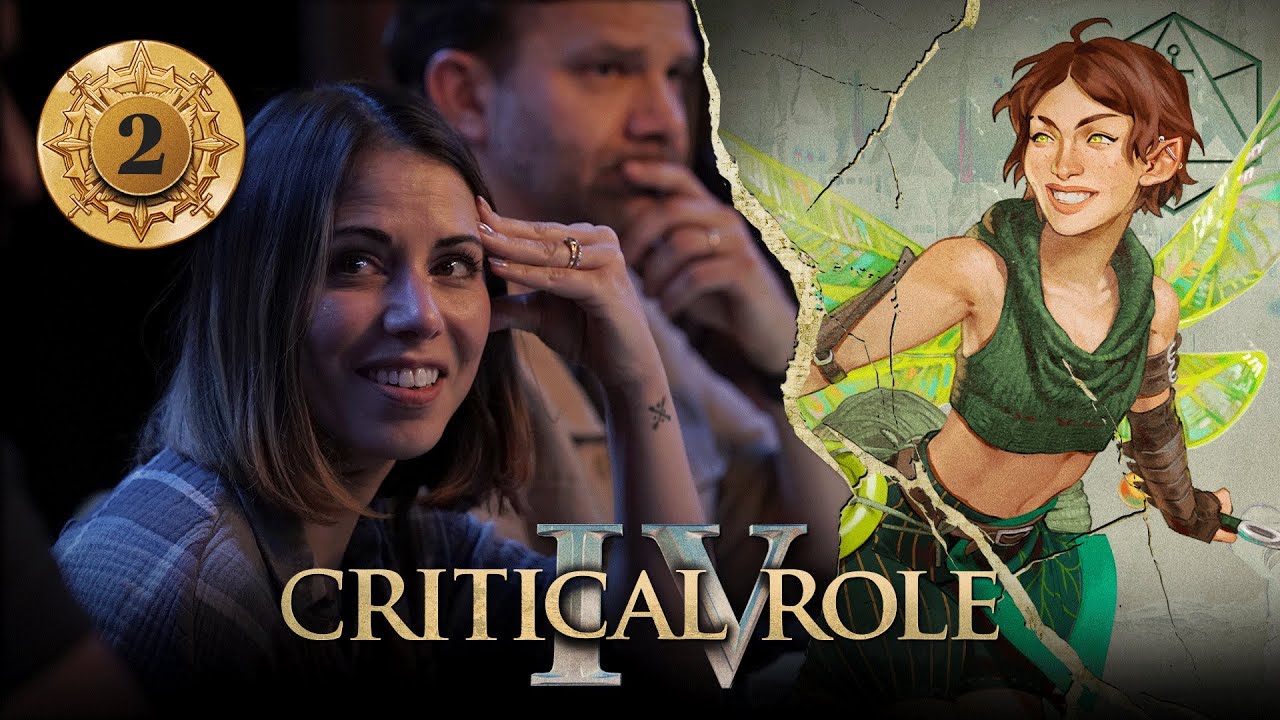
A revealing, unsettling second episode that turns Campaign 4’s inherited histories into active threats. Its increasingly fragmented structure costs some momentum, but Thimble’s grief, the sabotaged rescue and Wicander’s family revelation are exceptional.
What worked & what held it back
- Thimble’s farewell and wedding flashback give the episode a powerful emotional centre
- The forged glyph turns the failed rescue into a sophisticated sabotage mystery
- Wicander and Yanessa make the episode’s inheritance theme politically and emotionally concrete
- The Prismatic Retort reveal is an exceptional piece of religious and family horror
- Splitting the enormous ensemble across multiple storylines creates a fragmented rhythm
- Several subplots feel more preparatory than immediately dramatic
- Dense political and institutional threads sometimes compete for momentum
Spoiler warning: This review discusses Critical Role Campaign 4 Episode 2 in full.
Wicander Halovar believes in forgiveness.
His grandmother does not.
That difference takes most of Episode 2 to become obvious, but once it does, almost everything else in the episode begins arranging itself around it.
Old rebellions are not over because the fighting stopped. Noble families have not forgotten what was taken from them. Thjazi Fang’s death has not ended his plans. A wedding gift still shapes a friendship decades later. Institutions supposedly built for a new world are being pulled back toward inherited power.
Then Photarch Yanessa Halovar finally gives her grandson the lesson Campaign 4 appears increasingly interested in teaching everyone:
“There are no bygones. There are never bygones.”
Episode 1 gathered thirteen characters around one dead man.
Episode 2 starts showing them what the past expects in return.
Casimir Once Ran Into Fire for Thjazi
The Falconer’s Rebellion cold open initially looks like an excuse to show younger versions of Azune, Teor, Kattigan, Thimble and Thjazi in battle.
It is considerably more useful than that.
Azune is fifteen and bleeding out. Kattigan is badly wounded. Teor is performing battlefield triage while the Sundered Houses rain magic down around them. Thimble drops a flying sorcerer’s concentration by stabbing them beneath the skull.
And Thjazi is still trying to escape with an absurd number of stolen magical staves.
Then he gets hit.
Someone runs into the barrage, hauls him from the ground and carries him back toward safety.
“I got him.”
That is the detail the scene exists to leave behind.
By the present day, Casimir’s absence is becoming suspicious. He was involved in the escape operation. He has connections to the Crow Keepers. The plan collapsed, the wagon Cyd was meant to drive never arrived, and everyone is beginning to ask who knew enough to compromise the rescue.
Brennan Lee Mulligan could have introduced Casimir as a missing possible traitor.
Instead, he first shows us a man who once risked his life to save Thjazi.
That makes suspicion more interesting.
Whatever happened later, there was once something real enough to betray.
Thimble Finally Reaches the Funeral
The episode’s emotional high point comes without conspiracy, politics or cosmic horror.
Thimble finally gets to say goodbye.
She returns to the Fang home while Hal and Hero are playing Broken Wing, an old song from the Falconer’s Rebellion whose meaning has changed along with everyone who survived it.
Then she sees Thjazi.
“You stupid fuck.”
Laura Bailey lets the anger collapse almost immediately into guilt.
Thimble apologises for missing the execution. For failing to deliver the glyph. For not saving him.
“What am I going to do without you?”
It lands because we already know something she does not seem emotionally capable of accepting yet:
the failure was not simply hers.
The rescue had been compromised.
Episode 2 then makes their relationship hurt more by showing us how it began.
At Thjazi and Aranessa Royce’s wedding, Thimble appears through House Royce tradition as a fairy protector attached to the marriage.
Thjazi immediately starts questioning the premise.
Does she want to be a gift?
Does she have to be?
Within minutes, they are joking about mice, hair braiding and whatever freedom might look like next.
“We can do anything.”
It is a small flashback, but one of the episode’s most effective uses of history.
Thimble entered Thjazi’s life through somebody else’s idea of tradition and obligation.
Thjazi’s instinct was to give her a choice.
Now she is standing on his chest blaming herself for failing to give him an escape.
That is devastating without needing to become melodramatic.
The Fake Glyph Was Designed Around Azune Being Good at His Job
Episode 1 tells us the escape did not simply fail.
Episode 2 makes the sabotage more sophisticated.
Azune examines what was actually placed on Thjazi.
The object itself is cheap.
The magic is not.
What matters is that it produces exactly the magical profile Azune expected to find: conjuration and illusion.
But the apparent conjuration does not perform the real escape at all.
Its aura is part of the illusion.
Occtis understands the implication:
“It’s meant to fool you.”
That is the clever part.
Azune was not deceived because he performed his role badly.
The sabotage was constructed around the assumption that he would perform it correctly.
Someone knew what he planned to check.
Someone knew what magical signature he expected.
Someone attacked Thimble before she could deliver the real glyph.
Someone made sure Thjazi carried something convincing enough that Azune would give him the signal to proceed.
The rescue was not merely interrupted.
It appears to have been counterfeited.
That distinction pushes Campaign 4’s mystery forward enormously.
The characters begin reconstructing their own operation.
Cyd was supposed to drive the wagon.
Casimir had criminal connections capable of moving people unseen.
Thimble never made the handoff.
The Crow Keepers are now part of the evidence.
And multiple pieces of the plan failed in suspiciously coordinated ways.
Naturally, suspicion follows.
But Episode 2 is careful about turning suspicion into proof.
Casimir may look increasingly worrying.
That does not erase the man we just watched run through a battlefield to save Thjazi.
The past complicates the evidence instead of simplifying it.
Thjazi’s Final Words Are Starting to Look Like a Plan
Thjazi has been dead for two episodes and remains remarkably busy.
The shattered black mask from the silver box provides another example.
Thaisha touches it.
This goes poorly.
The fragments disappear into freezing mist, Thaisha drops unconscious and Bolaire begins examining what she actually retrieved.
His conclusion is considerably worse than “mysterious box.”
It is a coffin.
Its materials and inscriptions connect it to older ideas of death and the realms that existed before the Shapers’ War fundamentally altered Aramán’s relationship with the divine.
There is fascinating cosmology here, but the more important question is simpler:
Why did Thjazi want Bolaire to have it?
Because Episode 2 is beginning to prove that his final instructions were not random fragments from a dying man.
Thaisha and Occtis were sent for the coffin.
Bolaire was supposed to receive it.
Murray was named at the gallows.
And this is apparently not the first strange commission Thjazi has sent Bolaire. Bolaire reveals that he has previously researched questionable artefacts for him and even passed some along to unnamed recipients without asking many questions.
The coffin is not necessarily the beginning of a secret network.
It may simply be the latest thing Thjazi put through it.
Then, after Thaisha recovers, another possible connection flickers into view. Looking at Vaelus, she hears the distant call of a nightingale — a bird that should not be there — and immediately thinks:
“Night song.”
That proves nothing yet.
But with Vaelus hunting the Stone of Nightsong, the episode is increasingly allowing Thjazi’s supposedly separate artefact mysteries to brush against one another.
Then Bolaire reaches the Archanade and discovers crates of paint Thjazi arranged to have delivered.
Attached is a note:
“For Hal, with all my love.”
The joke works because Thjazi apparently spent his final days organising the world’s most irritating posthumous scavenger hunt.
But the implication underneath it is serious.
Thjazi knew enough to start moving people, artefacts and information into position.
Episode 1 asked why he was killed.
Episode 2 introduces a potentially more dangerous question:
What did Thjazi know before everybody else?
Wicander Believed the Creed Meant What It Said
This is where Episode 2 becomes much sharper.
Wicander’s problem is not that he lacks faith.
It is that he has taken his faith seriously.
He believes the language of the Candescent Creed.
Forgiveness.
Reconciliation.
Light overcoming shadow.
The possibility that people can change.
Tyranny and her sisters are almost proof of concept: beings associated with shadow who nevertheless found a place within the Creed.
Wicander therefore approaches Thjazi’s execution with an assumption that makes complete sense inside the worldview he has been taught.
Surely the old conflicts should be over.
Surely whatever happened during the Falconer’s Rebellion can become history.
Yanessa disabuses him of that idea.
“There are no bygones. There are never bygones.”
It may be the most important political line Campaign 4 has delivered so far.
To Wicander, forgiveness is a moral principle.
To Yanessa, history is leverage.
The Falconer’s Rebellion may be over militarily, but the Houses remember who opposed them.
The Shapers’ War may belong to an older generation, but the structures created afterward still define the present.
Peace has not erased power.
It has merely changed how power is exercised.
Then Yanessa gives him the fact he did not want.
House Tachonis wanted Thjazi dead.
House Halovar allowed the execution to proceed because keeping Tachonis close mattered more.
That revelation does not yet tell us why Tachonis wanted Thjazi executed.
It does something more immediately damaging.
It destroys Wicander’s comforting belief that his family tried to save Thjazi and simply lacked the power to succeed.
They made a choice.
Political necessity won.
The grandmother who taught him reconciliation knows perfectly well that she did not practice it.
Yanessa’s response is not ideological triumph.
It feels closer to confession.
She knows Wicander is discovering the distance between the Creed he believes in and the compromises required to maintain the institution carrying its name.
There is nothing solid, she tells him, that does not cast a shadow.
The problem is that Wicander has spent his life believing the Light removed them.
Inheritance Keeps Arriving With Terms and Conditions
Wicander’s story is the episode’s clearest version of the idea, but he is not alone.
Julien Davinos is dragged back toward the expectations of his family when General Raimond comes looking for him.
Julien has inherited a noble name, military history and a role somebody else seems much more enthusiastic for him to perform.
He responds with roughly the level of warmth you would expect from a man whose father has located him outside a brothel.
Murray faces the same conflict at institutional scale.
The Penteveral represents knowledge, effort and magical achievement that does not depend upon noble birth.
Yet inherited power is forcing its way back into the institution.
Dean Tallbarrel may technically have resigned, but Murray is told that all five Sundered Houses forced the issue.
Then Lord Primus Tachonis walks through the door.
The timing is almost rude.
Thematically, it is perfect.
The episode keeps placing earned identity beside inherited authority.
Some characters are desperate to live up to their names.
Others would quite like their names to leave them alone.
And some, like Wicander, are only beginning to discover what the name has been doing on their behalf.
None of these strands needs equal weight.
What matters is that they are all variations on the same problem:
you do not choose what you inherit.
You only choose what you do after you understand it.
Then Wicander Meets the Source of the Light
For most of Episode 2, Wicander believes he knows what Filament is.
The Candescent Creed has learned to distil the Light into physical form.
Filament empowers rituals.
It can be consumed.
It runs beneath the glowing markings on his own face.
Tyranny asks the question Wicander has apparently never needed to ask.
How is it made?
He knows the theology.
He does not know the machinery.
That gap becomes the cliffhanger.
Godard takes Wicander beneath Villa Aurora and farther into House Halovar’s secrets than he has previously been allowed.
Wicander treats the experience like initiation.
He is finally important enough to understand the Prismatic Retort.
Yanessa knows better.
Before revealing it, she needs him to understand one thing.
Her love for him is real.
Not everything she has told him is.
Then the machinery opens.
There is a celestial being inside.
Thirty feet tall.
Chained.
Its featherless wings splayed against the machine.
Its body apparently being used as the source from which House Halovar produces the gleaming substance it calls Filament.
There is no need to explain the horror for long.
Wicander wears that substance on his face.
He has treated it as evidence of divine Light.
His family has treated the creature producing it as infrastructure.
Then Yanessa adds the final inheritance.
“Wicky, I’d like you to meet your grandfather.”
Cut.
Perfect.
The episode does not merely reveal that the Candescent Creed has a dark secret.
It takes three things Wicander thought he understood — faith, power and family — and makes them the same secret.
Episode 1 Had One Room. Episode 2 Has a Problem
The major weakness is structural.
Episode 1 solved Campaign 4’s enormous cast with a funeral.
Everyone could occupy one location.
Every introduction could orbit Thjazi.
Episode 2 has to let them leave.
Suddenly Campaign 4 becomes several shows at once.
There is an investigation into the sabotaged rescue.
A supernatural mystery around the coffin.
Wicander’s religious and family crisis.
Julien’s Davinos conflict.
The changing Penteveral.
Thimble’s grief.
The emerging Crow Keeper trail.
Most of these stories are interesting.
Not all of them have equal momentum yet.
Wicander’s scenes escalate cleanly toward revelation.
The rescue investigation produces increasingly useful evidence.
Thimble’s arrival carries emotional urgency.
Other strands feel more like pieces being positioned for later episodes.
That is probably unavoidable with an ensemble this large, but it makes Episode 2 less elegant than the premiere.
Episode 1 found the perfect answer to thirteen player characters:
one room and one dead man.
Episode 2 reminds us that eventually everyone has to leave the funeral.
Verdict
Episode 2 is about discovering that history has not gone anywhere.
Casimir once saved the man he may now have betrayed.
Thimble entered Thjazi’s life through noble tradition and found somebody who immediately questioned whether tradition had any right to own her.
Azune discovers that the sabotage of the rescue was built specifically to exploit what he knew.
Thjazi’s final instructions reveal themselves as something closer to preparation.
Murray watches inherited power creep back toward an institution built around earned knowledge.
And Wicander discovers that the faith he thought transcended his family has been physically dependent upon it all along.
That is why Yanessa’s warning matters.
There are no bygones.
Campaign 4’s past is not backstory.
It is infrastructure.
Episode 2 is less structurally graceful than the premiere, and splitting thirteen characters into separate storylines inevitably produces stretches that feel more preparatory than dramatic.
But its best material is outstanding.
The rescue was deliberately counterfeited.
Thjazi appears to have left a plan behind.
House Tachonis wanted him dead.
And beneath Villa Aurora, Wicander finally learns where his family’s Light comes from.
It has been there longer than he has.
It is chained inside the machine.
And Yanessa tells Wicander it is his grandfather.
8.5/10
Sources
- Critical Role Campaign 4, Episode 2Critical Role
Enjoyed this article?
Supporting Rolling Realm helps fund more independent reviews, lore guides and spoiler-aware coverage. Every article remains free.
Critical Role Campaign 4 Episode 3 Review: Some Problems Have to Disappear
Campaign 4 stops merely showing us how power works and starts showing us what happens to people who get in its way.
Episode 3 turns political pressure into attempted disappearance, betrayal and open supernatural violence as Campaign 4’s separate storylines begin colliding.
Critical Role Campaign 4 Episode 6 Review: Forms Break, Truth Remains
The Soldiers reach Hawthorn’s Glade and discover that faith, beauty, darkness and even supernatural nature are poor substitutes for deciding what somebody actually chooses to do.
A cohesive Soldiers-focused episode where Wicander redefines the Light, Tyranny confronts demonic nature and Thimble pays for truth with memory.
Critical Role Campaign 4 Episode 7 Review: Power, Betrayal and One Terrible Castle
“On the Scent” turns a hunt through Timmony into a study of borrowed authority, as Wicander wrestles with inherited status and Casimir discovers how little respect betrayal actually bought him.
A slow-burning but rewarding episode that uses Timmony, the Candescent Creed and Castle Sloak to explore power, legitimacy and the humiliating limits of Casimir Gavendale’s new status.
Critical Role Campaign 4 Episode 3 Review: Some Problems Have to Disappear
Campaign 4 stops merely showing us how power works and starts showing us what happens to people who get in its way.
Episode 3 turns political pressure into attempted disappearance, betrayal and open supernatural violence as Campaign 4’s separate storylines begin colliding.
Critical Role Campaign 4 Episode 4 Review: What We Were Made For
The Overture ends with a massacre, an impossible return from death and Campaign 4's clearest argument yet that origin does not have to become destiny.
House Tachonis destroys Palazzo Davinos, Occtis dies and returns, and Bolaire reveals what they are as the Overture turns inheritance into a fight over ownership and choice.
Critical Role Campaign 4 Episode 5 Review: Somewhere to Return To
After certainty collapses, Campaign 4 sends its characters looking for new directions — and discovers that moving forward does not always mean leaving the past behind.
A strong transitional chapter that turns the Overture’s consequences into direction while finding emotional weight in Occtis’s undeath, chosen trust and the families still waiting for someone to come home.