The Oath Still Stands
The Soldiers follow Cyd into Tybry’s Lea and discover that when gods, revolutions and institutions fail, what matters is not preserving their old shape — but deciding which promises still deserve to survive.
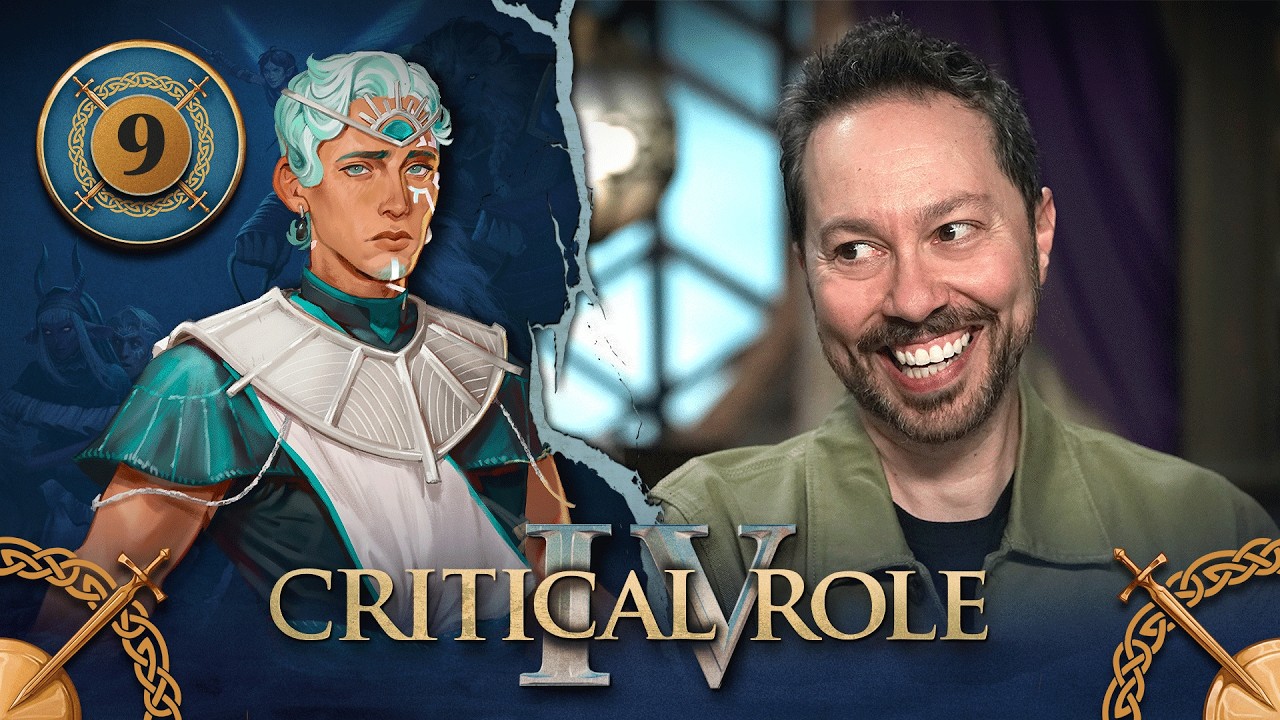
A dense but rewarding chapter that turns Timmony’s Hounds, fae, hospitals, politics and graves into variations on one question: what deserves to survive when the world that created it is gone?
What worked & what held it back
- The Hounds provide some of Campaign 4’s strongest and most thematically useful worldbuilding
- The Candescent Creed becomes a genuinely complicated institution rather than a simple villain
- Thimble’s post-revenge response gives her grief meaningful forward movement
- House Tachonis lore and the Castle Delawney descent turn exposition into immediate danger
- The middle is dense enough that several excellent lore conversations compete for space
- The pursuit of Cyd slows while the episode expands the setting around it
Warning: This review contains full spoilers for Critical Role Campaign 4, Episode 9.
The gods are dead.
The Hounds of the King still have a job.
That may be the cleanest way to understand “To the Hounds!,” an episode about what happens when the world changes faster than the promises people made inside it.
The Hounds once swore to protect their king in this world and the next.
Then the Shapers’ War removed the next.
They kept the oath anyway.
Not by pretending the old cosmology still worked.
By changing what keeping the oath looked like.
That distinction echoes through almost everything Episode 9 does.
The old customs between mortals and fae disappear, and helpful kettle-hobs become thieves.
The Candescent Creed emerges from compromised political origins, yet its hospitals now feed people who genuinely need help.
House Tachonis continues an ancestral duty surrounding death after the divine afterlife that once gave that duty meaning stops functioning.
Hal stages an old failed rebellion because somebody still needs to tell its story.
And Thimble discovers that getting the revenge she wanted does not produce the feeling she expected.
Episode 9 is dense, occasionally slower than it needs to be and absolutely determined to introduce another proper noun whenever the viewer appears comfortable.
But most of that density serves one idea.
When the old form breaks, what part of the promise is worth keeping?
Thimble Gets Revenge and Discovers That Grief Did Not Agree to the Deal
Episode 8 gives Thimble what she has been chasing for several chapters.
Casimir Gavendale is dead.
Episode 9 immediately asks whether it helped.
Not really.
Back in Brauwla’s public house, Tyranny asks Thimble whether she feels better now that Casimir is gone.
Thimble admits that she thought killing him might somehow make Thjazi being dead hurt less.
“It’s still just as bad.”
That is exactly where Campaign 4 should go after an episode called “Fanged Revenge.”
Vengeance can be justified without being restorative.
Casimir deserved consequences.
Thimble deserved the chance to confront him.
Neither of those things means his death can repair hers.
More importantly, this gives Episode 9 a quiet continuation of Casimir’s final argument.
Casimir complained that the glorious dawn never arrived.
He expected rebellion to produce a better world, did not get the result he believed he had been promised, and eventually treated disappointment as permission to betray the people beside him.
Now Thimble experiences her own failed promise.
She gets revenge.
The relief does not arrive.
And she does not respond the way Casimir did.
She keeps going.
Teor still needs Cyd.
The conspiracy around Thjazi is clearly larger than Casimir.
Even when the Black Rabbits later bring frightening rumours about the Golden Orchard and House Royce, Thimble insists that Cyd remains the immediate priority.
That difference matters.
Casimir let disappointment shrink his obligations.
Thimble discovers disappointment and keeps hers.
Dol-Makjar Is Already Deciding Which Version of the Revolution Survives
The cold open gives us two competing ways of preserving history.
At the Brethren Hall, Harondus Einfasen dismisses what Brennan describes as more than half of the city’s guard in one clean administrative action.
Turn in the equipment.
Collect compensation.
Thank you for your service.
Then record-keeping starts being consolidated and Einfasen begins politely probing Azune about where the Revolutionary Council may have failed to act.
Nothing about the scene looks like a coup.
That is what makes it unsettling.
The revolution is not being defeated in battle.
Its institutions are being reorganised.
Elsewhere in Dol-Makjar, Hal is doing something almost opposite.
At the Hallowed Round, he is rehearsing KoTher’ai, a story about Murzat, an orcish renegade from one of the failed uprisings against Azgra.
Hal insists the performance should not invite pity.
Murzat should stand upright.
Face outward.
Accept the cost of the choice.
Most importantly, the story is being performed on the place where it happened.
Hal asks:
“Was it for nothing?”
The answer from the actor is no.
The existence of the production is Hal’s own answer.
That juxtaposition is one of Episode 9’s better quiet ideas.
History does not survive simply because the past occurred.
Somebody decides how to preserve it.
Einfasen is turning revolutionary institutions into something more controllable.
Hal is recovering a failed rebellion and insisting that its failure does not make its meaning disposable.
One edits the machinery.
The other protects the memory.
House Tachonis May Be What Happens When a Function Survives Its World
Dame Morgaine gives Episode 9 its biggest expansion of House Tachonis.
Under the old Obridimian order, Halovar and Tachonis served different religious functions.
Halovar belonged to flame, proclamation and the Light.
Tachonis belonged to shadow, night and the passage of souls toward the halls beyond death.
Then the gods died.
Those halls stopped being available.
The dead did not stop arriving.
Morgaine describes Tachonis’s ancestral obligations as leading to an ever-expanding underworld after the permanent divine afterlife disappeared.
At the same time, she and the Hounds have been tracking something else.
Cairns across Timmony have been opened.
Workers near Sloak found one that had been dismantled, hurriedly rebuilt and left without remains inside.
Morgaine suspects House Tachonis acquired Sloak because they wanted access to something beneath the land rather than because rewarding Casimir was ever their real priority.
She believes they have been combing Timmony for some hidden resource.
That substantially enlarges the Tachonis mystery.
It also requires restraint.
Episode 9 establishes evidence that the Hounds increasingly associate Tachonis movements with opened cairns and something being removed from the land.
It does not establish exactly what they are seeking.
Or why.
Or whether every disturbed cairn belongs to the same operation.
So the useful comparison with the Hounds is not:
The Hounds adapted correctly while Tachonis definitely refused to adapt.
We do not know enough for that.
The sharper possibility is:
The Hounds show how an old duty can survive by changing its form. House Tachonis may be showing us what happens when a function survives long after the world that originally explained it is gone.
Whatever Tachonis is searching for remains unknown.
The pattern is becoming much harder to dismiss.
The Black Rabbits Literally Change Shape When People Stop Keeping Promises
The Miller’s Road gives Campaign 4 one of its strangest illustrations of the same idea.
The Black Rabbits initially look like an extremely small criminal organisation with unusually good branding.
Four-inch fae warriors.
Rabbit cavalry.
Poison-looking arrows.
Thorn-covered bodies.
Several apparent severed heads hanging from belts.
Perfectly normal roadside encounter.
Then Thimble’s natural 20 reveals what they actually are.
Kettle-hobs.
Helpful household fairies.
The heads are their own.
They have a head of blooms and a head of thorns.
When mortals honour their promises, kettle-hobs help.
When a promise is broken, they put on the thorn head, become grigs and begin stealing, curdling milk and spoiling crops until somebody starts keeping the bargain again.
It is wonderfully literal morality.
The relationship changes, so they change shape.
The people of Timmony stopped leaving out the traditional milk and bread.
The Black Rabbits started stealing what they needed.
Thimble does not solve that problem by threatening them back into good behaviour.
She offers them another relationship.
Ulbid Morn has a garden.
The garden needs tending.
The fairies need somewhere to live.
Clauny takes off the thorn head, becomes Clauny the Rose and promises that his people will keep their word.
Later they give the Soldiers rubyfold, Heroic Inspiration and magical help from afar.
Campaign 4 has repeatedly shown institutions that insist behaviour comes from rules.
The Black Rabbits suggest something simpler.
Sometimes behaviour comes from whether people keep treating one another like neighbours.
Thimble Gets Terrible News and Still Chooses Cyd
The same encounter also drops one of Episode 9’s ugliest rumours.
The Black Rabbits have heard from a travelling kelpie that something catastrophic happened around the Golden Orchard and House Royce.
The characters hear talk of a slaughter.
For Thimble, that could mean almost everybody she grew up around.
But the episode very deliberately keeps the status uncertain.
The original source cannot say whether the story is true.
Brennan reminds Thimble that she does not know whether the Golden Orchard itself has actually fallen.
Kattigan says it plainly:
“Unconfirmed.”
Thimble responds by saying they need to keep finding Cyd.
That is worth more than a long speech about friendship.
She has just killed the man she pursued for Thjazi.
It did not fix her grief.
Now she may have lost even more.
And she still does not make Teor’s emergency secondary to her own pain.
The Soldiers have become a party almost accidentally.
Moments like this are how we know it happened.
The Hounds Keep the Meaning of the Oath, Not Its Original Form
Then the episode reaches its title.
Dame Morgaine reveals that she and the other Hounds were not always dogs.
Hawkins opens a small compartment containing an image of a human knight named Sir Barryk of Vallow, strongly implying a connection to his previous life — although Hawkins himself carefully says he is told Barryk was an exemplary knight.
That tiny wording choice may matter.
The Hounds appear to possess continuity of oath without necessarily possessing ordinary continuity of autobiographical memory.
Morgaine explains that previous knights swore to defend their king:
“in this world and the next.”
Then the Shapers’ War destroyed the next world.
Her response is beautifully straightforward:
“Yet it seemed an ill thing to not keep our promise.”
The Druids of the Stag taught them that souls return to the world again and again.
So the knights asked whether they could return and serve again.
Now they do.
As dogs.
Happily.
Loyally.
Proudly.
There is Episode 9’s central idea in its purest form.
The Hounds do not fetishise the wording of the oath.
They preserve what it was for.
The old version imagined a knight continuing service in some divine afterlife.
That afterlife is gone.
So they find a different mechanism for continuing the service.
The form changes.
The promise survives.
That is considerably more interesting than loyalty as blind repetition.
Especially because the Hounds also know where their loyalty stops.
The Hounds’ Loyalty Has Borders
Episode 9 wisely does not make Morgaine and Hawkins uncomplicated instruments of righteousness.
They are agents of King Augustus.
That means duty imposes limits as well as purpose.
They are willing to help Teor find Cyd.
If House Tachonis kidnapped a traveller who was entitled to safe passage through Timmony, they have grounds to intervene.
But they need evidence.
Cyd’s actions in Dol-Makjar fall outside Timmony’s jurisdiction.
And openly accusing a Sundered House without proof could endanger the crown and kingdom they swore to defend.
That makes the oath feel more real.
It does not simply mean:
Help the protagonists because they are the protagonists.
It means weighing one obligation against another.
Free passage.
National sovereignty.
The King’s interests.
Justice.
Evidence.
Even Hawkins’ blessing comes with a condition: may Timmony hide the Soldiers until the moment they act against the King’s interests.
Felltower calls putting a condition on a blessing “gauche.”
He is not entirely wrong.
The Hounds preserve the meaning of their promise.
They still have to interpret that meaning every day.
That may be the difference between a living oath and an institution merely repeating itself.
King Augustus Is Also Fighting Over What Political Duty Means
The Hounds’ loyalty becomes more complicated once Morgaine explains why King Augustus has acquired enemies.
Augustus has apparently entertained ideas associated with members of the Falconer’s Rebellion: formalising representation that would allow ordinary towns and peasants to petition the king more directly through heralds or speakers.
Timmony already has local Alcalds.
Augustus considered making that relationship with the crown more formal.
Many lords saw the idea as an attack on their own vassalage and patronage.
According to Morgaine, the whispers calling Augustus a tyrant did not begin in farm or field.
They began in:
“castles and keeps.”
Then she makes a more dangerous suggestion.
Nobles do not spend much time carrying messages directly to peasants.
Priests do.
Morgaine believes clergy may have helped aristocratic opposition spread anti-Augustus rhetoric through the countryside.
But she immediately adds the qualification that matters:
“I have no proof of what I now say.”
Keep it there.
Episode 9 does not prove that the Candescent Creed is running an organised propaganda campaign against Augustus.
It shows a royal knight who believes religious networks may be carrying political messages for threatened nobles.
That possibility matters because the episode is about to show us the Creed doing genuine good.
Again, the institution refuses to become simple.
The Candescent Creed Is Harder to Reject When It Has Become Useful
Tybry’s Lea gives Wicander another version of the same problem.
The Candescent Creed has compromised origins.
We know that.
House Halovar built doctrine around political needs.
Its language has been used to marginalise fairies.
Episode 9 even gives us an especially ugly example in commercial anti-fae devices being sold under religious justification.
Then Thimble rolls a natural 20 and sees the Creed hospital.
And Brennan essentially says:
Thank god they are here.
There is food.
Healing.
Care for the poor.
Children getting treats.
A community celebrating Candle Feast.
After the gods died, people did not only lose theology.
They lost festivals.
Gatherings.
Ritual.
Public structures of care.
Some places replaced those things.
Some did not.
In Tybry’s Lea, the Creed did.
Lux Arathea makes the point even harder to dismiss.
She has healing magic.
She does not waste it performatively.
Miracles are not infinite.
The sickest people come first.
That is good work.
Full stop.
Which gives Wicander a much harder problem than simply discovering that his religion was based on lies.
An institution can have compromised origins and still become useful to people who had nothing to do with creating the compromise.
That does not cleanse the Creed.
The same broad institution can feed peasants while its religious language is used to justify killing fairies.
And Episode 9 goes one step further.
The hospital’s usefulness is not politically neutral.
The Creed Feeds the Poor — and Converts an Earl
At Candle Feast, Earl Gauntry Tallkeep arrives carrying the coffin of his dead wife, Lady Kasswyn.
He places it before Lux Arathea.
Publicly announces her death.
Then says:
“I wish for her soul to know the Light.”
He removes his circlet.
Kneels.
And Brennan makes the political consequence explicit:
the Earl of Gormalay converts to the Candescent Creed.
The same peasants who have been fed, healed and gathered by the Creed surround their lord while the Lux blesses him and Kasswyn’s coffin.
That is a major moment.
Not because it reveals the hospital’s charity to be fake.
The charity is real.
That is precisely why the conversion matters.
The Creed is building social infrastructure.
Social infrastructure creates trust.
Trust creates influence.
Influence becomes political power.
Episode 9 therefore refuses an easy choice between:
corrupt political religion
and
benevolent charitable institution.
The Creed can be both a place where someone receives desperately needed healing and an institution powerful enough to reshape the religious allegiance of an Earl.
Morgaine may suspect priests of carrying aristocratic propaganda.
The hospital may genuinely keep peasants alive.
Gauntry may sincerely convert because of grief.
Those facts do not cancel one another.
They make Wicander’s problem harder.
Which is exactly what it should be.
Wicander Is Starting to Preserve the Meaning Instead of the Words
Wicander gives his answer before Tyranny heads toward the hospital.
He prays with her.
Then says:
“Even if I don't believe in all of the words in my creed, I do believe that it means goodness will come.”
That line is almost the Hounds’ philosophy translated into religion.
Wicander no longer believes that preserving faith requires preserving every sentence he inherited.
He is trying to identify what those sentences were supposed to point toward.
Goodness.
Mercy.
Hope.
Help.
That is a substantial change from the young man we met quoting Creed doctrine as though authority and truth were interchangeable.
It also follows naturally from Hawthorn’s Glade.
The messenger can lie.
The message may still contain truth.
Episode 9 pushes that idea from private spirituality into institutional responsibility.
The Creed hospital is proof that something useful can grow from compromised foundations.
The anti-fae prejudice is proof that something harmful can grow there too.
Gauntry’s conversion is proof that useful institutions do not remain politically powerless for long.
Wicander therefore cannot solve his crisis by deciding whether the Creed is simply real or fake.
He has to decide what deserves continuation.
That is much harder.
Which is why it is much better.
Kattigan Has a Terrible Theory and Knows It Is Still a Theory
The hospital introduces another question.
Bellows Fever is spreading.
House Tachonis is moving through Tybry’s Lea.
Gauntry Tallkeep’s wife Kasswyn is dead.
His mourning period is ending.
Someone at the hospital says that “the lady” is being brought to the festival.
Kattigan starts connecting things.
Light can heal.
Tachonis deals with the dead.
The underworld is overflowing.
Could they be attempting to restore somebody?
Could Kasswyn be involved?
Could the fever somehow be supplying bodies?
Robbie Daymond immediately protects the distinction the review should protect too:
“I could be wrong.”
Then:
“It’s just an assumption. It’s just a guess.”
Good.
Keep it there.
Later, Gauntry arrives carrying Kasswyn’s coffin and publicly treating her as dead.
That does not prove Kattigan’s theory false.
It certainly does not make it canon.
Campaign 4 is now dense enough with mysteries that the difference between clue and conclusion matters more every week.
Kattigan has identified something strange.
The episode has not yet told us what it is.
Teor Can No Longer Use Battle to Avoid Asking Where His Magic Comes From
Castle Delawney gives Teor the episode’s quietest supernatural development.
Wicander has already asked him about the Light he uses.
Teor has spent much of his life not looking too closely.
That is easier during combat.
Somebody is in danger.
Magic happens.
Keep moving.
Then, underground beneath Castle Delawney, Teor deliberately places a hand against Wicander and casts Shield of Faith.
There is no active battle to hide inside.
They are still infiltrating an enemy castle looking for his brother, but the fog of combat is gone.
Brennan explicitly tells Teor that he can no longer use the need of battle to disguise what he is doing.
Wicander looks at him.
Something flashes behind Teor’s eyes.
Something is being called upon.
The magic feels celestial to Wicander, then Brennan immediately qualifies even that:
maybe “celestial” is simply Wick’s name for something he cannot identify.
That qualification is crucial.
The episode does not establish a celestial patron.
It establishes a question Teor can no longer comfortably ignore.
That fits Episode 9 perfectly.
Wicander is separating meaning from doctrine.
The Hounds separated oath from cosmology.
Teor may soon have to separate his power from whatever explanation he has spent years avoiding.
Cyd’s Trail Finally Reaches Castle Delawney
The Hounds have already established earlier in Episode 9 that Cyd’s scent was present with the Tachonis movement at the tavern.
Felltower provides the crucial geographical progression.
He has smelled the unmistakable aroma of a powerful carnivore inside one of the Tachonis wagons passing through Tybry’s Lea.
He has also watched Tachonis carriages arrive over several fortnights, stop around the central hospital and continue toward Castle Delawney.
More importantly, the recent wagons have arrived.
They have not left by the King’s Way.
Felltower therefore believes that if Teor’s brother was captured within the relevant window, he is probably still somewhere in Tybry’s Lea unless House Tachonis removed him by some other means.
That turns a general pursuit into a location.
Then the evidence gets worse.
The group sees a wounded Tachonis guard carrying injuries consistent with a large clawed animal.
The Black Rabbits’ earlier kindness even follows Thimble here, their blessing helping conceal her while she scouts.
Once the Soldiers get underground, the atmosphere changes.
Kattigan finds a rat.
Naturally.
The rat knows the lower chambers.
It also refuses to stay there.
Things go through the hidden door.
They do not come back.
Some die.
But they do not rot.
The rat cannot smell them anymore.
That is one of the episode’s best horror details because it describes absence rather than gore.
Something is not merely killing creatures.
It is removing them from the normal process the rat understands.
Then Thimble finds a cage.
Blood.
Scraps of black fur.
The implication is obvious.
The confirmation is not.
Cyd has black fur.
The party has been tracking a powerful carnivore.
A wounded Tachonis guard carries suggestive injuries.
But Episode 9 still does not physically show Cyd inside that cage.
The correct conclusion is:
The evidence is now extremely strong that the Soldiers have reached whatever happened to him.
Not:
The cage is definitively Cyd’s.
That distinction may matter enormously in Episode 10.
Tyranny Learns That Occtis Is the Worst Possible Disguise
Then Whitney Moore makes an inspired terrible decision.
Tyranny uses Occtis Tachonis’s face.
The logic is sound enough.
They are inside a Tachonis operation.
Occtis is a Tachonis.
Surely looking like a member of the family is safer than looking like Tyranny.
Instead she walks into a cavern containing more Tachonis soldiers than the party can comfortably count.
The House Seremai knight is waiting.
His chained reptilian creature has eight legs, a stone horn and glowing eyes.
Tyranny tries to bluff.
The knight smiles.
“If you were Occtis Tachonis, you'd already be dead.”
Then Tyranny begins turning to stone.
It is an excellent cliffhanger because it confirms something chilling but narrower than it first appears.
The people operating beneath Castle Delawney believe Occtis Tachonis should already be dead.
That makes perfect sense with what we already know.
House Tachonis killed him.
What Episode 9 does not tell us is whether this knight knows Occtis subsequently returned.
We do not know whether House Tachonis as a whole knows he is walking around again.
We do not know what they would do if the real Occtis appeared.
And we certainly do not yet have evidence of some standing order to kill him a second time.
Tyranny has nevertheless selected possibly the worst identity available for convincing these people that she belongs.
Campaign 4 continues to reward initiative.
Occasionally with petrification.
Episode 9 Has Enough Lore to Require Its Own Filing System
“To the Hounds!” is not a fast episode.
That remains its clearest weakness.
There are long stretches of travelling, questioning, historical explanation and speculation before Castle Delawney finally supplies sustained danger.
Timmony gives us Hounds.
The Stag.
Kettle-hobs.
Grigs.
Rubyfold.
Cairns.
Alcalds.
Candle Feast.
Bellows Fever.
Kasswyn.
Gauntry Tallkeep.
Castle Delawney.
At some point the notebook becomes a party member.
The difference from Campaign 4’s weaker exposition-heavy stretches is that most of this material belongs to the same argument.
The Black Rabbits explain what broken reciprocity does to behaviour.
The Hounds explain how an oath can survive a broken cosmology.
Augustus’s political reforms ask who inherited institutions are supposed to serve.
The Creed shows how compromised organisations can become necessary infrastructure and political power at the same time.
Tachonis shows why inherited functions deserve scrutiny.
Teor turns the problem inward.
And the final dungeon converts the lore back into immediate stakes.
So the episode sometimes asks patience from the viewer.
It usually pays it back.
Verdict: The Promise Matters More Than the Shape
“To the Hounds!” is one of Campaign 4’s most thematically coherent lore episodes.
The gods are dead.
That does not mean every promise made beneath them becomes meaningless.
The Hounds understand this better than anyone.
Their oath was written for a world with an afterlife.
The afterlife disappeared.
They did not abandon the oath.
They abandoned the assumption that there was only one way to fulfil it.
That idea quietly illuminates everything around them.
The Black Rabbits change when people stop keeping a social bargain.
Wicander is trying to preserve goodness without preserving every word of the institution that taught it to him.
Hal insists that a failed rebellion still deserves truthful memory.
Thimble discovers that revenge cannot deliver the relief she imagined and chooses not to let that disappointment make her smaller.
King Augustus is trying to change who gets heard by institutions built around inherited authority.
And somewhere beneath all of this, House Tachonis is continuing some ancient relationship with death that looks more dangerous every time we understand another piece of it.
The performances are strong across the board.
Laura Bailey makes Thimble’s post-revenge emptiness more interesting than another victory lap would have been.
Sam Riegel continues one of Campaign 4’s best slow character transformations by letting Wicander rebuild belief around ethics rather than authority.
Travis Willingham gets very little spectacle from Teor’s magical moment, which is exactly why it works.
Robbie Daymond remains good at letting Kattigan leap toward frightening theories while acknowledging that he may be wrong.
And Brennan Lee Mulligan somehow makes reincarnated dog-knights one of the most philosophically coherent pieces of worldbuilding in Aramán.
The episode is slower than “Fanged Revenge.”
It is also laying considerably more track.
By the time the Soldiers descend beneath Castle Delawney, Cyd feels terrifyingly close, House Tachonis feels much larger than the conspiracy around Thjazi, Teor’s magic has acquired a new question and Tyranny is starting to become a statue because she picked the one disguise that everybody in the room believes should already be a corpse.
RollingRealm Verdict: 9/10
“To the Hounds!” occasionally strains under the quantity of lore it wants to introduce, but its best ideas reinforce one another unusually well. Timmony’s fae, Hounds, hospitals, politics, graves and old religious duties all become variations on a single question: when the world that created a promise disappears, do you preserve the old form — or the reason the promise mattered in the first place?
The Hounds already know their answer.
The old world broke.
The oath still stands.
Sources
Enjoyed this article?
Supporting Rolling Realm helps fund more independent reviews, lore guides and spoiler-aware coverage. Every article remains free.
Critical Role Campaign 4 Episode 7 Review: Power, Betrayal and One Terrible Castle
“On the Scent” turns a hunt through Timmony into a study of borrowed authority, as Wicander wrestles with inherited status and Casimir discovers how little respect betrayal actually bought him.
A slow-burning but rewarding episode that uses Timmony, the Candescent Creed and Castle Sloak to explore power, legitimacy and the humiliating limits of Casimir Gavendale’s new status.
Critical Role Campaign 4 Episode 8 Review: What Victory Is For
Thimble finally gets Casimir, but Campaign 4’s strongest choice is making what happens after the revenge matter even more.
A brutal, funny and unexpectedly hopeful episode that turns Thimble’s revenge on Casimir into a larger argument about leadership, loyalty and what victory is for.
Critical Role Campaign 4 Episode 7 Review: Power, Betrayal and One Terrible Castle
“On the Scent” turns a hunt through Timmony into a study of borrowed authority, as Wicander wrestles with inherited status and Casimir discovers how little respect betrayal actually bought him.
A slow-burning but rewarding episode that uses Timmony, the Candescent Creed and Castle Sloak to explore power, legitimacy and the humiliating limits of Casimir Gavendale’s new status.
Critical Role Campaign 4 Episode 6 Review: Forms Break, Truth Remains
The Soldiers reach Hawthorn’s Glade and discover that faith, beauty, darkness and even supernatural nature are poor substitutes for deciding what somebody actually chooses to do.
A cohesive Soldiers-focused episode where Wicander redefines the Light, Tyranny confronts demonic nature and Thimble pays for truth with memory.