Somewhere to Return To
After certainty collapses, Campaign 4 sends its characters looking for new directions — and discovers that moving forward does not always mean leaving the past behind.

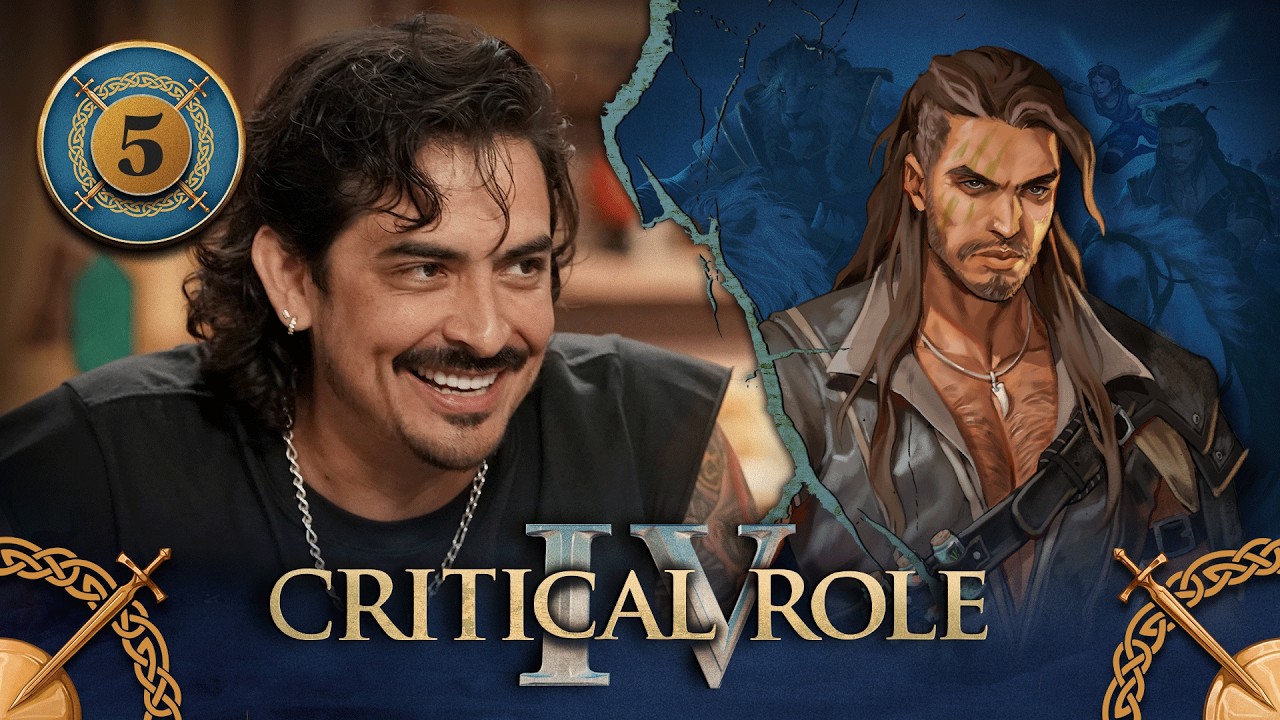
A strong transitional chapter that turns the Overture’s consequences into direction while finding emotional weight in Occtis’s undeath, chosen trust and the families still waiting for someone to come home.
What worked & what held it back
- The Soldiers, Seekers and Schemers finally give the sprawling ensemble clear direction
- Occtis's undead condition turns resurrection into lasting character consequence
- Azune and Aranessa make chosen trust a compelling answer to the campaign's fractured alliances
- Ulbid Morn and Teor give the episode a powerful emotional centre
- Route planning and regrouping are sometimes more functional than dramatic
- The transitional structure trades some of Episodes 3 and 4's momentum for clarity
Warning: This review contains full spoilers for Critical Role Campaign 4, Episode 5.
Occtis Tachonis came back from death.
He did not get his life back.
There is a difference.
His body no longer needs food or water. He will apparently never age. Breathing has become something he consciously chooses to do. Rest cannot properly comfort him because his body is neither restless nor restful.
Even ordinary possibilities he might once have taken for granted — sharing wine with a friend, growing old, perhaps starting a family, eventually dying surrounded by people who knew him — appear to have been taken away.
He is still Occtis.
His future is not the one Occtis expected.
That distinction gives Episode 5 its emotional shape.
Almost everyone in this episode has lost some form of certainty.
Wicander no longer knows what to do with a religion built by people who lied to him.
Aranessa no longer has a House powerful enough to make inherited dignity feel useful.
Julien has lost his father and home.
Teor is pursuing two men he once believed he knew better than almost anyone and now admits he barely understands.
Thimble is turning grief into pursuit because looking anywhere else would mean confronting what sits behind it.
And before the episode ends, two very different families will be waiting for children who may or may not come home.
Episode 4 was about refusing what other people decided you were for.
Episode 5 asks the quieter question that comes afterward:
Once certainty collapses, where do you go?
Occtis Came Back Without Getting His Life Back
Alexander Ward gets one of the episode's hardest opening scenes because Campaign 4 refuses to treat Occtis's return as a reward.
Brennan Lee Mulligan describes his new existence almost clinically.
Occtis is now aware of tendons, bones, muscles and the internal machinery of his body in a way living people normally are not.
If he stops deliberately breathing, he simply stops.
His blood is still.
He does not hunger.
He does not thirst.
He does not age.
His body remains his.
The ordinary mortal future attached to it does not.
That is a much better consequence than giving him some unsettling eye makeup and moving on.
Episode 4 asked whether death could be reversed.
Episode 5 answers:
Not cleanly.
Murray's investigation makes the situation stranger still.
The Stone of Nightsong is not a conventional phylactery containing Occtis's life force.
Instead, the Stone and Occtis have become permanently magically interwoven.
House Tachonis appears to have spent years constructing a magical process involving the Stone. The group interrupted that process at the last possible moment and redirected something none of them could have deliberately designed.
Brennan's analogy is wonderfully ridiculous: they effectively hijacked a machine headed toward catastrophe and somehow landed it safely on a rooftop.
The result is unprecedented.
True resurrection remains beyond mortal magic in Aramán.
But something closer than anyone seems to have managed in a very long time has happened: an undead being who retains his own mind, identity and selfhood. The Stone is bound to him in ways nobody yet understands, without that automatically meaning he should possess it or that remaining close to it is good for him.
The reactions around Occtis immediately make that uncertainty useful.
Vaelus still wants the relic she travelled across the world to recover.
Bolaire becomes fiercely protective of Occtis and makes Vaelus promise not to abandon him. Their argument is messy enough that Bolaire starts using Command spells during what is ostensibly a conversation.
Thaisha provides the simplest corrective.
Occtis worries about what being undead means.
Thaisha's answer is essentially:
You are still you.
Later she goes further.
His blood family may be horrifying, but that does not leave him without family.
He has her.
That feels like the most important answer available right now.
Everybody wants to know what Occtis has become.
Episode 5 keeps reminding them not to lose who Occtis is while investigating it.
Trust Has to Be a Choice
Episode 5 understands that its survivors do not have enough time to become comfortable with each other.
So Azune stops pretending otherwise.
He approaches Julien after the destruction of Palazzo Davinos.
Julien's father is dead.
His House has fallen.
The people around him include political enemies, strangers and one young man carrying the same family name as the people who slaughtered everyone at his home.
Trust should take months.
They have minutes.
Azune gives him the episode's clearest rule:
“Right now, trust has to be a choice, and the earning of it will follow.”
That works as character philosophy.
It also solves a problem Campaign 4 has had since its premiere.
Thirteen player characters cannot plausibly build deep mutual confidence before the plot starts requiring cooperation.
The campaign can either ignore that problem or turn it into part of the story.
Azune chooses the second.
He does not claim that Julien should already believe these people deserve his faith.
He asks Julien to extend enough trust for them to survive long enough to earn the rest.
Matt Mercer wisely refuses to make the speech work immediately.
Azune brings up their shared history around Thjazi and the Falconer's Rebellion.
Julien hears triumph.
Congratulations.
His family has finally been brought low.
Is this what Azune and Thjazi wanted?
Azune says no.
Julien walks away.
Good.
An offer of trust is not trust earned.
Then Aranessa quietly demonstrates the other half of Azune's argument.
She turns to Vaelus.
This is not somebody she knows well.
Vaelus came to Dol-Makjar pursuing an artifact connected to Thjazi, survived the massacre and still intends to keep the Stone close.
Aranessa cannot prove what Vaelus will do.
She has evidence.
Vaelus stood against the shades.
She could have taken the Stone and disappeared already.
She did not.
So Aranessa offers her trust anyway.
Not because certainty has arrived.
Because desperate circumstances require a decision before it does.
That makes the connection much stronger than if Azune were simply delivering a clever line.
Two characters independently reach the same conclusion.
Sometimes trust begins as evidence.
Sometimes it begins as choice.
The earning comes later.
Aranessa also looks at the language these families have used for generations.
The Sundered Houses.
And decides she no longer wants brokenness to be an identity.
That refusal matters because “Sundered” describes history.
Aranessa is suddenly unwilling to let it dictate the future.
Campaign 4 Finally Finds a Shape
Episode 5's biggest success is structural.
Campaign 4 finally stops behaving like thirteen protagonists waiting for the story to discover whose turn it is.
The cast divides into three distinct engines.
The Soldiers are already on the road, pursuing Cyd, Casimir and the betrayal surrounding Thjazi.
The Seekers prepare to head east with Occtis, Aranessa, Julien, Vaelus and Thaisha.
The Schemers — Hal, Murray, Bolaire and Azune — remain in Dol-Makjar to understand and exploit the political struggle inside the city.
The names are slightly theatrical.
They are also useful.
Each table has a different verb.
Soldiers pursue.
Seekers investigate.
Schemers manipulate.
The campaign has not become smaller.
It has become legible.
The Schemers immediately justify their name.
Azune looks at the apparent resurgence of the Sundered Houses and notices something important.
The Houses are all making moves.
That does not mean they are all making the same move.
Halovar and Tachonis fought for the gods during the Shapers' War.
Royce, Cormoray and Einfasen fought against them.
Only around seventy years separate those old battles from the present.
Azune's conclusion is that the Houses are not necessarily functioning as one coordinated conspiracy.
They are moving in parallel.
So create a wedge.
Give Cormoray and Einfasen reason to believe Tachonis may come for them next.
Let inherited distrust do some of the fighting.
That is a much more interesting political strategy than discovering that every antagonist has secretly been attending the same villain meeting.
Old hatred survives.
Campaign 4 is beginning to ask how useful that can be.
The Seekers, meanwhile, get an emotional objective hidden inside Occtis's vision.
He remembers a lone orcish warrior bearing the sign of the Barrowguard.
Thaisha immediately thinks of Alogar.
Her and Hal's son.
Nobody knows that the warrior actually was Alogar. Hal explicitly cautions against certainty. Occtis himself does not recognise the man.
But possibility is enough.
Before the Seekers leave, Hal asks Thaisha that if it is their son, she should find him and bring him home.
That turns the journey east into something more than following another clue.
Somewhere beyond the Dvalmar Pass may be a son who has not come back yet.
The episode will return to that idea from the opposite direction before it ends.
The Soldiers Have to Hunt People They No Longer Know
The cold open gives the Soldiers a simple objective.
Find Cyd.
Find Casimir.
The problem is that Teor immediately admits he does not really know either man anymore.
Cyd is his brother.
Casimir was once his comrade.
There was a time when Teor would have claimed to understand both of them extremely well.
Years have passed.
Now he sits in the rain and realises:
he knows next to nothing.
That turns travel mechanics into character work.
The first tracking check initially looks like a miss.
Kattigan reaches 19 when the useful threshold is 20.
Then, after the break, Brennan allows the Guidance everyone realised should have been available.
That lifts Kattigan to the DC 20 success.
It is not enough to recover the trail cleanly.
It is enough to rule things out.
That distinction improves the sequence.
The evidence narrows the world.
Character knowledge has to do the rest.
Which roads make sense?
What would Cyd choose?
What would Casimir expect Cyd to choose?
Would Cyd remain on the obvious highway?
Would someone hunting him know him well enough to predict when he would leave it?
Brennan does not use travel as a series of Survival checks until the next scripted location appears.
A middling success changes the problem from:
Where are the tracks?
to:
Who is the person making them?
And Teor has already established why that is painful.
He is trying to predict the present actions of people whose past selves remain much clearer in his memory.
The other Soldiers are carrying their own forms of uncertainty.
Wicander leaves Villa Aurora after discovering that his family built his faith around manipulation.
He looks back.
Then he prays anyway.
Brennan notes that whatever Wicander has learned about the Candescent Creed, ritual still offers comfort.
That would already be a good complication.
Episode 5 pushes it further.
Later, at Ulbid's home, Wicander quotes the Ember Eternalis about being tested through lies, dimness and even betrayal by one's own kin.
His conclusion is not that the scripture is fraudulent because the people who taught it to him were fraudulent.
He starts interpreting what has happened through the scripture for himself.
This is a test.
The Light will bear truth.
That is much more interesting than simple deconversion.
House Halovar may have manufactured the institution.
Wicander is beginning to discover that they do not necessarily own what its words mean to him.
Tyranny has the opposite problem.
She always loved leaving the Halovar household.
Now she has actually left.
It is wet.
Cold.
Uncomfortable.
And much less celebratory than imagined.
Brennan dryly wonders whether doing the right thing is not supposed to bring immediate material rewards.
Otherwise people might behave selfishly.
Meanwhile Kattigan is having a fantastic time.
Everyone else is grieving, spiritually destabilised or questioning their identity.
He is on a hunt.
Robbie Daymond lets Kattigan's excitement be almost embarrassing.
The farther Campaign 4 gets from noble drawing rooms, the more comfortable he becomes.
The Trail Finally Becomes Real
The Soldiers spend much of Episode 5 converting suspicion into direction.
Abalang Howl gives them their first useful political evidence.
They find him imprisoned in a roadside gibbet after his people robbed a Timmony-bound caravan carrying Light shortly after Thjazi's arrest.
The episode strongly connects his imprisonment to Halovar power, but it never needs us to invent direct ownership of the caravan.
They free him.
Teor heals him.
Then Abalang tells them what he saw.
Carriages heading north.
Mounted guards bearing House Tachonis symbols.
People driving some of the carriages with crow feathers in their cloaks.
They appeared to be lingering because they were unsure which direction to take.
That does not prove Casimir personally designed every piece of Thjazi's failed rescue.
It does something better.
It makes the apparent connection between Crow-aligned figures and Tachonis resources considerably harder to dismiss.
The mystery narrows without becoming solved.
Tyranny then decides the rescue should produce some information warfare while they are here.
She encourages Abalang to attribute his imprisonment to Lord Nicander Halovar while remaining carefully vague about who freed him.
On a natural 20 Persuasion, he understands the assignment perfectly.
He will make certain every mention of the Halovars is accompanied by assurances that they have behaved with complete propriety.
Nothing untoward whatsoever.
Very subtle.
The party has barely left Dol-Makjar and is already manufacturing politically useful stories.
Then the trail becomes personal.
A later, much stronger tracking effort does not simply reveal some convenient footprints.
It leads Thimble to Brookmeadow.
The little water fairy has seen Cyd.
Tall.
Jet-black fur.
Black mane.
Amber eyes.
Heading north.
Struggling.
Frightened.
Thimble knows immediately that it is him.
That is the breakthrough the Soldiers actually needed.
Cyd was here.
He was scared.
He kept moving.
Brookmeadow also introduces Hawthorn's Glade, one of the hidden fairy refuges that became necessary after the doors to Faerie closed.
The worldbuilding works because it arrives through a practical problem.
Fairies need protection from big folk.
The wilderness provides that.
Unfortunately, civilisation is also rather useful when the undead are roaming around.
Safety from one danger means accepting proximity to another.
Thimble promises not to expose Brookmeadow to the rest of the group.
Then she goes back and explains that she has found Cyd's fur.
Not normal fur.
Stressed fur.
Teor rolls a 17 Insight against Thimble's 16 Deception, giving him reason to see through the story.
He nevertheless accepts — or at least knowingly plays along with — the remarkably useful concept of stressed fur.
Then he asks Thimble to thank whoever provided the information.
Perfect.
The ambiguity is funnier than resolving exactly what Teor understood.
And the scene quietly says something useful about Thimble.
At the beginning of the episode, she describes the hunt as a way to make everything else disappear.
If Casimir remains ahead of her, perhaps grief can remain behind her.
That sounds like tunnel vision.
Yet when Thimble encounters someone vulnerable, she instinctively protects her.
The hunt is consuming her attention.
It has not consumed the person underneath it.
Somewhere to Return To
Then the Soldiers reach Ulbid Morn.
And Episode 5 finds its heart.
Ulbid is a gnomish observer living at a lookout above the wilderness.
He watches the roads.
Studies weather.
Helps smugglers occasionally.
And maintains a charmingly rigid commitment to honesty while participating in criminal activity.
His conclusion about the Barrowdell of the Stormwrack is not complicated:
It is getting worse.
Useful.
Worrying.
Not the reason Ulbid becomes memorable.
That happens inside his home.
There are old toys.
Fireworks.
A carefully maintained banner written in Gnomish.
WELCOME HOME.
Ulbid has three daughters.
Cerebel.
Demuriel.
Elanadel.
He has not seen them for fifteen years, two months and seventeen days.
The precision matters.
Ulbid is not someone who has stopped counting.
He is also not written as somebody naively certain that his daughters will return.
He knows what the obvious possibilities are.
He has tried to prepare himself for the day someone tells him something terrible happened.
His hope diminishes.
It does not disappear.
So he tends the banner.
Keeps the fireworks.
Keeps the house ready.
Because there is one possibility he cannot bear.
One of his daughters finally returning and discovering that nothing remained to tell her she was still welcome.
Hope, for Ulbid, is not confidence.
Hope is maintenance.
That lands directly on Teor.
He is looking for his own brother.
Cyd is probably alive.
Teor simply no longer knows who that brother has become.
Ulbid has an even harder version of the same uncertainty.
Then he explains why his daughters left.
They heard the cry.
The Falcon's cry.
The rebellion Teor lived through did not merely create war heroes, political enemies and monuments.
It reached three young women in a remote mountain home and convinced them to leave their father because the world needed changing.
That is a very different way to look at revolution.
Teor knows what the cause meant to the people who answered it.
Ulbid shows him what it meant to someone who watched them go.
Travis Willingham plays the scene with exactly the restraint it needs.
Teor cannot promise that Ulbid's daughters are alive.
He can offer something smaller.
If their travels ever cross Cerebel, Demuriel or Elanadel, he will tell them that their father is still here.
Ulbid will be ready.
That would already justify the title.
But Episode 5 has quietly built the same image earlier.
Hal and Thaisha do not know whether the warrior Occtis saw was their son.
They know only that he might have seen Alogar.
Hal cannot go with the Seekers.
So he asks Thaisha:
if it is him, find him.
Bring him home.
Ulbid stays in one place because his daughters might come back.
Thaisha travels east because her son might still be out there.
Different parents.
Different strategies.
Same hope.
Somebody has to preserve the possibility of return.
Kattigan Turns the Doll Over
Then Robbie Daymond gets the episode's final quiet image.
Kattigan takes one of the old dolls from the toy chest.
It distracts him enough during watch that Robbie deliberately accepts disadvantage.
At dawn, Kattigan studies it properly.
From the front, the doll remains beautifully carved.
Then he turns it over.
The back has been hollowed out by rot and termites after years of being left behind.
Kattigan looks at it.
Then throws it off the cliff.
The image invites interpretation.
Episode 5 does not give us enough to declare precisely what Kattigan thinks it means.
That is why it works.
Ulbid has spent fifteen years maintaining evidence that his daughters still have somewhere to return to.
Kattigan discovers that one of the things they left behind has been changing anyway.
Both images can be true.
Memory can be maintained.
Maintenance cannot prevent everything from decaying.
Sometimes the thing you remember and the thing still sitting in front of you are no longer identical.
Teor is discovering that about Cyd.
Wicander is discovering it about his faith.
Occtis is discovering it about himself.
But Episode 5 wisely stops short of making Kattigan explain any of that.
He throws the doll away.
Then gets on with the morning.
Episode 5 Trades Momentum for Direction
Episode 5 is not as exciting as Episode 4.
It should not pretend to be.
A substantial part of its first half is aftermath and organisation.
Occtis's condition has to be understood.
The Stone has to be discussed.
Travel plans have to be made.
The cast has to split.
Political strategies have to be established.
The Soldiers spend considerable time deciding which road the people they are pursuing probably chose.
There are moments where the machinery of Campaign 4 is visible.
That is the episode's principal weakness.
The three-table reorganisation is satisfying structurally before it becomes satisfying dramatically.
The Seekers and Schemers mostly represent future promises here.
Even the Soldiers spend more time establishing the pursuit than confronting the people being pursued.
But that work pays off immediately in clarity.
The Soldiers have confirmation that Cyd passed through the woods and evidence connecting Tachonis guards with people wearing crow feathers.
The Seekers have the Barrowguard vision, a possible connection to Alogar and a reason to head east.
The Schemers have identified a political vulnerability in the Houses.
Occtis has a new existence rather than a solved resurrection.
Aranessa has stopped waiting for inherited dignity to save her.
Wicander has begun reclaiming religious meaning from the people who manufactured the religion.
And the campaign has finally moved far enough beyond Dol-Makjar to discover that the wider world is experiencing problems of its own.
Episode 4 was a detonation.
Episode 5 is the map drawn afterward.
Less spectacular.
Necessary.
Verdict
Critical Role Campaign 4 Episode 5 is a strong transitional chapter that finally converts the Overture's accumulated consequences into direction.
It is slower than the episodes immediately before it.
There is no Palazzo Davinos massacre.
No player-character death.
No god-killing mask revelation.
No single cliffhanger designed to dominate the conversation afterward.
Instead, the episode does something Campaign 4 badly needed.
It makes the story legible.
The Soldiers have a pursuit.
The Seekers have a question.
The Schemers have a strategy.
And the people inside those structures begin confronting what happens when the certainties that once organised their lives stop working.
Alexander Ward makes Occtis's undeath matter by focusing on the mortal future he has lost rather than treating his condition as a new collection of powers.
Luis Carazo gives the ensemble a practical philosophy when Azune argues that trust may sometimes have to be chosen before it can be earned.
Aranessa then proves the argument by extending that trust to Vaelus herself.
Aabria Iyengar and Brennan continue making Aranessa one of Campaign 4's strongest supporting figures by allowing her to look at the phrase Sundered Houses and decide she no longer wants brokenness to be an identity.
Sam Riegel gives Wicander a more complicated path than simply rejecting the Candescent Creed: he is already beginning to interpret its scripture independently of the family that created it.
Laura Bailey turns a hidden fairy into both the Soldiers' first direct confirmation of Cyd's trail and proof that Thimble's protective instincts have survived her grief.
Robbie Daymond makes Kattigan visibly more comfortable the farther he gets from aristocratic drawing rooms, then ends the episode with a symbolic gesture that remains stronger because he never explains it.
And Travis Willingham gets the episode's best scene by letting Teor sit with another man who does not know whether his family is coming back.
Ulbid Morn has kept a welcome banner ready for more than fifteen years.
Not because he knows.
Because he does not.
Earlier, Hal sends Thaisha east with almost the same hope.
Maybe Occtis saw Alogar.
Maybe he did not.
If it is their son, bring him home.
That is Episode 5.
Occtis does not know what he has become.
Aranessa does not know what remains of her family.
Wicander does not know which parts of his faith are still his.
Teor does not know who Cyd has become.
Thimble does not know what Casimir's betrayal ultimately bought.
Hal and Thaisha do not know whether the warrior in Occtis's vision was Alogar.
Ulbid does not know whether his daughters are alive.
Nobody gets certainty.
They get directions.
East.
North.
Back into Dol-Makjar.
Toward family.
Toward enemies.
Toward answers.
Moving forward does not always mean leaving the past behind.
Sometimes it means keeping open the possibility that something — or someone — can still come home.
Score: 8.5/10
A strong transitional chapter that turns the Overture's consequences into direction while finding emotional weight in Occtis's undeath, chosen trust and the families still waiting for someone to come home.
Sources
Enjoyed this article?
Supporting Rolling Realm helps fund more independent reviews, lore guides and spoiler-aware coverage. Every article remains free.
Critical Role Campaign 4 Episode 7 Review: Power, Betrayal and One Terrible Castle
“On the Scent” turns a hunt through Timmony into a study of borrowed authority, as Wicander wrestles with inherited status and Casimir discovers how little respect betrayal actually bought him.
A slow-burning but rewarding episode that uses Timmony, the Candescent Creed and Castle Sloak to explore power, legitimacy and the humiliating limits of Casimir Gavendale’s new status.
Critical Role Campaign 4 Episode 6 Review: Forms Break, Truth Remains
The Soldiers reach Hawthorn’s Glade and discover that faith, beauty, darkness and even supernatural nature are poor substitutes for deciding what somebody actually chooses to do.
A cohesive Soldiers-focused episode where Wicander redefines the Light, Tyranny confronts demonic nature and Thimble pays for truth with memory.
Critical Role Campaign 4 Episode 8 Review: What Victory Is For
Thimble finally gets Casimir, but Campaign 4’s strongest choice is making what happens after the revenge matter even more.
A brutal, funny and unexpectedly hopeful episode that turns Thimble’s revenge on Casimir into a larger argument about leadership, loyalty and what victory is for.
Critical Role Campaign 4 Episode 4 Review: What We Were Made For
The Overture ends with a massacre, an impossible return from death and Campaign 4's clearest argument yet that origin does not have to become destiny.
House Tachonis destroys Palazzo Davinos, Occtis dies and returns, and Bolaire reveals what they are as the Overture turns inheritance into a fight over ownership and choice.
Critical Role Campaign 4 Episode 6 Review: Forms Break, Truth Remains
The Soldiers reach Hawthorn’s Glade and discover that faith, beauty, darkness and even supernatural nature are poor substitutes for deciding what somebody actually chooses to do.
A cohesive Soldiers-focused episode where Wicander redefines the Light, Tyranny confronts demonic nature and Thimble pays for truth with memory.
Critical Role Campaign 4 Episode 2 Review: There Are No Bygones
Campaign 4 starts digging beneath family, faith and old loyalties — and discovers that nothing inherited comes without a history.
Episode 2 turns old loyalties, inherited authority and House Halovar’s hidden machinery into active threats as Thjazi’s sabotaged escape begins to take shape.