The Dead Man at the Centre of Everything
Campaign 4 introduces thirteen characters by killing the one man who connects almost all of them.

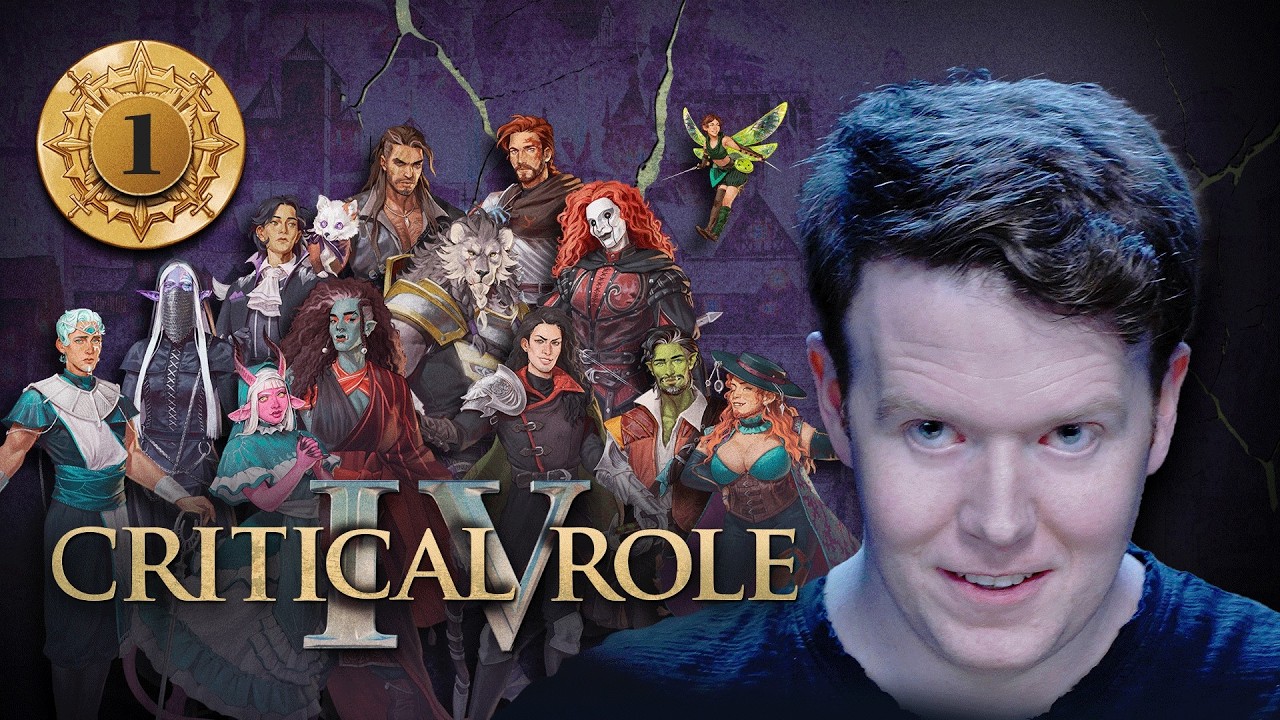
An audacious, emotionally grounded premiere that turns Thjazi Fang’s death into character introduction, political statement and conspiracy mystery. The lore density can be overwhelming, but the episode’s central construction is remarkably strong.
What worked & what held it back
- Thjazi’s execution gives the premiere an immediate dramatic and emotional centre
- The failed rescue develops into a carefully constructed central mystery
- A huge ensemble is made personal through sharply defined performances
- The funeral structure turns grief itself into the campaign’s party formation
- The sheer volume of names, history and terminology can be overwhelming
- Worldbuilding occasionally arrives faster than viewers have reason to retain it
- The enormous ensemble sometimes costs the premiere momentum
Spoiler warning: This review discusses Critical Role Campaign 4, Episode 1, The Fall of Thjazi Fang, in full.
Campaign 4 has thirteen player characters to introduce.
Brennan Lee Mulligan solves that problem by hanging the one man most of them already know.
Thjazi Fang is dead before Critical Role has properly finished welcoming us to Aramán, yet he dominates the next four hours more completely than most living protagonists could manage.
Every person who walks into his funeral brings another version of him through the door: brother, rebel, commander, husband, thief, mentor, hero, enemy.
By the end of The Fall of Thjazi Fang, Campaign 4 has not really assembled an adventuring party.
It has assembled an argument over who Thjazi Fang was.
That is a far more interesting place to begin.
The Execution Tells Us Almost Everything
The execution beneath Dol-Makjar’s Guardian Wall is an exceptional cold open.
Above Thjazi stand enormous monuments to the heroes of the Shapers’ War, revolutionaries preserved forever as civic mythology.
Below them, another rebel is being executed.
The sentence comes through the Chamber of Lords-Advisory, while the Sundered Houses surround the proceeding with heraldry, soldiers and ceremony. House Halovar’s Photarch invokes peace and heroic legacy. Parts of the crowd cheer for Thjazi anyway.
Nobody needs to explain the contradiction.
The gallows are standing underneath it.
And Brennan gives Thjazi just enough time to become irresistible.
He jokes about lunch with his brother. He accepts Azune Nayar’s covert escape plan with the confidence of somebody for whom impossible schemes appear to have become routine. He remains funny and defiant almost all the way to the end.
Then he looks into the sky.
Everything changes.
Hal’s natural 20 lets him catch the fear in his brother’s face and briefly reconnect with him. Thjazi’s final thoughts suddenly become urgent: help Murray at the Penteveral, there is paint waiting with Bolaire, tell Thimble not to be scared.
Then comes the public declaration:
“I can still hear the falcon’s cry.”
The lever is pulled.
The rope goes taut.
The dice do not save Thjazi.
They make losing him worse.
That natural 20 gives Hal one final doorway into his brother’s mind only for the door to slam shut halfway through Thjazi’s last message.
It is also where Liam O’Brien establishes Halandil Fang as the emotional centre of the premiere.
Hal spends the execution trying not to look for rescue.
He has spent weeks pulling strings and making deals, but when his brother searches the crowd for him, Hal refuses to let Thjazi’s final sight be one of panic.
For a bard whose life is built around words, he suddenly has none.
That contrast between the brothers becomes increasingly important.
Thjazi meets fear with jokes, defiance and motion.
Hal survives the day by standing still enough for everyone else to fall apart around him.
Thjazi’s Funeral Introduces Everyone Better Than a Tavern Ever Could
The farramh at Hal’s home in the Rookery is the real structural trick of Episode 1.
A campaign this large could easily spend its premiere cycling through disconnected introductions.
Instead, every arrival answers the same question:
What did Thjazi Fang mean to you?
Thaisha Lloy arrives grieving and furious because the escape plan she helped arrange failed.
Occtis Tachonis arrives carrying an uneasy personal history with Thjazi.
Azune carries in the body of the man who once carried him through battle.
Teor Pridesire arrives looking at Dol-Makjar as though somebody changed the city while he was away.
Wicander Halovar brings perhaps the most interesting contradiction of the early introductions: a young man whose faith in the Candescent Creed appears sincere even though the institutional world surrounding that faith has just helped sanctify Thjazi’s execution.
Even Kattigan Vale’s drunken arrival — expecting “a funeral, not a reunion” — underlines just how many apparently separate lives Thjazi managed to connect.
Then come people who remember him less kindly.
Aranessa Royce brings the remains of a failed marriage.
Julien Davinos brings contempt — and the uncomfortable history of being the man credited with bringing Thjazi Fang to heel at Maharlian Falls.
Bolaire brings the unmistakable sense that Thjazi had entire compartments of his life that even those closest to him never understood.
Nobody is introducing themselves merely because a campaign premiere requires it.
They are introducing their version of the dead man.
That distinction matters.
Was Thjazi a freedom fighter?
A criminal?
A reckless bastard?
A revolutionary?
A husband?
A mentor?
A thief?
A hero?
Episode 1 refuses to settle the argument.
Even Thjazi cannot.
The result is that thirteen characters do not need an artificial reason to become connected.
They already belong to the same story.
They just disagree about what that story was.
Hal and Thjazi Are Both Performers
The episode becomes even stronger when you look at the Fang brothers side by side.
Thjazi performs resistance.
At the gallows, he jokes because humour is one of the last things his executioners cannot confiscate.
He turns his final public words into a political statement.
Even facing death, he controls the room as much as anybody physically restrained and standing beneath a noose possibly can.
Hal performs something different.
He hosts.
He pours drinks.
He welcomes strangers into his home.
He comforts Shadia.
He makes sure people have food.
He moves through the funeral doing all the small things required to stop grief from turning a household into wreckage.
It would be easy to mistake that for passivity.
It is not.
Hal’s entire first episode is an act of emotional labour.
The man whose life has revolved around theatre spends the day keeping everyone else’s scene moving because his brother no longer can.
That makes the Rookery more than a convenient location for introductions.
The funeral is happening inside Hal’s world — a neighbourhood of performers, storytellers and musicians — and the episode itself becomes an exercise in competing narratives.
Everybody is telling a different story about Thjazi.
Hal is the person forced to listen to all of them.
The Escape Did Not Simply Fail
The episode’s strongest mystery begins with something Azune believes he has confirmed.
At the gallows, he casts Detect Magic on Thjazi.
He finds exactly what he expects to find: traces of conjuration and illusion magic near the back of Thjazi’s coat.
As far as Azune knows, the rescue device is there.
Except later, when he reaches Thjazi’s ransacked apartment, the truth becomes much worse.
Thimble is barely alive.
The real escape glyph is still with her.
She never delivered it.
That changes the nature of what happened.
The plan did not merely fail because someone was late.
Azune detected magic on Thjazi that looked sufficiently like the magic he expected.
If the real device never reached the prisoner, then somebody appears to have placed something else there.
That means the failure has shape.
Someone attacked Thimble.
Someone knew enough about the rescue to interfere with it.
Someone appears to have wanted the rescue to fail.
And then Thjazi looked into the sky and panicked.
This is where Episode 1 stops being simply tragic and becomes suspicious.
The apartment gives the audience more than vague signs of foul play. Kattigan reconstructs a sizeable group of masked attackers, while evidence at the scene points toward the Crow Keepers. Yet even that apparent answer comes with an asterisk: among the battered footwear is one conspicuously finer set of boots.
Someone has left clues.
They just do not fit together cleanly.
And something important is missing.
The Stone of Nightsong is gone.
Now the episode’s questions start multiplying:
Who knew about the escape?
Who substituted the magic?
Who attacked Thimble?
Who took the Stone?
What did Thjazi see above the gallows?
Why was a man joking his way toward execution suddenly frightened by whatever he saw?
The premiere gives us evidence without giving us answers.
That is exactly how a conspiracy mystery should begin.
Aramán Works Best When Its History Hurts Someone
There is a lot of lore in The Fall of Thjazi Fang.
Sometimes too much.
The Shapers’ War, the Falconer’s Rebellion, the Sundered Houses, the Candescent Creed, the Old Path and the Penteveral all arrive before the audience has had much time to decide what deserves permanent storage.
That is Episode 1’s clearest weakness.
The problem is not that the lore is uninteresting.
The problem is that the episode occasionally asks viewers to process history faster than the drama can tell them why it matters.
But whenever that history is attached to somebody’s pain, Aramán immediately comes alive.
The Falconer’s Rebellion matters because Azune and Teor fought beside Thjazi.
House Halovar matters because Wicander belongs to it while confronting the limits and consequences of its authority.
The Old Path matters because its funeral rites shape how Thjazi’s body is mourned, adorned and protected.
The Guardian Wall matters because a society celebrating revolutionary heroes has just executed another revolutionary beneath them.
That last image may be the premiere’s most important piece of worldbuilding.
Aramán does not feel like a fantasy setting waiting for adventurers to switch it on.
It feels like a place where revolutions happened, institutions survived them, winners rewrote parts of the story and everyone inherited somebody else’s unfinished argument.
That is a much more promising foundation than lore for lore’s sake.
Thirteen Characters Still Nearly Break the Episode
None of this completely solves the obvious problem.
There are still thirteen player characters.
There are moments when The Fall of Thjazi Fang feels less like watching a premiere and more like being seated at the world’s most emotionally complicated wedding reception while being expected to remember everybody’s family history.
Not every introduction lands with equal force.
Some relationships remain hazy simply because the episode does not have enough hours to make every connection equally clear.
But the important thing is that most characters feel distinct.
Wicander’s earnestness is not Teor’s suspicion.
Occtis’ discomfort is not Tyranny’s curiosity.
Azune’s controlled guilt is not Hal’s grief.
Bolaire can enter an episode already overloaded with mysteries while wearing a mask and somehow make the correct audience reaction, “Fine, apparently we need another one.”
And the episode remembers to be funny.
That matters enormously.
Four straight hours of mourning would flatten grief into atmosphere.
Instead, the humour comes from the characters themselves: social awkwardness, terrible liquor, strange customs, uncomfortable introductions and Wicander being spectacularly capable of making almost any social situation harder.
The funeral remains sad.
It simply remains inhabited by living people.
That is why it works.
By Nightfall, Thjazi Has Left Everyone a Problem
The final stretch demonstrates just how many narrative explosives Thjazi managed to leave behind.
Julien privately desecrates the body.
Bolaire notices something shadow-like following Julien out of the house.
Vaelus arrives searching for property Thjazi stole from her.
That property is the Stone of Nightsong.
And then Thaisha remembers the other object Thjazi asked her to retrieve.
The silver box.
Upstairs, Thaisha shows Hal the box.
Downstairs, Vaelus says Thimble’s name.
The box flies open.
Broken black clay begins assembling itself into a mask resembling Bolaire’s.
Cut.
It is the right cliffhanger because it does more than introduce another mystery.
It suggests the mysteries may already be connected.
Thimble.
Bolaire.
The box.
The Stone.
The sabotaged escape.
The thing Thjazi saw above the gallows.
His unfinished instructions.
Suddenly the dead man’s scattered secrets are beginning to occupy the same room.
Verdict
The Fall of Thjazi Fang is an unusually ambitious Critical Role premiere, but its real achievement is surprisingly simple.
It finds one dramatic event capable of introducing almost everything else.
Kill Thjazi Fang.
Then make everyone explain why that matters.
His funeral introduces the ensemble.
His execution introduces the politics.
His failed rescue introduces the conspiracy.
His relationships introduce the history.
His secrets introduce the campaign’s mysteries.
And Hal gives all of it somewhere human to land.
The lore occasionally arrives faster than the episode can make it meaningful, and thirteen characters remain thirteen characters no matter how elegant the structure surrounding them is.
But those problems feel like the cost of ambition rather than evidence that the ambition was misplaced.
Thjazi Fang dies eighteen minutes into Campaign 4.
Four hours later, the entire campaign is still happening because he did.
9/10
Sources
- Critical Role Campaign 4, Episode 1Critical Role
Enjoyed this article?
Supporting Rolling Realm helps fund more independent reviews, lore guides and spoiler-aware coverage. Every article remains free.
What We Learned from Critical Role Campaign 4, Episode 2
False glyphs, unfinished promises and the hidden source of the Light
Episode 2 reaches back into the Falconer’s Rebellion before exposing a false escape glyph, the Coffin of Olbalad, growing noble pressure and the chained source of Filament beneath Villa Aurora.

Thjazi Fang: The Dead Man at the Centre of Episode 1
What the people around him reveal about the man behind the gallows
Thjazi Fang dies at the beginning of Campaign 4, but Episode 1 keeps rebuilding him through the brother, soldiers, wife, friends and enemies he leaves behind.
What We Learned from Critical Role Campaign 4, Episode 1
Consequence, authority and the mysteries left behind in Dol-Makjar
Episode 1 begins with Thjazi Fang’s execution, a rescue that has already gone wrong and a wake full of old friends, enemies and secrets. Here are the main pieces of lore it leaves behind.
Critical Role Campaign 4 Episode 2 Review: There Are No Bygones
Campaign 4 starts digging beneath family, faith and old loyalties — and discovers that nothing inherited comes without a history.
Episode 2 turns old loyalties, inherited authority and House Halovar’s hidden machinery into active threats as Thjazi’s sabotaged escape begins to take shape.
Critical Role Campaign 4 Episode 3 Review: Some Problems Have to Disappear
Campaign 4 stops merely showing us how power works and starts showing us what happens to people who get in its way.
Episode 3 turns political pressure into attempted disappearance, betrayal and open supernatural violence as Campaign 4’s separate storylines begin colliding.
Critical Role Campaign 4 Episode 4 Review: What We Were Made For
The Overture ends with a massacre, an impossible return from death and Campaign 4's clearest argument yet that origin does not have to become destiny.
House Tachonis destroys Palazzo Davinos, Occtis dies and returns, and Bolaire reveals what they are as the Overture turns inheritance into a fight over ownership and choice.