What Victory Is For
Thimble finally gets Casimir, but Campaign 4’s strongest choice is making what happens after the revenge matter even more.

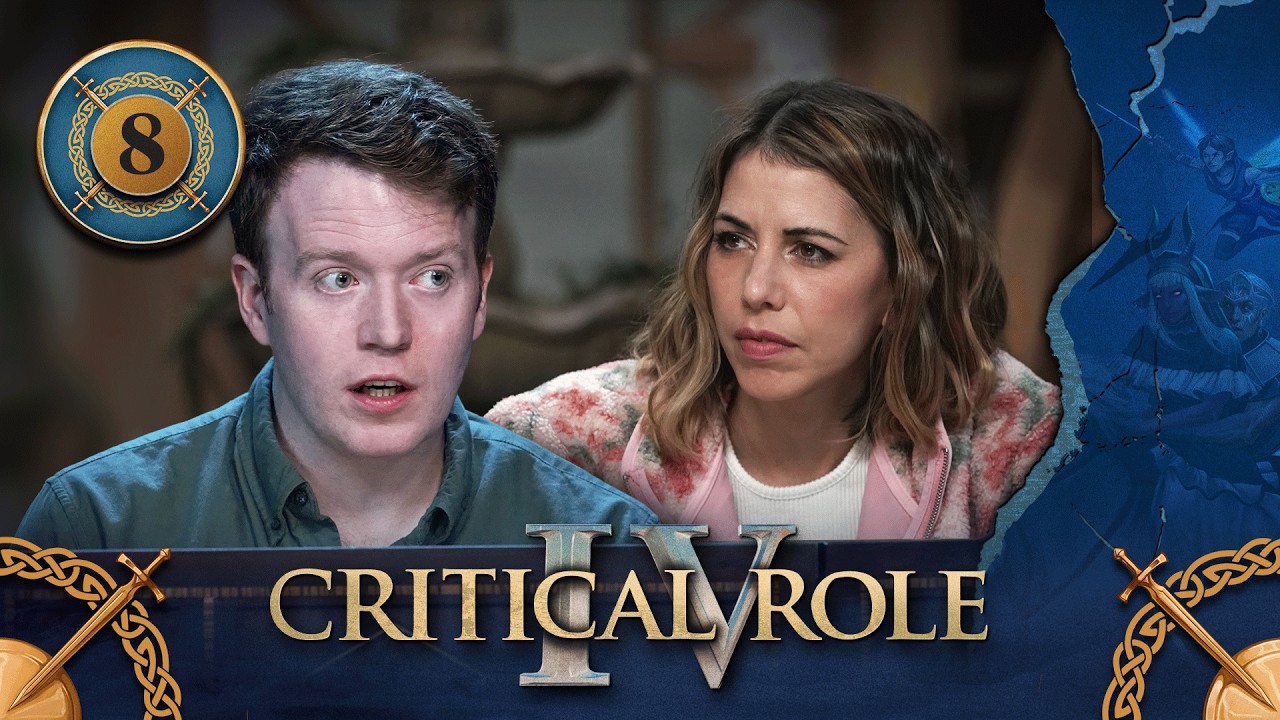
A brutal, funny and unexpectedly hopeful episode that pays off Thimble’s hunt for Casimir, then turns victory into a sharper question about leadership, loyalty and what should replace a bad ruler.
What worked & what held it back
- Thimble’s revenge receives a brutal and emotionally earned payoff
- Wicander gets some of his strongest character development of the campaign
- Casimir’s final argument makes his betrayal legible without excusing it
- The aftermath makes victory and governance more interesting than the kill itself
- The Castle Sloak battle occasionally sprawls tactically
- The illusory-squid comedy may undercut the revenge sequence for some viewers
Warning: This review contains full spoilers for Critical Role Campaign 4, Episode 8.
Casimir Gavendale spent the last episode discovering that owning a castle could not make people respect him.
Episode 8 kills him inside it.
Then something more interesting happens.
Everyone has to decide what the castle is for.
“Fanged Revenge” absolutely delivers the vengeance its title promises. Thimble reaches the man who betrayed Thjazi, spends several increasingly vicious rounds opening his throat and eventually finishes the job while looking into his one remaining good eye.
But Campaign 4 does not treat Casimir's death as the destination.
The Soldiers suddenly possess a defeated garrison, frightened prisoners, a miserable fortress, Wicander Halovar's enormous inherited authority and the power to decide what happens next.
That is where Episode 8 becomes better than a revenge story.
Episode 7 asked what separates having power from deserving it.
Episode 8 asks the question that comes afterward.
What is victory for once nobody can stop you?
Casimir Finally Explains Why He Gave Up on Thjazi
The best thing Episode 8 does for Casimir happens immediately before killing him.
For several episodes, we have known the important facts.
Casimir accepted money.
He betrayed Thjazi.
He expected the execution.
He later complained that handing Thjazi over should have earned him more respect from House Tachonis.
That tells us what he did.
Episode 8 finally gives him an argument for why he thinks he was entitled to do it.
Facing Thimble on the walls of Castle Sloak, Casimir turns the Falconer's Rebellion back on her. He accuses people like Thimble of drawing him into a life built around promises of a better future that never arrived.
Where was the glorious dawn?
How long was he supposed to wait for another falcon's cry?
If nobody could know a better day was coming, what right did they have to tell people to keep waiting?
That is much more revealing than another declaration that loyalty means nothing.
Casimir was once a brother-in-arms who ran beside these people.
Then disappointment became his permission structure.
His argument contains something recognisable. Revolutions fail. Promises go unanswered. People who sacrifice for change can eventually look around and discover that the world remains unfair.
Casimir's moral failure is not noticing any of that.
It is deciding that disappointment releases him from responsibility.
Thimble's answer is tiny:
“You never did have patience.”
Then she attacks.
She refuses to let disillusionment become absolution.
Casimir did not merely stop believing the glorious dawn was coming.
He decided that gave him permission to sell somebody who had once stood beside him.
Thimble's Revenge Hurts Because There Was Something Real to Betray
Campaign 4 does not need to pretend Casimir was secretly redeemable to make his death complicated.
It only needs us to remember that he was once part of something real.
Casimir describes Thjazi as having been a brother.
Thimble throws the same history back at him:
“Thjazi never did anything to you. You were a brother. Your greed is what brought you to this.”
That is enough.
Her anger is not simply:
You killed my friend.
It is:
You betrayed somebody who once stood beside you.
The actual-play mechanics make the vengeance appropriately ugly.
Thimble does not get one neat cinematic strike and a convenient death.
Casimir keeps surviving.
She keeps coming back.
One side of his throat.
Then the other.
After Casimir complains about waiting for the falcon's cry, Thimble finally connects the wounds across the front of his throat.
“Can you hear it now?”
Casimir dies with his cloak hanging over the parapet, soaked in blood — the first and final pennant of the Baron of Sloak.
Laura Bailey is vicious without making Thimble suddenly feel generically bloodthirsty.
This is specific.
Casimir is specific.
And the proof comes almost immediately afterward.
Once he is dead, Thimble starts trying to make the killing stop.
Killing Casimir Does Not Mean Killing Everyone Who Served Him
The smartest choice in “Fanged Revenge” comes after its titular revenge has already happened.
The surviving defenders are still armed.
They still have oaths.
Some believe they have failed those oaths simply by surviving their baron.
It would be easy for the encounter to continue until one side runs out of hit points.
Instead, the Soldiers start de-escalating.
That matters mechanically as well as morally. Brennan Lee Mulligan allows the players' nonviolent actions to affect the social side of the battle rather than treating initiative as a sealed box that can only be escaped through damage.
Eventually the surviving knights confront what their obligations actually require.
Sir Copsewood believes his duty should die with Casimir.
Sir Finch asks the obvious question:
Did Casimir keep his own oaths?
Copsewood's answer is essentially that reciprocity is irrelevant.
That is not how an oath works.
It is a tiny argument containing one of Campaign 4's larger political problems.
When does loyalty remain a virtue after the person receiving it stops deserving it?
Teor gives them a way out.
They already owe loyalty elsewhere.
Casimir does not need to own them from beyond the grave.
The fight ends because people decide it can end.
Not because everybody on the losing side is dead.
After Thimble's extremely personal vengeance, that restraint is essential.
Casimir was the target.
Everyone standing near him was not.
Wicander Nearly Dies and Still Finds Something to Give Away
Wicander's part in the battle gives Episode 8 a smaller version of the same argument.
He goes down.
Badly.
Tyranny responds with exactly the level of composure expected from somebody who has become emotionally attached to Wicander while insisting that this is probably not happening.
She drags him inside the giant Chanter's Egg squid and makes it extremely clear that dying would be personally unacceptable to her.
The comedy works because the fear underneath it is real.
Tyranny began Campaign 4 as part servant, part bodyguard, part family asset.
By Episode 8, losing Wick terrifies her.
Then Brennan introduces Campaign 4's expanded dying rules.
After succeeding on a death save, Wicander has a choice.
He can stabilise.
Or he can remain in danger and use his turn to give Heroic Inspiration to somebody else.
Wick sees Teor fighting and gives it to him.
He remains dying.
Only on a later turn does he stabilise.
It is almost suspiciously perfect character mechanics.
Wicander has spent several episodes learning that leadership cannot simply mean possessing status.
Now the rules themselves ask:
You have something useful. Do you spend it protecting yourself or helping somebody else?
Wick helps somebody else.
Later, the episode asks essentially the same question with a castle.
Casimir Had the Title. Winifred Cosgrove Had the Trust.
Episode 7 already established that Casimir misunderstood authority.
House Tachonis gave him a title.
A deed.
Money.
New armour.
And Castle Sloak, apparently because someone decided betrayal should be rewarded with structural damp.
Casimir thought becoming Baron would make people treat him like one.
When they did not, he doubled their taxes.
He tried to borrow legitimacy from Wicander.
He believed power had to be performed downward until fear started looking enough like respect.
Episode 8 introduces his opposite.
Dame Winifred Cosgrove does not begin the episode owning anything.
She does not hold the deed.
She has not been appointed Baroness.
But when the fighting is over and the surviving defenders need answers, they naturally look to her.
Brennan explains why.
They trust her.
She supports them.
She already behaves like somebody responsible for the people around her.
“Leadership is an act.”
There is Episode 8's argument.
Casimir thought the office would produce the behaviour.
Cosgrove has the behaviour before anybody gives her the office.
She is also from Sloak.
Her father was the last knight of the Order of the Howling Rain, and she now carries that tradition herself.
Asked why she remains in this miserable place, her answer does not require political theory.
It's home.
Casimir receives Sloak and immediately thinks about what the people there owe him.
Cosgrove thinks of herself as belonging to it.
One treats territory as possession.
The other treats it as responsibility.
Wicander Decides to Do Good Without Controlling What Comes Back
Before giving Sloak away, Wicander has one of his most important conversations so far.
The Soldiers are discussing what happens if House Halovar learns what he has done.
Kattigan asks whether anybody has ever genuinely been grateful to him.
Tyranny asks whether he can still tell the difference between gratitude and fear.
Wick admits that he no longer knows.
Everyone they have met on this journey has seemed frightened of either him or his family.
That is a remarkable admission for Wicander.
He has spent his whole life receiving reactions to power and assuming some portion of them reflected affection, faith or respect.
Now he is starting to understand how difficult those things are to distinguish when the person standing opposite you knows your surname can ruin them.
And then Wick decides:
“Let's just do a good thing that we know is good.”
Whether people are grateful is up to them.
Whether they keep his secret is up to them.
That is almost the episode's thesis stated in-character.
Wicander finally does something good without demanding control over the response.
That is a completely different relationship with power.
The Paperwork Is Dubious. The Local Legitimacy Is Not.
The Soldiers briefly realise that, by the logic of conquest and everyone's assumptions around the Halovar name, they may have accidentally acquired Castle Sloak.
Nobody particularly wants it.
This is already an excellent joke after an entire episode in which Casimir desperately wanted owning this ruin to mean something.
Then Wicander turns to the person everybody is already following.
Cosgrove.
The legal situation is not remotely clean.
Sir Finch explains that Sloak would ordinarily fall to the local Earl to grant to a new vassal. Casimir's own appointment was already irregular because House Tachonis had pushed it through while the Earl apparently preferred not to challenge them.
Then Tyranny gets out her Forgery Kit.
A constitutional convention this is not.
They alter the deed.
Wicander lends his name.
The surviving knights rally around Cosgrove.
Later, Dame Morgaine looks over the document, calls it “stunningly official looking” and suggests that King Augustus can affirm the title when he returns.
So the distinction is worth making carefully.
The paperwork is dubious. The local legitimacy is not.
Cosgrove's final legal title remains provisional.
The trust behind it does not.
That makes the contrast with Casimir even better.
His paperwork was real.
His legitimacy was doubtful.
Cosgrove has the opposite problem.
The paperwork can be fixed later.
The people are already looking at their leader.
The Rebellion Casimir Calls a Failure Saved the Woman Who Replaces Him
Then Episode 8 delivers the detail that makes the entire Castle Sloak aftermath click.
Cosgrove sees the new falcon.
She recognises Thimble, Teor and Kattigan as people who fought with the Torn Banner.
And she tells them that the Torn Banner saved her life when she was seventeen years old.
To the three of them, she says, she owes every breath she has drawn since.
That is devastating in context.
Casimir dies arguing that the Falconer's Rebellion failed.
Where was the glorious dawn?
How long was he supposed to keep waiting for evidence that any of it had mattered?
Minutes later, the episode places Castle Sloak in the hands of a woman who is alive because those rebels once fought.
The glorious dawn did not arrive as promised.
That does not mean nothing survived the night.
Cosgrove herself is evidence.
Casimir wanted proof that the rebellion had produced something worth waiting for.
He dies before meeting one of its consequences.
And now she has his castle.
That is better than a rebuttal.
It is inheritance.
The Falcon Means Something Different to Everyone Who Hears It
Episode 8 becomes richer when its falcon moments are read together.
The first belongs to Thaisha.
At a roadside inn, Aranessa is frightened, exhausted and struggling even to eat. She asks whether Thjazi might already have been reborn.
Thaisha tells her something personal.
She tends to associate people with animals.
Thjazi always made her think of a falcon.
After leaving Dol-Makjar, she heard a familiar cry and chose to believe it was him letting her know everything would be all right.
The wording matters.
Thaisha does not prove that Thjazi has reincarnated.
She chooses an interpretation that allows hope to survive.
Casimir hears the idea of the falcon differently.
For him, its absence becomes evidence against hope.
How long was he supposed to wait?
Thimble answers by making the symbol herself.
Casimir's expensive black mantle is stripped from his body.
The group bleaches a falcon onto it.
Then Thimble writes:
“The FANGed falcon lives on.”
He complains that the falcon never returned.
His friends make one.
And then Copsewood sees it.
This is the same man Brennan describes as receiving perhaps the first piece of information in his life that does not support his cynicism.
He looks at the falcon and says:
“We heard its cry. I will not sit idly by while I hear it again.”
Then he kneels to Cosgrove.
That may be Episode 8's neatest answer to Casimir.
Casimir waits for hope to arrive as proof.
Copsewood sees other people create something hopeful and decides that means he should act.
The difference is not whether the falcon is real.
The difference is what hearing it asks you to do.
The Battle Is Long, but It Is Actually About Something
“Fanged Revenge” is heavily dominated by combat.
Its runtime shows.
There are long stretches involving walls, windows, rain, mud, movement speed, visibility, climbing, concentration, readied actions and precisely how far someone can travel before Castle Sloak turns into an extremely wet geometry examination.
That keeps Episode 8 from reaching the campaign's absolute top tier.
But it is also one of Campaign 4's stronger demonstrations of what actual-play combat can accomplish when kill everything is not the only objective.
The party begins divided.
Wicander and Tyranny are already inside because Dr. Finger has somehow survived long enough to become an active tactical condition.
Thimble is infiltrating.
Kattigan and Teor are outside.
The weather matters.
The terrain matters.
Then Tyranny deploys one of Ulbid's Greater Chanter's Eggs and introduces a giant squid into a battle that previously had no discernible need for marine life.
The squid becomes cover.
Then a dying Wicander ends up inside it.
Then everybody realises it is repeating itself on an eight-second loop.
Actual play occasionally produces images scripted drama would reject for lack of restraint.
More importantly, the encounter keeps revealing character.
Thimble wants Casimir.
Tyranny wants Wicander alive.
Kattigan refuses to abandon Teor.
Wicander supports Teor while dying.
Then, once the central objective is accomplished, the group begins actively shrinking the battle instead of searching for reasons to continue it.
The combat takes a long time.
It rarely feels like nothing is happening.
Revenge Ends One Problem. Victory Creates Responsibility.
Casimir's death is unusually definitive for Campaign 4.
One of its longest-running threads finally produces an ending.
The man who betrayed Thjazi is dead.
But Episode 8 does not confuse the end of that pursuit with the end of the Soldiers' journey.
Cyd is still missing.
House Tachonis remains involved.
Dame Morgaine provides the next concrete direction: the Tachonis caravan split, and another group travelled north along the King's Way toward Tybry's Lea.
Hawkins arrives ready to discuss how Teor's brother might be wrested from House Tachonis.
The Soldiers therefore leave Sloak with considerably more than revenge.
A next direction.
A new ally.
A new Baroness whose title still needs formal affirmation.
A new banner.
And a clearer idea of what kind of group they might be.
That last part matters most.
The Soldiers did not begin as a party united by ideology.
They began as people attached to Thjazi for different reasons.
Episodes 5 and 6 taught them how to travel together.
Episode 7 gave them a common enemy.
Episode 8 asks what remains once that enemy is dead.
Their answer is surprisingly constructive.
Verdict: “Fanged Revenge” Is Better After the Revenge
“Fanged Revenge” could have been Campaign 4's easiest episode.
Find Casimir.
Fight Casimir.
Kill Casimir.
Celebrate.
Instead, its strongest material begins when the title has already been fulfilled.
Laura Bailey gives Thimble the vicious catharsis the story has earned, but Casimir is allowed one final argument before he dies. He stopped believing change would come and decided disappointment justified becoming smaller.
Thimble refuses that bargain.
Sam Riegel gives Wicander another quietly important chapter, first through an actual-play mechanic that lets him help someone else while his own life remains at risk, then through the much larger decision to do something good without demanding gratitude, secrecy or control in return.
Whitney Moore continues making Tyranny both ridiculous and unexpectedly perceptive.
And Brennan Lee Mulligan uses Winifred Cosgrove to clarify a distinction Campaign 4 has spent several episodes circling.
Casimir had the office.
Cosgrove had the practice.
He had authority written on paper.
She had people already looking to her.
Power can be transferred. Leadership has to be lived.
Then the episode gives us the cruelest possible answer to Casimir's despair.
He dies arguing that the rebellion failed to produce the future it promised.
The woman who replaces him is alive because the Torn Banner saved her when she was seventeen.
The falcon did come back.
Not as proof that history automatically bends toward justice.
Not necessarily as Thjazi reincarnated.
As people deciding that failed hope is still worth carrying forward.
RollingRealm Verdict: 9/10
“Fanged Revenge” occasionally gets bogged down in the physical administration of its long Castle Sloak battle, but the encounter continually produces character rather than merely damage. Thimble's confrontation with Casimir is a brutal payoff to one of Campaign 4's longest-running threads, while the aftermath turns an episode about revenge into a much stronger argument about leadership, loyalty and what people choose to do with victory.
Casimir wanted the title because he thought it would prove he mattered.
The people who defeat him prove themselves by deciding they do not need it.
Sources
Enjoyed this article?
Supporting Rolling Realm helps fund more independent reviews, lore guides and spoiler-aware coverage. Every article remains free.
Critical Role Campaign 4 Episode 7 Review: Power, Betrayal and One Terrible Castle
“On the Scent” turns a hunt through Timmony into a study of borrowed authority, as Wicander wrestles with inherited status and Casimir discovers how little respect betrayal actually bought him.
A slow-burning but rewarding episode that uses Timmony, the Candescent Creed and Castle Sloak to explore power, legitimacy and the humiliating limits of Casimir Gavendale’s new status.
Critical Role Campaign 4 Episode 9 Review: The Oath Still Stands
The Soldiers follow Cyd into Tybry’s Lea and discover that when gods, revolutions and institutions fail, what matters is not preserving their old shape — but deciding which promises still deserve to survive.
A dense but rewarding episode that uses Timmony’s Hounds, the Candescent Creed and House Tachonis to ask what deserves to survive when old systems fail.
Critical Role Campaign 4 Episode 6 Review: Forms Break, Truth Remains
The Soldiers reach Hawthorn’s Glade and discover that faith, beauty, darkness and even supernatural nature are poor substitutes for deciding what somebody actually chooses to do.
A cohesive Soldiers-focused episode where Wicander redefines the Light, Tyranny confronts demonic nature and Thimble pays for truth with memory.