The Shapers’ War: The First Pieces of Campaign 4’s Fading History
What Episode 1 tells us—and what remains uncertain
Episode 1 introduces the Shapers’ War through the Guardian Wall, noble politics and the Stone of Nightsong. These first sources reveal a conflict remembered through unity, revolution and loss while leaving its cause, sides and outcome unknown.
Watch the supporting moments
The campaign’s first historical image is an enormous memorial showing people of many ancestries side by side.
Campaign 4 introduces the Shapers’ War before it explains the crime that will bring Thjazi Fang to the gallows.
The first image of Dol-Makjar is the Guardian Wall. Figures around eighty feet tall emerge from its masonry and the surrounding mountainside. Orcs, dwarves, elves, humans, halflings, gnomes and beast folk stand side by side.
They are named as heroes of the Shapers’ War. Moments later, the same memorial figures are described as heroes of a revolution whose memory is fading.
That is the first source Campaign 4 gives us: not a battlefield, commander or date, but a monument. Episode 1 shows how Dol-Makjar remembers the war long before it explains what the war was.
The war survives first as a public image
The Guardian Wall presents a carefully shaped memory.
Its heroes are carved with determination, strength and hope. The city around them is described as dedicated to heroism, camaraderie and the mortal struggle to make a brighter day. Whatever happened during the Shapers’ War, Dol-Makjar has built part of its civic identity around the idea that people stood together against something greater than themselves.
The range of peoples shown matters. The monument places many ancestries beside one another rather than giving the victory to a single house, nation or species.
That does not prove that every people fought as one, that the statues show every participant or that the memorial gives us an unbiased history. Monuments tell us what later societies choose to honour. Episode 1 confirms the image of shared heroism; it does not yet give us the complete coalition behind it.
A war, a revolution, or both?
The opening narration uses two closely connected descriptions:
- heroes of the Shapers’ War;
- heroes of a revolution now fading from memory.
It is tempting to treat those phrases as a full explanation and call the Shapers’ War a rebellion. Episode 1 does not quite go that far.
The episode never defines who the Shapers were, what was being overthrown or how the revolution related to the war. The figures may be heroes of both the conflict and the revolution surrounding it. The revolution may describe the war’s wider political meaning. It may refer to something closely connected but not identical.
For now, the safest conclusion is that the memorial ties the Shapers’ War to a revolutionary legacy. The exact relationship remains unwritten.
The Guardian Wall is a memorial, not a confirmed battlefield
The wall is our main visual source for the conflict, but Episode 1 never says the war was fought there.
The statues emerge from the mountainside at Dol-Makjar’s eastern edge. They preserve the heroes, but no named battle, siege or act of sacrifice is attached to that location.
This distinction matters because the execution takes place beneath them.
The gallows are raised under figures associated with mortal hope and revolution. Thjazi is then condemned for sedition under the authority of the present political order. Later, Teor looks back at the wall and senses a conflict between the official celebration around the execution and the uncertainty in the crowd.
That contrast is an interpretation created by the scene rather than a confirmed historical parallel. Episode 1 does not say Thjazi fought for the same cause as the people carved above him. It does show modern power using a memorial to older resistance as the setting for a public execution.
The noble houses still measure time from the war
The Shapers’ War is not only remembered in stone.
During the Farramh, Aranessa speaks with Wicander Halovar and remarks on how far their houses have come since the war, now that they are aligned and represented together on the Chamber of Lords-Advisory.
Her comment is pointed rather than a neutral history lesson. It comes during a tense exchange between members of powerful houses, and its exact implications remain hers.
Even so, the remark tells us that the Shapers’ War remains a recognised dividing line in noble political memory. House Royce, House Halovar and the modern Chamber can be discussed in terms of what changed since that conflict.
Episode 1 does not establish:
- whether those houses fought on opposite sides;
- whether the houses existed in their current form during the war;
- what “aligned” means beyond their present Chamber relationship;
- whether that alignment is genuine cooperation or political convenience.
The war is clearly part of how the ruling class describes its own history, but the details are still hidden behind polite language and old tension.
A stolen relic carries the war into the present
The most concrete surviving consequence of the war is not the wall. It is the Stone of Nightsong.
Inside Thimble’s ransacked hideout, Occtis remembers reading about the Stone at the Penteveral. He recalls it as an elven artefact used during the Shapers’ War, though he cannot remember what it did.
That memory is useful but incomplete. Occtis is reconstructing a school reference after discovering that the relic has been stolen. He gives us a cultural connection to the elves and the war, not a full account of its history.
The episode later supplies the missing purpose.
The Stone protected elven spirits after death. It carried them through the darkness of the Tenebral Reaches towards the Garden of the Spirit, sparing them from the hardships of the realm of the dead.
Its existence is tied directly to a loss suffered during the Shapers’ War.
The immortal nightingale was destroyed
Sylandri’s original guardian spirit was an immortal celestial that took the wings of a nightingale. That spirit performed the passage later associated with the Stone.
Episode 1 confirms that the nightingale was destroyed during the Shapers’ War. The Stone of Nightsong was created after that destruction to continue the funerary protection it had provided.
This gives the war a consequence beyond cities and noble houses. Something celestial was destroyed, and an entire people needed a new way to protect their dead.
The episode does not tell us:
- who destroyed the nightingale;
- whether its destruction was deliberate;
- where it happened;
- whether Sylandri was present;
- what other divine or magical beings were involved;
- how soon after the loss the Stone was made.
The title given to Sylandri—shaper of the elves—also raises an obvious question. The episode never explicitly explains whether the “Shapers” in the war’s name were beings like Sylandri, their servants, their creations or something else entirely.
That connection remains possible, not confirmed.
Two accounts leave a small chronology question
Occtis remembers the Stone as an artefact used by elves in the Shapers’ War. Later lore says it was created after the immortal nightingale was destroyed during the war.
Those statements do not necessarily conflict. The nightingale may have been destroyed before the conflict ended, allowing the Stone to be created and used during its later stages. Occtis may also be remembering a broad historical reference rather than an exact sequence.
Episode 1 does not settle the timing.
This is a useful example of how the archive should treat early lore. We have two pieces of evidence, each with a different level of detail. The answer is not to force them into a precise timeline before the campaign provides one.
History survives in four different forms
By the end of Episode 1, the Shapers’ War has reached us through four kinds of source.
The monument
The Guardian Wall presents a public memory of many peoples, mortal hope and revolutionary heroism.
Education
Occtis remembers encountering the Stone of Nightsong in the Penteveral, showing that at least part of the war’s relic history survives in formal study.
Noble politics
Aranessa invokes the war while discussing the modern alignment of powerful houses and their representation in the Chamber.
Sacred objects
The Stone preserves a direct consequence of the war: the destruction of Sylandri’s original guardian and the need to protect elven souls by another means.
Together, these sources make the war feel foundational without making it fully known. It shaped public identity, political language, scholarship and funerary magic. Yet the actual conflict remains mostly beyond view.
What Episode 1 confirms
The transcript and audited records establish that:
- the Guardian Wall memorialises heroes of the Shapers’ War;
- its statues are around eighty feet tall;
- the memorial represents orcs, dwarves, elves, humans, halflings, gnomes and beast folk side by side;
- the figures are also associated with a revolution whose memory is fading;
- the monument presents determination, heroism, strength and hope;
- Aranessa speaks of noble houses being aligned since the war;
- Occtis remembers the Stone of Nightsong as an elven artefact connected to and used during the war;
- Sylandri’s original celestial guardian took the wings of an immortal nightingale;
- that guardian was destroyed during the Shapers’ War;
- the Stone was created after the destruction to continue protecting elven spirits.
What remains unknown
Episode 1 does not establish:
- when the Shapers’ War occurred;
- what caused it;
- who or what the Shapers were;
- whether the war and the revolution were exactly the same event;
- the opposing sides;
- any named leader or ordinary participant;
- where its battles were fought;
- whether the Guardian Wall marks a battle site;
- how the conflict ended;
- who destroyed the immortal nightingale;
- what role Sylandri played;
- why the revolution’s memory is fading;
- how the modern noble houses were divided before becoming “aligned.”
The first pieces, not the finished history
Episode 1 does not give us a traditional account of the Shapers’ War.
It gives us a city standing beneath its heroes. A soldier remembering a relic from school. A noble using the war as a measure of political progress. A funerary object created because a celestial guardian did not survive.
That scattered approach makes the war feel older and larger than any single explanation. Its consequences are everywhere, while its central story remains missing.
For now, the Guardian Wall provides the clearest image: many peoples carved together, carrying a hope that Dol-Makjar still displays even as the memory behind it begins to fade.
All factual statements in this article are drawn from the Episode 1 transcript and audited archive records. Aranessa’s and Occtis’s statements remain attributed to them, and possible connections involving the war’s revolutionary meaning, the identity of the Shapers and the Stone’s chronology are presented cautiously rather than as confirmed canon.
Enjoyed this analysis?
Rolling Realm remains free for everyone. Optional support helps with continued research, development and episode coverage.
Support Rolling Realm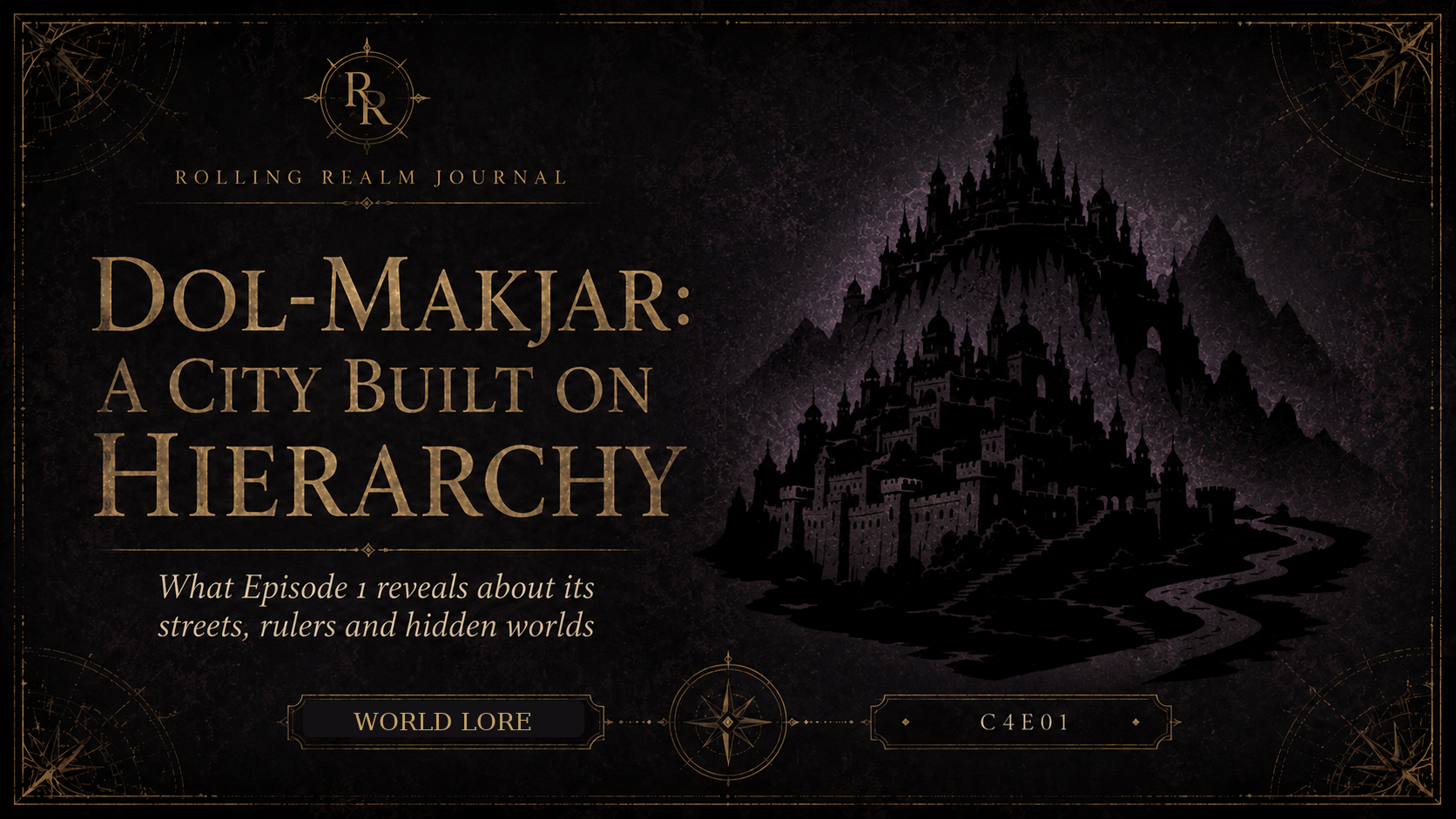
Dol-Makjar: A City Built on Hierarchy
What Episode 1 reveals about its streets, rulers and hidden worlds
Episode 1 introduces Dol-Makjar through monuments, sky bridges, noble galleries, working streets and hidden rooms. Together they reveal a city shaped by old history, divided power and lives built on many levels.
What We Learned from Critical Role Campaign 4, Episode 1
Consequence, authority and the mysteries left behind in Dol-Makjar
Episode 1 begins with Thjazi Fang’s execution, a rescue that has already gone wrong and a wake full of old friends, enemies and secrets. Here are the main pieces of lore it leaves behind.
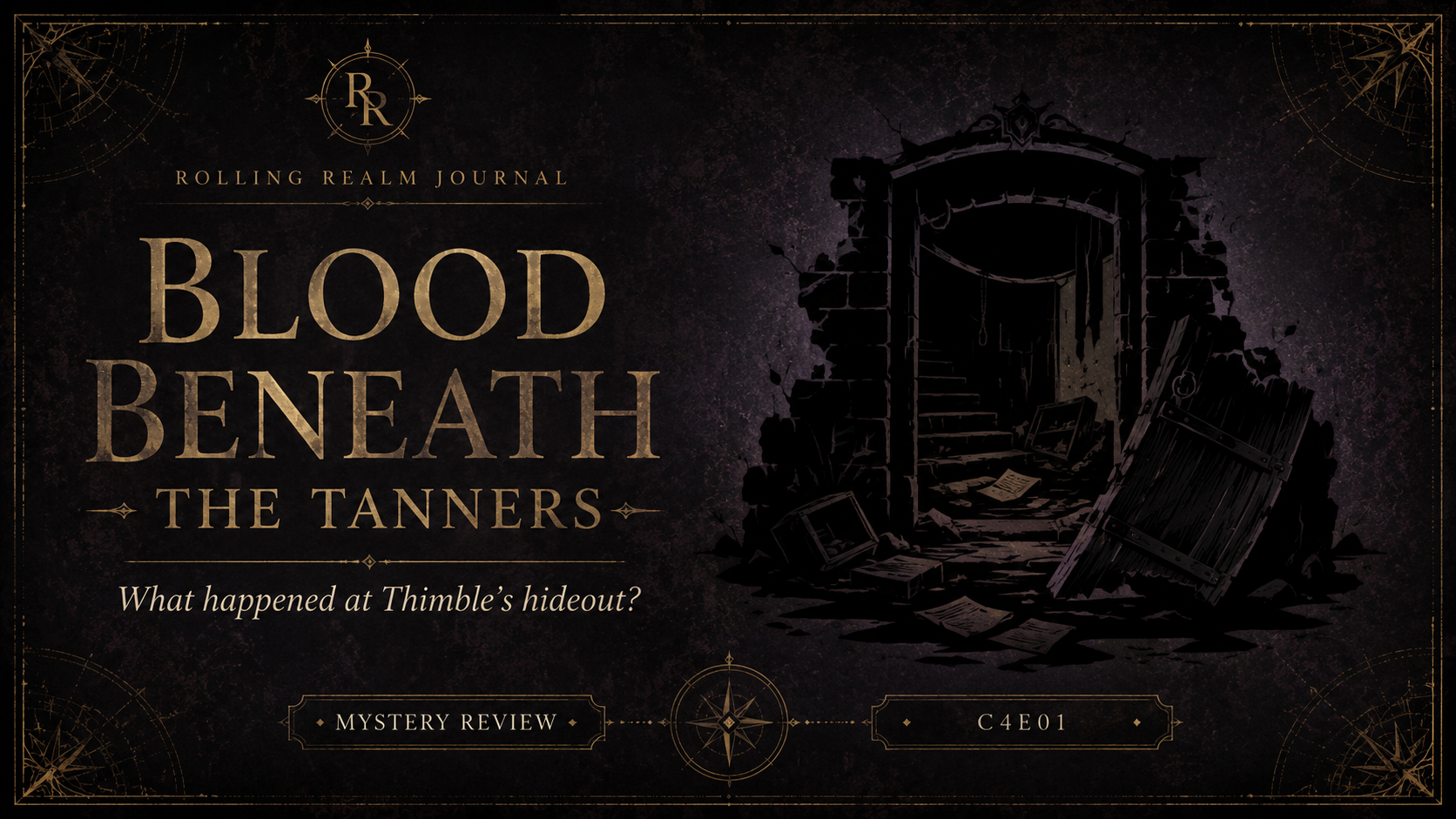
Blood Beneath the Tanners
What happened at Thimble’s hideout?
Fresh blood, a hidden staircase and a room torn apart lead to one of Episode 1’s largest mysteries: who attacked Thimble, how did they find the hideout and what were they really trying to take?