What We Learned from Critical Role Campaign 4, Episode 1
Consequence, authority and the mysteries left behind in Dol-Makjar
Episode 1 begins with Thjazi Fang’s execution, a rescue that has already gone wrong and a wake full of old friends, enemies and secrets. Here are the main pieces of lore it leaves behind.
Watch the supporting moments
The campaign opens with the consequences of the Falconer’s Rebellion already shaping the day.
Campaign 4 opens beneath the Guardian Wall, where Halandil Fang waits to watch his brother die.
There is no calm beginning here. The Falconer’s Rebellion has already ended. Thjazi Fang has already been condemned. A secret rescue is already falling apart. The people we meet are not stepping into a new story. They are carrying the weight of an old one.
By the end of Episode 1, Thjazi’s death has pulled together family, soldiers, nobles, rebels, priests, old friends and stranger powers. The episode gives us a city full of hidden rooms, old wounds and people who do not agree on what Thjazi was.
These are the main pieces of lore Episode 1 leaves us with.
1. The story begins after the rebellion has already ended
The Falconer’s Rebellion is over before the campaign begins. Thjazi has been captured, the Chamber of Lords-Advisory has passed sentence and soldiers bearing the crests of several Sundered Houses surround the hanging.
That changes how we first meet him. We do not see the rebel making his plans. We see the condemned man, and we learn about him through the people who came to mourn him, save him, hate him or watch him fall.
The public ceremony presents the execution as lawful and final. Yet the scene is full of doubt. Some people in the crowd cheer for Thjazi. Wicander expected mercy. The Photarch insists that Thjazi must die. Thjazi sees something in the sky that frightens him, then rushes to pass on several last messages.
The rope ends his life, but it does not settle his story.
2. Dol-Makjar shows its divisions through its streets and buildings
Episode 1 teaches us a great deal about Dol-Makjar simply by showing where people stand.
At the Guardian Wall, Thjazi and the crowd are below. The nobles sit high above them in private galleries. Before anyone explains the city’s politics, the city has already shown us who holds the better view and who stands closest to danger.
The same pattern appears elsewhere. The Fang home in the Rookery becomes a meeting place for mourners, rivals, nobles and old soldiers. Inside Ograhmson Leather Tannery, a secret door leads to Thimble’s hidden base.
Again and again, Dol-Makjar hides one world beneath another:
- A public execution hides a rescue attempt.
- A tannery hides a rebel safehouse.
- A family wake gathers people from rival groups.
- A protected funeral can still be broken from inside the house.
The city is not just a backdrop. Its walls, galleries, cellars and hidden doors tell us who can watch, who can hide and who is allowed to enter.
3. Thjazi becomes more important after his death
Thjazi dies early, but the rest of the episode keeps returning to him.
His body is taken home. His friends try to understand why the rescue failed. People who loved him, blamed him or hated him come to the Farramh. His final messages point toward Murray, the Penteveral, paint and Thimble, while Thaisha carries out his request involving a silver box.
Each person remembers a different Thjazi.
Halandil remembers his brother. Azune Nayar is left with the knowledge that he gave a rescue signal that led nowhere. Thimble nearly dies protecting the real escape glyph. Aranessa shows us a private side of Thjazi that does not fit neatly with his public name. Julien’s anger shows that the Falconer’s Rebellion still shapes old grudges.
No single view gives us the whole man. That seems to be the point. Thjazi leaves behind pieces, and everyone else must decide what those pieces mean.
4. The rescue was broken before Thjazi reached the rope
The failed rescue depended on several people doing their part.
Thimble was meant to place a fragile escape glyph inside Thjazi’s coat. Azune would find it during his official magical search and quietly allow it through. When broken, the glyph would send Thjazi to a waiting wagon. Cyd Pridesire would drive, while Thaisha and Occtis helped move him beyond Dol-Makjar. Wicander was meant to be the last hope if the plan failed.
Instead:
- Thimble was attacked before she could deliver the glyph.
- Cyd and the wagon did not appear.
- Wicander could not stop the sentence.
- Azune still found what seemed to be magic on Thjazi’s coat.
- The real glyph was later found with Thimble.
That last detail is the strangest. If the true glyph never reached Thjazi, what did Azune sense?
Someone may have known about the rescue. The magic may have been a false copy. The attack on the hideout may have been meant to stop the escape, steal the Stone of Nightsong, or both. Episode 1 gives us the broken pieces, but not the hand that broke them.
5. The attack on Thimble’s hideout was planned
The hideout is not simply damaged. It has been searched.
There is fresh blood near the hidden entrance and down the stairs. The rooms have been torn apart. Bodies seem to have been dragged away. Thimble is missing, and so is the Stone of Nightsong.
Later, the group works out that around seven masked attackers entered the hideout. Thimble killed at least three of them and escaped through a drainage grate, badly wounded but still carrying the true rescue glyph. Six sets of tracks came from old, tattered boots, while one came from much finer boots. The episode does not tell us who wore them or why that attacker stood apart.
Crow feathers, pine resin, alcohol and tobacco smoke make Kattigan think of the Crow Keepers, but this only suggests a connection. The attackers may have belonged to the guild, worked for someone else or carried signs meant to point suspicion in that direction.
What we can say is that the attackers knew where to go, entered while Thimble was finishing the glyph, searched the hideout and removed their dead. This was not random violence.
6. The Farramh brings the wider world into one house
The Farramh of Thjazi Fang gathers almost every part of the episode under one roof.
Family mourns beside old soldiers. Nobles arrive with old grudges. Candescent followers enter a death rite outside their own faith. Bolaire brings links to the Museum and to Thjazi’s hidden dealings. Murray brings the Penteveral. Thaisha and the Old Path show that their funeral customs carry real power.
The wake becomes a small picture of Dol-Makjar itself: grief, politics, faith, family and suspicion pressed together in the same rooms.
After Julien secretly spits on Thjazi’s body, Bolaire senses that the Old Path protection has been crossed and sees a small shadow-like shape follow him away.
That moment tells us something important. Old rites are not empty habits in this world. The protection around Thjazi is real, though the episode does not yet explain what the shadow is or exactly how it came into being.
7. The Stone of Nightsong opens the story beyond Dol-Makjar
When Vaelus arrives, the room turns cold and the story suddenly reaches much further back.
Vaelus comes from the Mournvale as a Sister of Sylandri, a goddess believed to have fallen. She says Thjazi stole the Stone of Nightsong. Bolaire explains that the Stone once helped guide elven souls after the death of Sylandri’s immortal nightingale.
The episode tells us that Thimble and Thjazi retrieved the Stone on an earlier adventure. Vaelus says Thjazi stole it from her. We have not yet seen enough to know how those accounts fit together.
What matters is the size of the history behind the object. Its theft turns the hideout attack into a much older mystery, reaching back to the Shapers’ War, a fallen goddess, the Mournvale and the path of the dead.
Episode 1 begins in one city, but its roots already reach far beyond it.
8. The silver box places Thimble at the heart of the mystery
Near the end of the episode, Thaisha brings out a silver box that Thjazi asked her to retrieve.
It will not open. Then Vaelus says Thimble’s name downstairs.
The box wakes.
Black clay and velvet begin to shape themselves into a mask much like the living mask worn by Bolaire.
In one moment, several threads come together: Thjazi’s last plans, Thaisha’s secret task, Thimble’s absence from the Farramh, Bolaire’s strange nature and an object no one yet understands.
We still do not know whether the mask is a message, a vessel, a living being or something else. We only know that Thjazi asked Thaisha to retrieve the box, and that speaking Thimble’s name opened it.
The questions still waiting for answers
Episode 1 tells us that Thjazi is dead. It leaves almost everything around his death open.
- Why did the Photarch refuse mercy?
- What did Thjazi see in the sky?
- Who placed false magic on his coat?
- Who attacked Thimble’s hideout?
- Where is the Stone of Nightsong?
- What is following Julien?
- What is forming inside the silver box?
These questions all sit beneath events that looked simple from the outside. A sentence was read. A man was hanged. A body was taken home. A funeral began.
But beneath each of those moments, someone was hiding something.
Final thoughts
The main lesson of Campaign 4’s first episode is that the past is still alive.
Thjazi’s rebellion shapes the people at his execution. Older wars shape the guests at his wake. The Stone of Nightsong carries the memory of a fallen goddess. The Old Path can still protect the dead. Family history decides who mourns, who hates and who still feels they owe Thjazi something.
Campaign 4 begins with the city declaring that Thjazi Fang’s story is over.
Everything that follows tells us it is not.
All factual statements in this article are drawn from the Episode 1 archive and its timestamped scene evidence. Where the article offers an interpretation, it is presented as insight rather than confirmed canon.
Enjoyed this analysis?
Rolling Realm remains free for everyone. Optional support helps with continued research, development and episode coverage.
Support Rolling Realm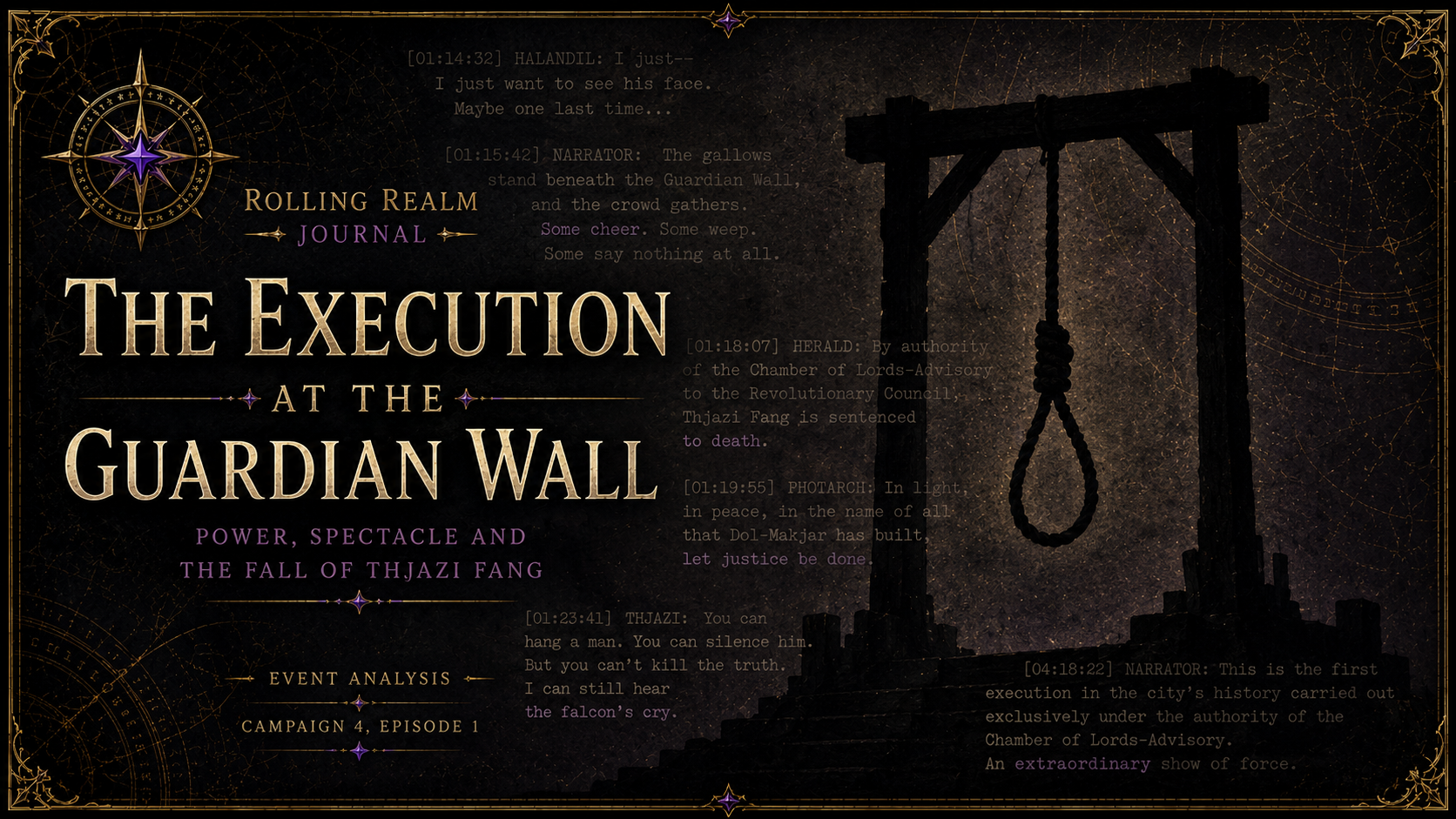
The Execution at the Guardian Wall
Power, spectacle and the fall of Thjazi Fang
Thjazi Fang is hanged beneath monuments to the heroes of an older revolution. The crowd, the failed rescue and the Photarch’s decision leave more questions than the public ceremony answers.