Dol-Makjar: A City Built on Hierarchy
What Episode 1 reveals about its streets, rulers and hidden worlds
Episode 1 introduces Dol-Makjar through monuments, sky bridges, noble galleries, working streets and hidden rooms. Together they reveal a city shaped by old history, divided power and lives built on many levels.
Watch the supporting moments
The opening establishes the gray stone city, the River Vrosh, its descending spires and the Guardian Wall.
Dol-Makjar first appears as a city of gray stone beneath the Mountains of Kavros. Its towers follow the River Vrosh down from the heights, and the great figures of the Guardian Wall look out over the people below.
It is a grand first sight.
It is also the place where Thjazi Fang is about to die.
Episode 1 does not stop to give us a full history lesson about the city. Instead, it lets Dol-Makjar explain itself through streets, walls, houses, uniforms and doors. By following the characters across a single day, we begin to see how its people live and where its power rests.
A city descending from the mountains
Dol-Makjar stands at the eastern edge of Kahad. The Mountains of Kavros rise behind it, while the River Vrosh runs down through the city.
The opening description gives the city a stepped shape. Towering spires follow the river down from the mountains, one level after another. Mist rises from the water. Magpies cross the gray sky. The recent days have mostly been overcast.
This gives Dol-Makjar a strong shape before we know any of its streets. It is a city built against height, stone and water. Later scenes keep returning to that same sense of levels: houses on hills, bridges between towers, nobles seated above a crowd and hidden rooms beneath ordinary buildings.
Episode 1 never hands us a complete map. It does something better. It lets us feel that there is always another part of the city above, below or behind the one we can see.
The Guardian Wall carries the city’s old story
The Guardian Wall is more than a defence. It is one of the places where Dol-Makjar tells people what it believes about itself.
Around eighty-foot statues rise from the wall and mountainside. Orcs, dwarves, elves, humans, halflings, gnomes and beast folk stand side by side as heroes of the Shapers’ War. The transcript also calls them heroes of a revolution now fading from memory.
The wall is tied to hope, fellowship and the mortal struggle to build a brighter future.
Then the city hangs Thjazi beneath it.
The contrast is hard to miss. Dol-Makjar places a public execution beneath a monument to an older revolution. The episode does not tell us that Thjazi and the carved heroes belong to the same cause. It does show that the city’s proud past and its troubled present now share the same ground.
That is why Teor’s later question lands so well. Looking back on the trumpets, the crowd and the gallows, he wonders what has happened to the city of the Revolutionary Council and the Pariah Blades.
For Teor, Dol-Makjar is not only a place. It is a promise from the past, and he is no longer sure the city has kept it.
The Rookery belongs to artists, not lords
The Rookery shows another face of Dol-Makjar.
It is a tall neighbourhood of towers, sky bridges, conical roofs, perches and aviaries. Yet the transcript makes a point of saying that its height does not make it a castle for lords and ladies. It belongs to poets, performers, actors, jesters, singers and musicians.
Seats are set upon rooftops, all facing toward a stage and academy lower down the hill. Storytellers and bards have trained there for as long as anyone can remember.
This is where Halandil Fang has built his life. His home is modest but comfortable, near the top of the hill rather than at its highest point. It has room for guests, family, music, unfinished verses and works still being written.
The Rookery is important because it shows that Dol-Makjar’s vertical shape does not always mean noble power. Height can also belong to art, community and a good view of the river.
Even so, power still reaches into this creative part of the city. Halandil has been granted the Dithyramb of Azgra by the Revolutionary Council. The deed is signed by lords and other city figures, and it makes him responsible for preventing arcane trouble in the public space.
The gift is real, but so are its conditions. In Dol-Makjar, even a theatre comes with rules, signatures and people who expect to be obeyed.
The Tanners shows the city at work
Two neighbourhoods south of the Rookery lies the Tanners, at the far southern edge of the city.
The transcript calls it a grimy, working-class neighbourhood. Its name comes from its many tanneries. The streets carry the smell of leather being cured and flesh being broken down.
This part of Dol-Makjar feels far removed from the noble galleries of the Guardian Wall. It is a place of hard work, strong smells and ordinary trade.
It is also a good place to hide.
Behind the painted wall of Ograhmson Leather Tannery lies one of Thjazi’s secret apartments. A few marked bricks open the way. Beyond them is the room where Thimble prepared the escape glyph and where masked attackers later searched for magical objects.
Dol-Makjar’s public life and secret life often occupy the same space. A theatre can carry rules set by the council. A tannery can hide an illegal arcanist. A family home can become the meeting place for rebels, soldiers, nobles and old friends.
The city has many doors, and not all of them look like doors.
The nobles watch from above
Episode 1 shows social rank most clearly at the execution.
The crowd stands beneath the Guardian Wall. The nobles sit higher up in private galleries and sky boxes. Sir Julien watches from an elevated noble box. Bolaire, though not a noble, is welcomed into those spaces because they deal in noble affairs.
No one needs to explain the difference. The seats explain it.
Those below are pressed together in the square. Those above have space, privacy and a clear view of the event. Nobles rise to congratulate Julien after the body falls. The gallery is not only a place to watch. It is a place where alliances, praise and reputation move from one person to another.
The same divide appears in quieter ways. Loza remembers Thjazi as a commoner from Dol-Makjar who married a noblewoman and later joined a rebellion against her house. That memory tells us that noble and common birth still carry meaning in the city, even when people cross the line between them.
Dol-Makjar is not shown as a place where every person stays in one rank forever. Thjazi crosses that line through marriage. Bolaire enters noble spaces through influence. Halandil gains a public theatre through a council grant. But each crossing is noticed.
Several powers share the city
Dol-Makjar has no single face of authority in Episode 1.
The Revolutionary Council is part of the city’s government. It is named in the sentence announced at Thjazi’s execution, and it grants Halandil the theatre deed.
The Chamber of Lords-Advisory is tied to the noble houses. It sentenced Thjazi, and his death becomes the first execution in the city carried out solely under the Chamber’s authority.
The Sundered Houses bring soldiers, heraldry, trumpets and nobles to the Guardian Wall. Bolaire sees the execution as a major day for their growing power.
The Revolutionary Guard handles official security and investigation. Azune serves as an Arcane Marshal, scans Thjazi for magic and later investigates the broken rescue.
Episode 1 does not fully explain how all these groups answer to one another. What it does show is a city where power is shared, watched and tested.
The execution matters because one part of that system has just gained ground. The Chamber has used a power it had never used alone before, and the Sundered Houses are there to make that power visible.
Faith is also reaching for the city
House Halovar brings another kind of influence into Dol-Makjar through the Candescent Creed.
The Photarch says the Creed has plans unfolding in the city but has struggled to spread its message there. She calls Dol-Makjar the seat of the revolution. Wicander believes Halandil’s new theatre could help the Creed reach a wider audience.
This is a small scene, but it tells us a great deal. Culture is not separate from power. A stage can become a way to shape how people think. A popular artist can become a path into parts of the city that a noble house or faith has not yet reached.
The Farramh at Halandil’s home also shows that the Candescent Creed is not the only tradition in Dol-Makjar. The funeral follows the Old Path, with relics, flowers, whispered words and protection around the dead.
Episode 1 does not say that these faiths are openly at war. It does show them meeting in the same house, carried by people with very different ideas about death, light and what should happen to a soul.
One house brings the whole city together
By nightfall, Halandil’s home holds an unusual gathering.
Family members stand beside former rebels. Soldiers speak with nobles. A demon from the Candescent Creed tries to follow an Old Path funeral. A masked figure from noble circles arrives. An estranged wife enters with the man who helped capture Thjazi. Later, a Sister of a fallen goddess comes searching for a stolen relic.
Vaelus looks around and sees family, criminals and nobles gathered together.
That may be the clearest picture Episode 1 gives us of Dol-Makjar. The city is divided by district, rank, house, faith and history, but those divisions do not keep its people apart. They keep colliding.
The Fang home becomes a smaller version of the city outside it: crowded, tense, grieving and full of unfinished business.
What Episode 1 confirms about Dol-Makjar
From the transcript and audited records, we can say that:
- Dol-Makjar is a gray stone city at the eastern edge of Kahad;
- its spires descend beside the River Vrosh from the Mountains of Kavros;
- the Guardian Wall honours heroes of the Shapers’ War and an older revolution;
- the Rookery is a vertical artistic neighbourhood of towers, bridges and aviaries;
- the Tanners is a grimy working-class district at the far south of the city;
- the Revolutionary Council forms part of the city’s government;
- the Chamber of Lords-Advisory sentenced Thjazi to death;
- Thjazi’s execution was the first carried out only under the Chamber’s authority;
- the Sundered Houses hold strong military and political influence;
- the Revolutionary Guard performs official security and investigative work;
- the Candescent Creed is trying to spread further within the city;
- noble birth, common birth and formal titles still matter to the people who live there;
- illegal magic and hidden refuges exist behind ordinary city walls.
What remains unknown
Episode 1 has not yet told us:
- how the Revolutionary Council and Chamber divide their powers in normal times;
- who leads the Revolutionary Council;
- how long the Sundered Houses have been gaining influence;
- how much support Thjazi and the Falconer’s Rebellion still have within the city;
- how widely the Candescent Creed has spread;
- how most of Dol-Makjar’s other districts look or live;
- whether the city’s old revolutionary story still means the same thing to everyone.
These are not gaps in the setting. They are the questions the setting gives us.
A city of layers
Dol-Makjar begins as a skyline beneath a gray sky. By the end of Episode 1, it feels much larger.
It is the Guardian Wall and the noose beneath it. It is the Rookery’s music, the Tanners’ stench, the noble boxes above the crowd and the hidden room behind painted bricks. It is a city that honours an old revolution while new powers gather strength inside it.
No single district tells the whole story.
To understand Dol-Makjar, we have to keep looking at what stands above, what lies below and what has been hidden in between.
All factual statements in this article are drawn from the Episode 1 transcript and audited archive records. Where the article offers an interpretation, it is presented as insight rather than confirmed canon.
Enjoyed this analysis?
Rolling Realm remains free for everyone. Optional support helps with continued research, development and episode coverage.
Support Rolling Realm
What We Learned from Critical Role Campaign 4, Episode 1
Consequence, authority and the mysteries left behind in Dol-Makjar
Episode 1 begins with Thjazi Fang’s execution, a rescue that has already gone wrong and a wake full of old friends, enemies and secrets. Here are the main pieces of lore it leaves behind.
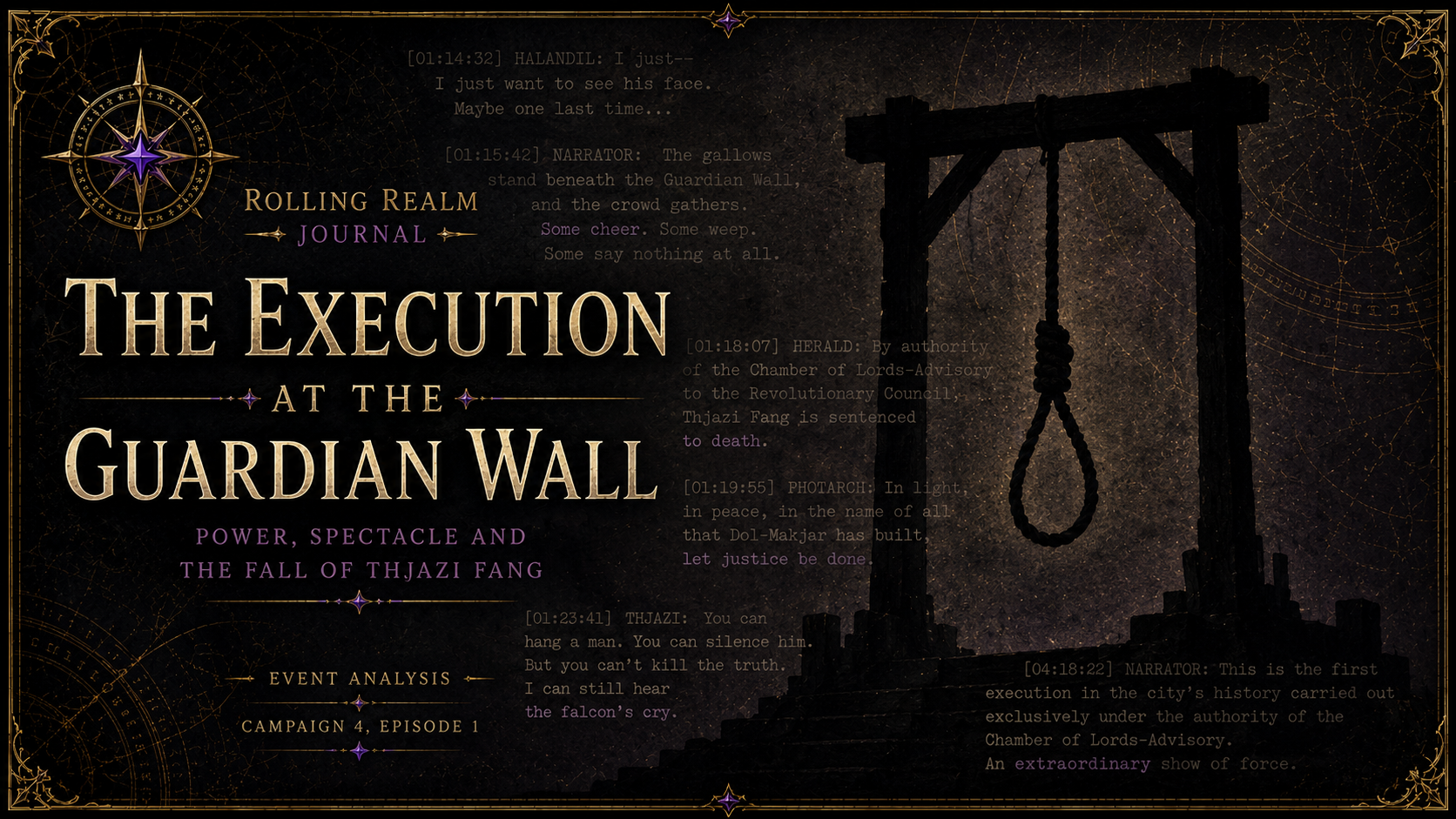
The Execution at the Guardian Wall
Power, spectacle and the fall of Thjazi Fang
Thjazi Fang is hanged beneath monuments to the heroes of an older revolution. The crowd, the failed rescue and the Photarch’s decision leave more questions than the public ceremony answers.
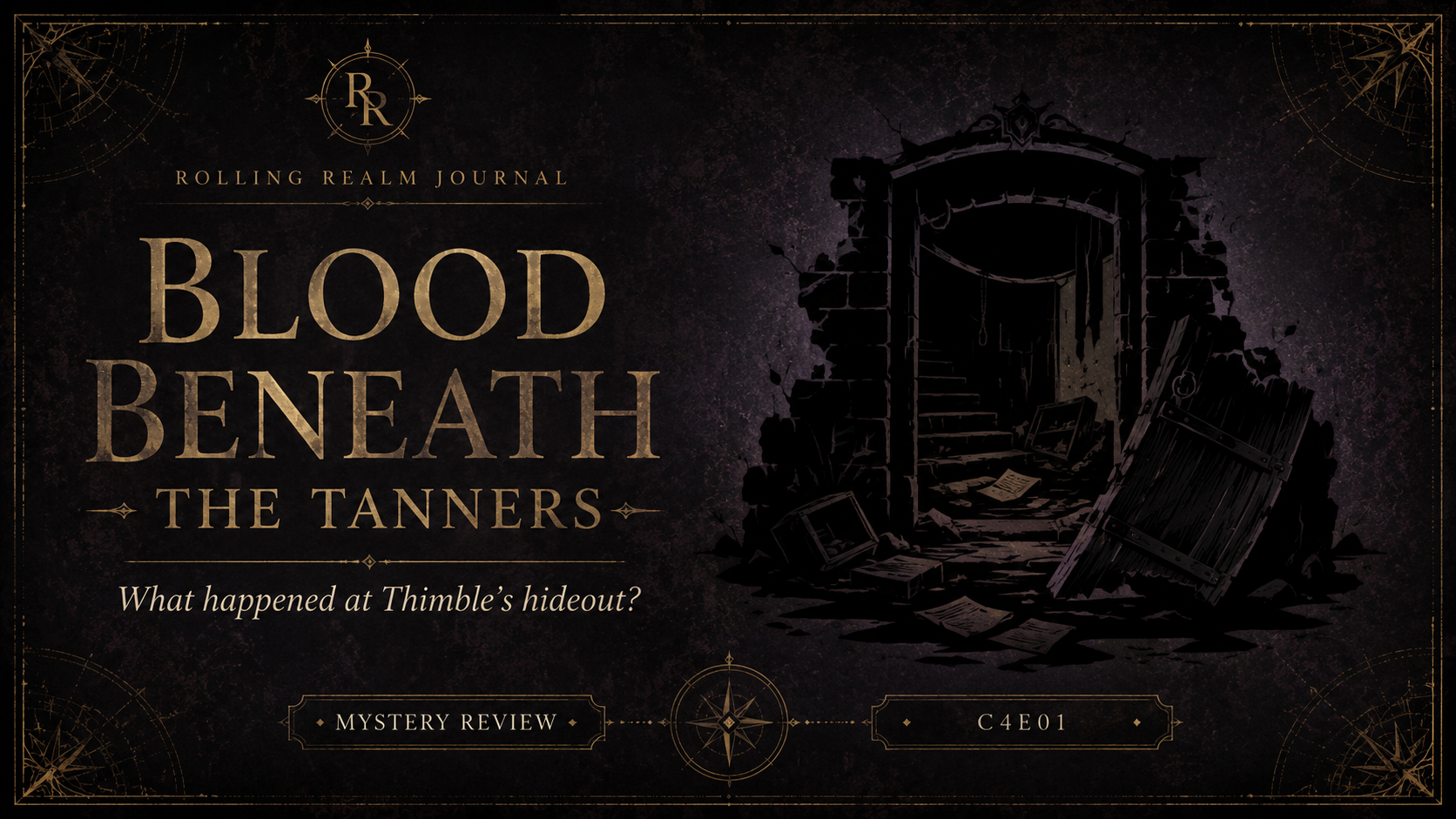
Blood Beneath the Tanners
What happened at Thimble’s hideout?
Fresh blood, a hidden staircase and a room torn apart lead to one of Episode 1’s largest mysteries: who attacked Thimble, how did they find the hideout and what were they really trying to take?