The Farramh at Halandil’s House
How death brings the people of Dol-Makjar together
Thjazi Fang’s Farramh turns Halandil’s family home into a meeting place for old soldiers, nobles, arcanists, rivals and loved ones. The gathering reveals an orcish mourning custom while drawing together the unfinished stories of Episode 1.
Watch the supporting moments
The ceremony begins on the day of death or as soon afterwards as possible, with the body placed for viewing.
When Halandil Fang returns from the Guardian Wall, his daughter is setting the table.
She is not preparing an ordinary family meal. Shadia Fang is getting the house ready for the Farramh, the mourning ceremony that begins on the day of a death or as soon afterwards as possible.
For a moment, habit takes over. She starts placing plates as though everyone will sit down together. Halandil gently lowers her hand. The table is where Thjazi Fang will be laid out for the people who loved him.
This is where most of Episode 1 takes place after the execution. One modest home in the Rookery becomes a place for grief, old customs, political anger, family reunions and new mysteries.
By the end of the night, almost every part of Thjazi’s life has passed through Halandil’s door.
The mourning begins as soon as it can
The transcript gives us a simple explanation of the Farramh.
In orcish custom in Kahad, the grieving begins on the day of death, or as soon as possible afterwards. The body is placed for viewing so family, friends and others who knew the dead can come to pay their respects.
Episode 1 does not explain every stage of the ceremony. We do not yet know how long a Farramh normally lasts or what final rite brings it to an end. What we see is the beginning: the home is prepared, the body is returned, offerings are gathered and the door remains open to mourners.
The setting matters. This is not a grand temple or a noble hall. It is the Fang home, a house built for family dinners, visiting friends and people passing through. The same large room that normally holds laughter and food now has to hold a body.
That makes the grief feel close. Thjazi is not kept apart from ordinary life. He is brought back into the home where so many pieces of his life were already waiting.
Azune carries Thjazi inside himself
The Revolutionary Guard brings Thjazi’s body to the house on a cushioned carrying surface. A white funerary sheet from the Candescent Creed and House Halovar covers him.
Azune Nayar looks at the formal arrangement and says it feels wrong. He lifts Thjazi from it and carries him inside himself, leaving the sheet behind on the street.
The act is personal. Years earlier, during the Falconer’s Rebellion, Thjazi carried an injured Azune through a battlefield. Now Azune carries him for the last time.
Before Halandil sees his brother, Azune smooths away the fear and panic left on Thjazi’s face. He tries to give him some look of peace.
Nothing can undo the execution. But the people closest to Thjazi can still decide how he enters the family home and how he will be remembered there.
A life is rebuilt through small objects
Once Thjazi is inside, the room slowly changes around him.
Shadia places candles. There is a dish of coins, bottles of Thjazi’s favourite liquor and a small tin box filled with old orcish rune stones from childhood. Other belongings begin to gather around the body.
The objects are not chosen because they are valuable. They matter because they belonged to him or remind people of who he was.
Many of Thjazi’s possessions were already in Halandil’s house. His life had become dangerous enough that anything he could not grab during a quick escape was kept with his family. His tools stayed with him, but his memories were left somewhere safer.
The Farramh brings those memories back together. The candles, coins, drink, rune stones and other treasures form a picture of Thjazi that the public execution could not show.
At the Guardian Wall, he was a condemned prisoner. At the Farramh, he becomes a brother, uncle, friend, soldier, rebel and adventurer again.
The Old Path gives the body protection
The Farramh is described as an orcish custom, but some of the rites around Thjazi come from the Old Path.
When Loza Blade approaches the body, she takes a piece of jasmine, places it behind Thjazi’s ear and kneels beside him. She whispers an old prayer in a mixture of orcish and Druidic.
Its meaning is simple: she hopes the path to the next life is set with flowers.
Later, the episode tells us that the candles, coins and treasures placed by loved ones do more than honour the dead. Together, they create a protection around Thjazi.
This is important because the protection is not only symbolic. Something can cross it, and when that happens, the house notices.
Episode 1 does not explain every rule of the Old Path or what the protection was meant to prevent. It only shows that the dead are not left unguarded.
The house welcomes people who would rarely share a room
The guests reveal how many different lives Thjazi lived.
Family members arrive first. So do neighbours and people who knew him when they were young. Former fighters from the Falconer’s Rebellion and the old Torn Banner come to pay their respects. Members of the Revolutionary Guard enter the same house as illegal arcanists and people from Dol-Makjar’s criminal world.
The Candescent Creed is represented by Wicander Halovar and Tyranny. House Royce arrives through Aranessa, while Sir Julien Davinos enters as her escort. Bolaire Lathalia, Murray Mag’Nesson and others from Thjazi’s stranger circles also find their way inside.
One home holds family, soldiers, nobles, priests, criminals and arcanists.
That does not mean they trust one another. The Farramh gives them a place to stand together, but it does not remove their history.
New guests have to learn the rules
Tyranny has never attended a funeral before.
She enters a family home carrying Thjazi’s scimitar and has little idea how mortals are expected to behave around the dead. Olgud begins explaining the basics: this is someone’s home, they are not going to raid the kitchen, and there are lines that should not be crossed.
The scene is funny, but it also shows what the Farramh does. It brings outsiders into a family custom and asks them to respect it.
The Fang home already carries old protections. A cold-iron nail above the door burns hot when Tyranny approaches, reacting to her demonic nature. Yet she is still allowed inside because she has come with Wicander and is carrying something that belongs to Thjazi.
The house is guarded, but not closed.
That balance runs through the entire ceremony. People are welcome to mourn, bring offerings and speak with the family. They are not free to treat the home or the dead however they please.
Grief does not erase old anger
The Farramh gives people a place to remember Thjazi, but each person remembers someone different.
Aranessa comes to mourn the husband she remained tied to across years of separation. Wicander arrives carrying the weight of a promise that failed. Loza sees the reckless fighter she once knew. Azune and Teor remember a leader from the rebellion. Occtis remembers someone who helped him as a child.
Julien remembers an enemy.
The room therefore holds more than grief. It holds blame, guilt, love and old political wounds. Aranessa openly challenges House Halovar’s claim that it worked to save Thjazi. Halandil questions Wicander in private. Thaisha’s anger follows Julien through the house.
The ceremony does not settle any of these conflicts. It gives them a place to surface.
That is one of the clearest things Episode 1 shows about mourning: people do not arrive with the same story of the dead. The Farramh has to hold all of those stories at once.
Thjazi’s magical world arrives late
When Murray enters, another part of Thjazi’s life comes through the door.
She brings cranberry rolls and his favourite Yahrgraz. Around her are arcanists and occult figures such as Tashmara Cobblegrave, Uncle Emerald and Davrasi Gaunt.
Their arrival changes the feeling of the room again. The gathering is still a funeral, but it is also a reunion, a place where people exchange names, make plans and reconnect with contacts they have not seen for years.
This does not make the grief less real. It shows how mourning works in a crowded life. People cry, drink, remember, argue and sometimes talk business in the same room.
Thjazi knew people across many hidden parts of Dol-Makjar. The Farramh is the first time we see just how wide that circle was.
Julien crosses the protection around the dead
While the room is distracted, Julien approaches Thjazi’s body.
No named person directly sees what he does. He waits until he appears to be alone, leans over the body and spits on it.
Later, as Julien leaves, the cold-iron nail above the door glows. Bolaire senses that the Old Path protection around Thjazi has been crossed. A small shadow-like presence follows Julien out into the Rookery.
The transcript does not tell us exactly what the shadow is. It does not confirm whether Julien summoned it, released it or simply drew its attention.
What it does confirm is that his act had a result beyond the insult itself. The protection around Thjazi was real, and Julien crossed it.
The Farramh therefore becomes more than a place where characters meet. It is also the source of one of Episode 1’s supernatural mysteries.
Even an accusation has to pause for grief
Near the end of the night, Vaelus enters the house seeking the Stone of Nightsong.
She calls Thjazi a thief and asks to see his belongings. Halandil refuses to let his brother’s death become a public spectacle and asks her to explain what she wants.
Vaelus is ancient, angry and far from home. Yet when Murray reminds her that she is standing among grieving loved ones, Vaelus stops. She apologises and admits that she has forgotten what grief is like.
That moment shows the strength of the custom. The Farramh cannot remove Vaelus’s claim, but it makes even her recognise that there is a time and place for it.
She remains in the house. Food and drink are offered. The accusation is not forgotten, but it is made to wait.
The ceremony ends the episode without ending
Episode 1 closes while the Farramh is still underway.
Vaelus asks about Thimble. Upstairs, Thaisha Lloy has taken Halandil to retrieve a silver box she believes is connected to one of Thjazi’s final requests.
When Thimble’s name is spoken, the box flies open. Black clay and velvet begin forming a mask like Bolaire’s.
The ceremony began as a way to say goodbye. By its final moments, it has gathered nearly every mystery Thjazi left behind into one house.
The stolen Stone, the missing Thimble, the crossed protection, the shadow following Julien and the mask in the box all now sit beside the family’s grief.
The Farramh is not finished when the episode ends. Neither is Thjazi’s story.
What Episode 1 confirms
From the transcript and audited archive, we can say that:
- a Farramh begins on the day of death or as soon afterwards as possible;
- the body is placed for viewing so loved ones can pay their respects;
- Shadia prepares the Fang home before Thjazi arrives;
- Azune carries Thjazi into the house and helps place him for viewing;
- candles, coins, liquor, flowers and personal belongings are arranged around the body;
- Loza performs a traditional Old Path farewell;
- the offerings around Thjazi form a protection;
- family, former comrades, guards, nobles, religious figures, arcanists and criminal associates attend;
- Wicander returns Thjazi’s scimitar during the gathering;
- Julien secretly spits on Thjazi’s body;
- the Old Path protection is crossed and a shadow follows Julien away;
- Vaelus arrives seeking the Stone of Nightsong;
- the silver box opens while the Farramh is still taking place;
- the ceremony remains unfinished at the end of Episode 1.
What remains unknown
Episode 1 does not yet tell us:
- every stage or final rite of a Farramh;
- how long the ceremony usually lasts;
- the full meaning of every offering placed around the dead;
- what the protection around Thjazi was meant to do;
- what the shadow following Julien is;
- whether the mourners will learn what Julien did;
- how the ceremony will change when Thimble returns;
- whether Vaelus will remain long enough to take part in the later rites;
- how the awakened mask is tied to Thjazi, Thimble or Bolaire.
These are open questions. The transcript gives us the beginning of the ceremony, not its complete history.
One house holds the whole episode
The Fang home begins Episode 1 as Halandil’s family house.
By nightfall, it has become a map of Thjazi’s life.
His brother and children are there. So are his old soldiers, his estranged wife, the man who captured him, the people who tried to save him, the arcanists who knew his secrets and the ancient stranger who accuses him of theft.
The Farramh brings them together because Thjazi is dead. It also shows why his death cannot bring easy closure.
Every person who enters carries another memory, debt or mystery through the door.
All factual statements in this article are drawn from the Episode 1 transcript and audited archive records. Character claims remain attributed to their speakers, and interpretive ideas are presented as insight rather than confirmed canon.
Enjoyed this analysis?
Rolling Realm remains free for everyone. Optional support helps with continued research, development and episode coverage.
Support Rolling Realm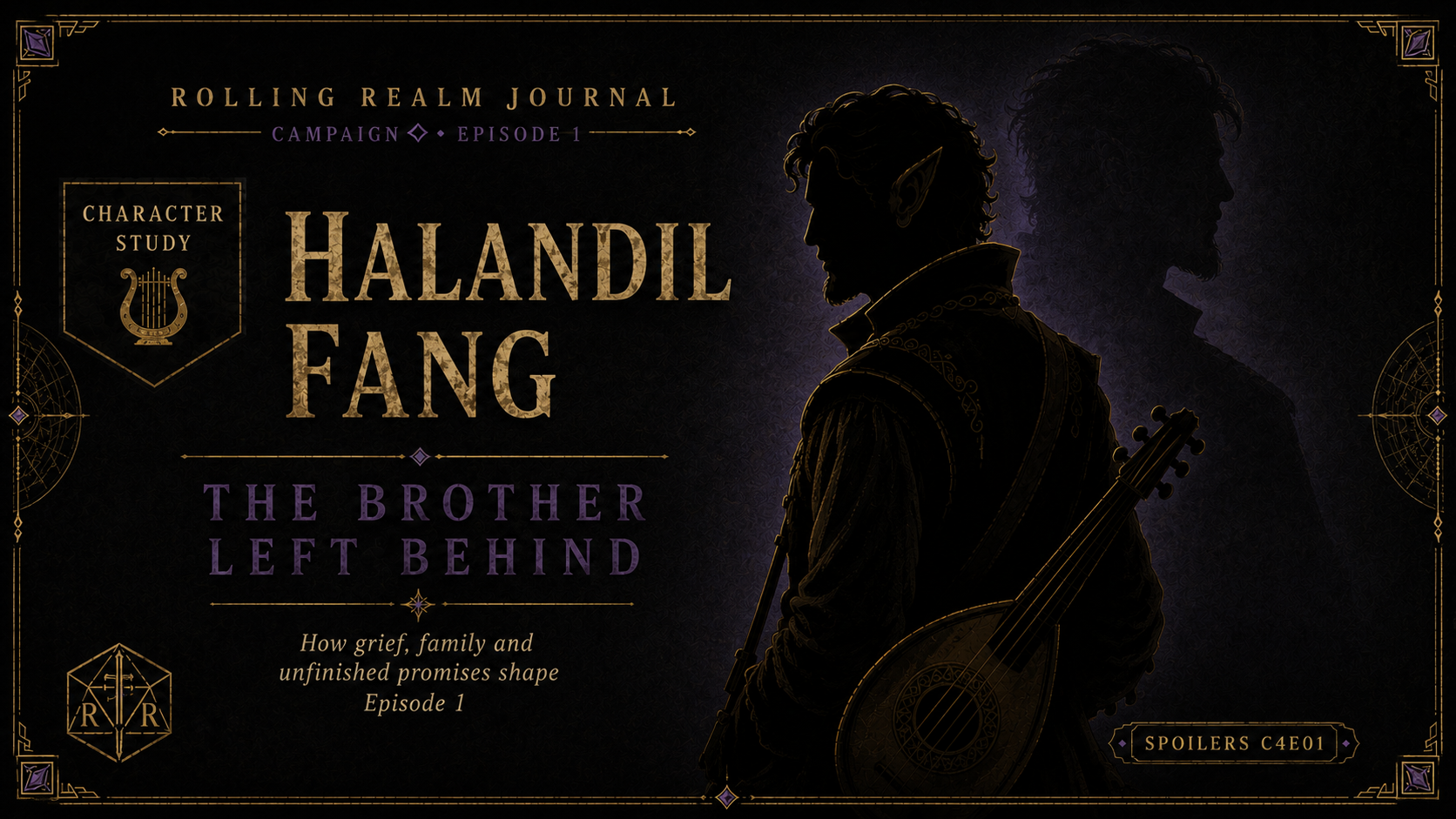
Halandil Fang: The Brother Left Behind
How grief, family and unfinished promises shape Episode 1
Halandil Fang begins Episode 1 trying to save his brother and ends it surrounded by the family, mysteries and unfinished promises Thjazi leaves behind.
What We Learned from Critical Role Campaign 4, Episode 1
Consequence, authority and the mysteries left behind in Dol-Makjar
Episode 1 begins with Thjazi Fang’s execution, a rescue that has already gone wrong and a wake full of old friends, enemies and secrets. Here are the main pieces of lore it leaves behind.

Thjazi Fang: The Dead Man at the Centre of Episode 1
What the people around him reveal about the man behind the gallows
Thjazi Fang dies at the beginning of Campaign 4, but Episode 1 keeps rebuilding him through the brother, soldiers, wife, friends and enemies he leaves behind.