Sanctuary with Teeth
A long road leads to richer character work, strange comedy and a sanctuary whose safety comes with an oppressive edge.
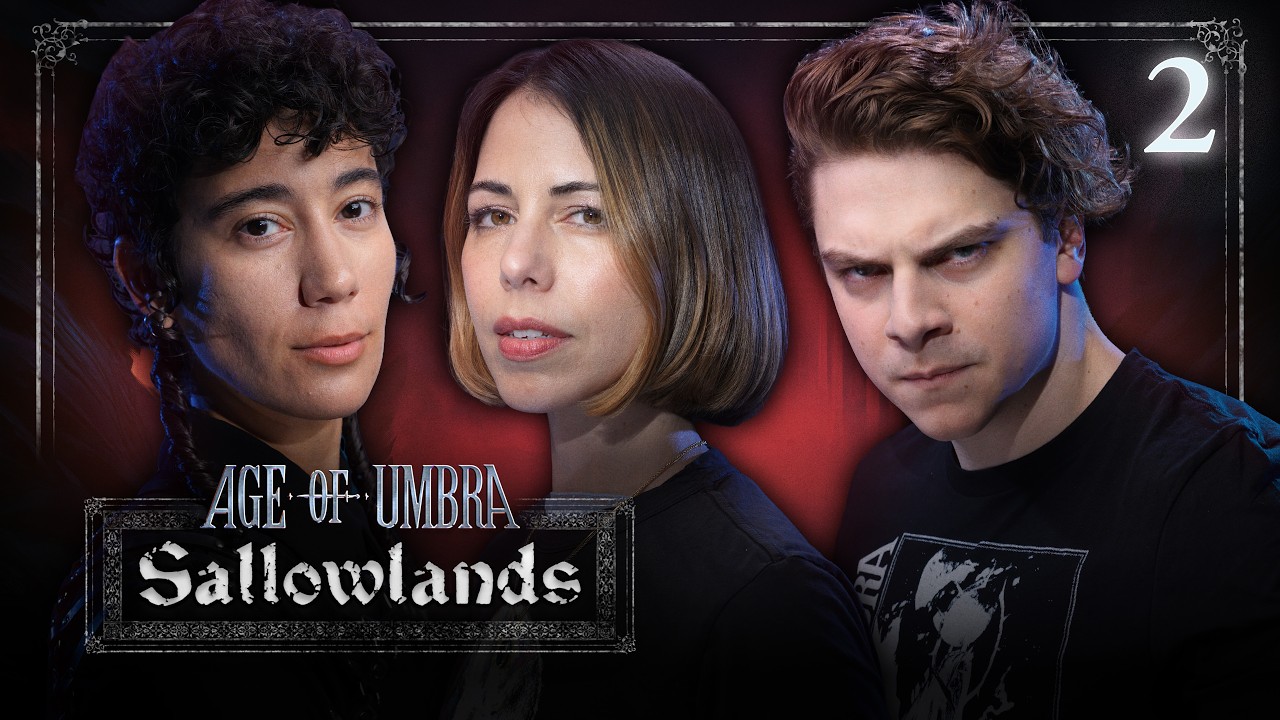
A confident second episode that replaces the premiere’s extended combat with richer character work and outstanding religious horror. Its journey still runs long, but the Tower of Oxudos gives the Sallowlands a compelling new centre of power, safety and fear.
What worked & what held it back
- The five travellers deepen their relationships without losing their disagreements
- The Tower of Oxudos is a superbly realised sanctuary with an oppressive edge
- Mercy, Caguama and Alphonse give the episode competing ideas about faith, hope and responsibility
- Stygs’ Company brings warmth and absurdity without feeling disconnected from the setting
- The final scene turns suspicion into a clear and immediate threat
- More than half the episode passes before the party reaches the tower’s perimeter
- Another extended travel countdown risks repeating the premiere’s slow middle
- The Stygs’ Company trade lasts longer than its narrative purpose requires
- Rules explanations and arithmetic occasionally interrupt otherwise strong scenes
The Onyx Spire deepens the party through intimate conversations, strange comedy and a destination that transforms the shape of the story. The road remains longer than it needs to be, but the episode’s character work and exceptional final act make it a clear step up from the premiere.
Spoiler warning: This review discusses Age of Umbra: Sallowlands Episode 2 in full, including the Tower of Oxudos and the episode’s ending.
New to the miniseries? Read our spoiler-free Sallowlands cast, schedule and viewing guide. Catching up from the beginning? Read our Episode 1 review.
The party now has room to disagree
Episode 1 brought five strangers together through rescue, danger and compassion. Episode 2 asks what happens once they have enough safety to speak honestly.
The answer is not harmony.
Alphonse challenges Caguama over the decision to spare the Tatchra. Caguama sees a broken remnant of the Old World that may still contain something worth reaching. Alphonse sees a killer allowed to escape and possibly endanger the next travellers who cross its path.
Neither position is treated as foolish. Caguama accepts that the creature may hunt others. Alphonse’s anger is tied to a practical fear: compassion offered to one dangerous being may leave someone else exposed to its violence.
That disagreement gives the new party substance. They are no longer united only because the story has placed them on the same road. They have different answers to the question at the heart of the Sallowlands: when something has been corrupted, how long should anyone continue searching for the person or purpose it once held?
Vico Ortiz plays Caguama’s fear and conviction together. Their optimism is not ignorance of the danger. Caguama remembers having to destroy the body of Osha after her death, even while believing that her soul would still join the Umbra. Their refusal to abandon hope emerges from loss rather than innocence.
Zachery Renauldo gives Alphonse an equally persuasive severity. The skull mask, distrust of the Old World and insistence that mortalkind must adapt all suggest a person trying to survive by refusing nostalgia. His argument with Caguama is harsh, but it is not empty cruelty.
The scene ends without agreement. That restraint makes it one of the episode’s strongest exchanges.
Mercy turns resurrection into a question of purpose
Mercy continues to be the party’s most visually grotesque character and one of its gentlest.
During the long rest, he repairs his body by pressing dead flesh against himself and allowing the fungril to consume its moisture. The description is revolting. The conversation with Sister that surrounds it is tender.
Abubakar Salim finds a quiet sadness beneath Mercy’s hesitant speech. Mercy does not remember what his hands did before his rebirth, but he believes that receiving a second chance creates an obligation to do good. His hope comes not from certainty about his former life but from deciding what this life should become.
Sister’s response is crucial. She does not merely reassure him that he is useful. She calls him beautiful.
Laura Bailey plays Sister with an unusual mixture of distance, affection and guilt. She created the conditions that gave Mercy new life, yet the scene leaves open whether that magic was wholly kind. Mercy himself describes his existence as both a blessing and a curse, while Bowen’s later reaction shows that others may not accept what she created.
The episode repeatedly allows other people to turn Mercy into a symbol. Bowen fears how the Twilight Exemplars will react to him. Alphonse advises Mercy that some will call him an omen and others a miracle. Sister later presents him as evidence that a new age of miracles may already have begun.
Mercy listens to those interpretations, but his strongest moment comes when he defines himself.
At the gates of the Tower of Oxudos, he explains that frightened people once struck him while shouting for mercy. In his innocence, he believed they were giving him a name. He then turns that misunderstanding into an appeal: everyone before the tower is seeking mercy, and granting it should be part of faith.
It is a beautifully constructed piece of character work. Mercy takes a history of rejection and uses it to argue for welcome rather than revenge.
The journey is more varied, but still too long
The episode’s early travel is stronger than the weaker stretches of Scattered Pilgrims because each complication changes the group’s situation.
Resting in the Rotten Shallows leaves most of the party sickened. Escaping the marsh rewards them with a brief sunrise and the sight of green light around the distant mountain. The Sallow Opens then replace poison and rot with dust, exposed ground and a storm large enough to erase the horizon.
The Sickened die is a good idea because it turns an apparently sensible choice—taking a long rest—into a consequence carried into later scenes. The die penalises every action roll. When healing would clear hit points, a player can instead reduce the die by the same amount, forcing the group to choose between treating illness and repairing injuries.
The land does not merely attack during a contained encounter. It changes the value of decisions after they have been made.
The dust storm also produces clear collaborative action. Mercy shields the others with his body. Dillywin uses her knowledge of the wastes to guide them, with Sister bracing herself so Dillywin can gain height. Caguama climbs high enough to recover their direction, while Alphonse provides rope to keep the group together.
These contributions are easy to picture, and the danger feels different from the poisonous marsh.
The problem is accumulation. Episode 1 already devoted a large part of its middle to sequential travel challenges and visible countdowns. When another four-step journey counter appears, even the players joke about how many countdowns they have encountered.
The countdown gives everyone a meaningful contribution, but the pattern is already familiar. Each new obstacle now needs a stronger identity to avoid feeling procedural.
This journey largely succeeds because the storm has a powerful physical presence and because it leads into Stygs’ Company. Even so, more than half the episode passes before the party reaches the tower’s militarised perimeter, and sanctuary is not granted until considerably later.
The road contains good material. It simply occupies too much of the episode.
Stygs’ Company makes survival strange and funny
Stygs’ Company initially appears to be another group preparing to strip the travellers of everything they own.
Armed figures surround the party. Bowen begins removing his armour. The group reluctantly adds gold, blood, skulls and personal belongings to a growing pile. Then Edra Stygs emerges and reveals that this is, technically, a trade.
The sequence is a wonderfully ridiculous introduction to a faction whose ethics make sense only after accepting the conditions of the Sallowlands. Its members are coercive raiders and traders operating according to a code that is threatening, strange and apparently sincere.
Edra’s rule is internally consistent: take something, leave something. The party misunderstood the process because Stygs’ Company presented a transaction like an armed robbery.
Matthew Mercer gives Edra immediate authority without making her humourless. The scene becomes even better when she recognises Caguama as the “turtle tyke” from her childhood.
Caguama’s bird puppet, Mr. Beaks, then turns a hostile negotiation into an emotional reunion.
The scene is absurd, but it also develops Caguama’s history. Their compassion is not limited to dramatic gestures toward legendary creatures. They once carried entertainment and kindness through the Sallowlands, and Edra remembers that small joy decades later.
The resulting trade gives the party several damaged and only partly understood objects, including a magical weapon and an unfolding wooden glider. They feel scavenged rather than conveniently awarded, which suits a setting where useful things survive in altered and imperfect forms.
The scene does overstay its welcome. Once Edra recognises Caguama and the misunderstanding becomes a trade, the extended examination of every item delays the tower without adding much tension.
Fortunately, the cast remains funny enough to keep the sequence enjoyable.
The Tower of Oxudos is the episode’s real achievement
The Onyx Spire is magnificent from a distance.
It rises from an ancient island pillar, surrounded by walls, soldiers, ballistae and terrifying chain-driven cages that carry people hundreds of feet into the air. Forests appear to grow across levels of the tower. Black stone, silver trim and religious carvings make it look like a gothic sanctuary preserved above a dead lake.
Inside, it becomes something more complicated.
The tower contains families, healers, farms, workshops and hundreds of people sustaining a functioning vertical city. Compared with the scattered settlements and ruined landscapes outside, this is one of the clearest demonstrations that civilisation has endured.
It is also immediately oppressive.
Every stranger is watched. Soldiers patrol the balconies. Places of worship appear almost as frequently as the structures required to feed and house the population. Petra describes the tower’s survival as the result of keeping blasphemy outside its walls.
The episode never reduces this tension to a simple revelation that the sanctuary is secretly false. Its safety is real. Its food, medicine and protection are real. Lorraine’s treatment removes the sickness carried from the marsh. People have built lives and raised families there.
That is what makes the tower disturbing.
Its faith is bound up with real order and preservation, but so are surveillance, exclusion and punishment. The question is not whether the tower protects people. It is what its leaders believe that protection allows them to demand in return.
The promised city is becoming harder to dismiss
The tower also gives the travellers their clearest view yet of the promised city.
From the rising cages, the group sees that it is far larger than they understood and that water has returned to part of the dead lake. The sight expands the promise drawing them south, but it also makes that promise more difficult to explain.
Later, Alphonse questions an older resident who says that the city appeared about three months earlier after a terrible cracking sound. During that conversation, Alphonse alone sees an airship descend through the clouds before reporting it to the others.
The most unsettling detail is not the airship itself.
When Alphonse asks whether the city is becoming larger, the resident cannot offer a clear answer. He becomes caught on its beauty instead.
The scene does not confirm that the city is enchanting people, expanding or deliberately drawing them toward it. Alphonse interprets the man’s reaction as uncanny, and Caguama wonders whether enchantment could be involved.
That uncertainty is more effective than an answer. The city no longer feels like a simple destination. Its presence may already be changing how people think about the land around them.
Faith provides shelter until someone asks the wrong question
The party’s entrance into the tower depends on presenting themselves in language its leaders will accept.
Caguama speaks of surviving the Apostasy and seeking the prophet. Sister describes a coming age of miracles. Alphonse reveals a divine inscription. Mercy asks for the compassion that faith claims to offer.
Their group Presence sequence works because it turns persuasion into a shared statement of identity. The mechanic does not simply ask which character has the highest social modifier. Each person contributes a reason they should be allowed through the gate.
The sequence culminates in Caguama spending three Hope on a Tag Team with Sister, allowing their very different appeals to become one final case for sanctuary.
Petra grants them refuge, but her welcome remains conditional. They may rest, worship and perhaps become part of the community. Their request to meet Oxudos will be passed upward, with no promise that the prophet will agree.
The episode then makes Oxudos’ inaccessibility increasingly suspicious.
Bowen has lived at the tower his entire life without seeing him. Lorraine has not seen the prophet since she was young. She remembers him as driven and powerful, but becomes uncomfortable when Caguama asks whether the tower intends to bring healing beyond its own walls.
None of this proves that Oxudos is dead, imprisoned, fraudulent or absent. It does show that his authority remains active while personal access to him has almost disappeared.
Oxudos’ authority is exercised by people who interpret his edicts while ordinary residents appear to have almost no access to him.
That is an unsettling arrangement even before the episode shows how those interpretations are enforced.
The ending reveals what sanctuary costs
The final scene is devastating because it happens in public.
A frightened man found with allegedly blasphemous texts is branded a “Horizon Speaker” and accused of spreading “the word of the Horizons.” Petra marks his face with light, declares him exiled and has him thrown from the tower.
His guilt is not independently established. Neither is the truth of his claims.
He calls the tower’s faith false and urges the crowd to demand answers. The episode does not yet tell us whether he is a reliable source, a frightened dissident, a dangerous zealot or some mixture of all three.
The horror lies in the response.
The gates close. The crowd returns to work. The city resumes its normal rhythm as though nothing exceptional has occurred.
The ending suggests that the tower treats the suppression of questions as part of protecting its survival. The watchful glances, Petra’s suspicion, Lorraine’s discomfort and the inaccessible prophet no longer feel like separate warnings. They become parts of a system willing to destroy someone publicly and call the act protection.
It is an excellent cliffhanger because it gives the travellers an immediate moral problem without resolving the larger mystery.
They came seeking Oxudos, healing and information about the promised city. They have found shelter, but they now know what may happen to people who challenge the story holding that shelter together.
Final thoughts
The Onyx Spire is a stronger and more confident episode than the premiere.
Its best scenes allow kindness, faith and fear to overlap rather than assigning them to obvious heroes and villains. Caguama’s compassion accepts the risk of consequences. Alphonse’s suspicion may protect people. The Tower of Oxudos offers genuine refuge while its leaders enforce obedience through terror. Mercy is called both omen and miracle, then asks to be judged by what he chooses to do.
The journey remains too long, and the repeated countdown structure is beginning to show its seams. Stygs’ Company also holds the road for longer than necessary.
Those weaknesses matter, but they do not define the episode.
The character conversations give the party genuine ideological differences, while the Tower of Oxudos is beautiful, useful, devout and frightening. It may be the safest place the travellers have encountered.
By the end, that safety feels like a threat of its own.
Sources
- The Onyx Spire | Age of Umbra: Sallowlands | Episode 2Critical Role
- Critical Recap: Age of Umbra — Sallowlands Episode 2, The Onyx SpireCritical Role
- Age of Umbra: Sallowlands CreditsCritical Role
Enjoyed this article?
Supporting Rolling Realm helps fund more independent reviews, lore guides and spoiler-aware coverage. Every article remains free.

Age of Umbra: Sallowlands Episode 1 Review: Beauty in the Ruins
A grotesque, compassionate premiere builds an instantly memorable party, even when its first battle and repeated travel challenges slow the episode.
Scattered Pilgrims introduces a vivid dark-fantasy party and ends with an exceptional act of compassion, although its long first battle and repeated travel challenges weaken the middle.
Age of Umbra: Sallowlands — Cast, Schedule and Where to Watch
Matthew Mercer leads a new standalone Daggerheart story through six weeks of dark fantasy in the Halcyon Domain.
A spoiler-free guide to the cast, characters, weekly schedule, UK release times and viewing options for Critical Role’s six-part Daggerheart miniseries.
Sallowlands Episode 2: What We Learned
Stygs’ Company, the Tower of Oxudos and a newly appeared city beside water returned to part of the dead lake.
The Onyx Spire reveals a mobile trade company, a failed religious expedition, a fortified vertical sanctuary and a newly appeared city beside water returned to part of the dead lake.