Beauty in the Ruins
A grotesque, compassionate premiere builds an instantly memorable party, even when its first battle and repeated travel challenges slow the episode.


A vivid, compassionate dark-fantasy premiere whose cast and final act make the journey worth taking, although its first battle and travel-heavy middle both last longer than they need to.
What worked & what held it back
- Immediate chemistry between five distinctive, compassionate characters
- A grotesque Sallowlands setting with genuine beauty beneath its horror
- Cagauma and the Tatchra deliver an exceptional final encounter
- Hope, Fear and countdowns make survival feel collaborative
- The bounty-hunter battle occupies almost fifty minutes
- Repeated travel challenges flatten the middle of the episode
- Rules and playtest explanations occasionally interrupt the momentum
Scattered Pilgrims introduces its party by letting them mistake one another for threats, choose strangers over safety and meet a legendary monster with compassion instead of a killing blow.
That pattern gives Age of Umbra: Sallowlands a strong identity from its first episode. This is a grotesque world full of bodies that should not still be moving and creatures twisted beyond recognition, but the people crossing it remain curious, funny and capable of care.
The premiere does not sustain that focus throughout its full runtime. Its first combat runs long, and a second extended stretch of travel makes the middle feel more repetitive than dangerous. The cast and final act are strong enough to carry it.
Spoiler warning: This review discusses Age of Umbra: Sallowlands Episode 1 in full, including the Tatchra encounter and ending.
New to the miniseries? Read our spoiler-free Sallowlands cast, schedule and viewing guide.
The party feels alive almost immediately
The episode begins with Sister moving alone through Rustsaw Wood. Laura Bailey gives her a careful physical rhythm: the staff strikes the ground before each step, while the fungril network she has left behind grows quieter in her mind. The scene establishes loss before it establishes danger.
Then a large shape rushes from the trees and Sister lands a critical hit.
Mercy’s entrance is an excellent piece of character comedy because the joke never erases the horror. Abubakar Salim describes a corpse-like fungril whose damaged jaw hangs loose before silver spores begin stitching it together. Mercy forgives the attack without resentment, while Sister answers through threads of mycelia that she had warned him to show himself.
Dillywin follows from the canopy with Badger, her enormous pig-like bat. Jennifer English gives Dillywin restless movement, blunt emotional insight and an immediate trust in anyone who smells right. The three characters should look alarming beside one another. Instead, their odd tenderness makes them feel like a travelling family within minutes.
That chemistry is the premiere’s greatest strength. The players establish existing affection without closing the group to newcomers. Alphonse and Cagauma are absorbed because the first three characters have already shown that helping someone matters more than understanding everything about them.
The Sallowlands are horrible in the right ways
Matthew Mercer makes the region feel diseased rather than merely empty.
Rustsaw Wood is all tangled red-brown growth, dead branches and predators moving beyond sight. The Crust of the Lake Tomb rises around a dry lakebed that has collapsed into dust and salt. The Rotten Shallows turn preserved corpses into part of the landscape, their final motions repeating long after life has gone.
The descriptions are dense, but they usually give players something to touch, climb, smell or fear. The party does not receive a lecture about a ruined world. They discover it through the silence of dead trees, the scarcity of water and the evidence left by things large enough to break paths through a forest.
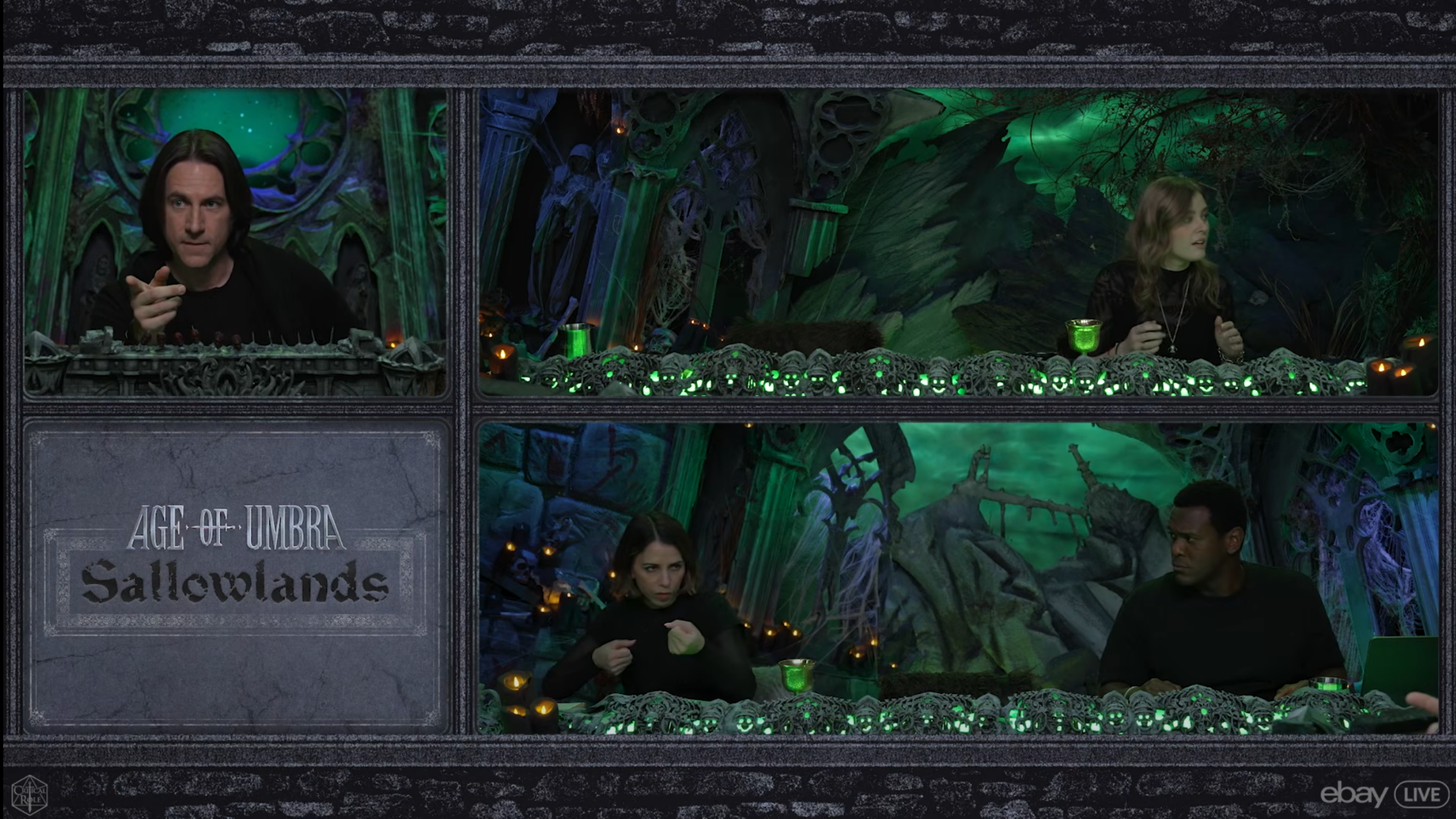
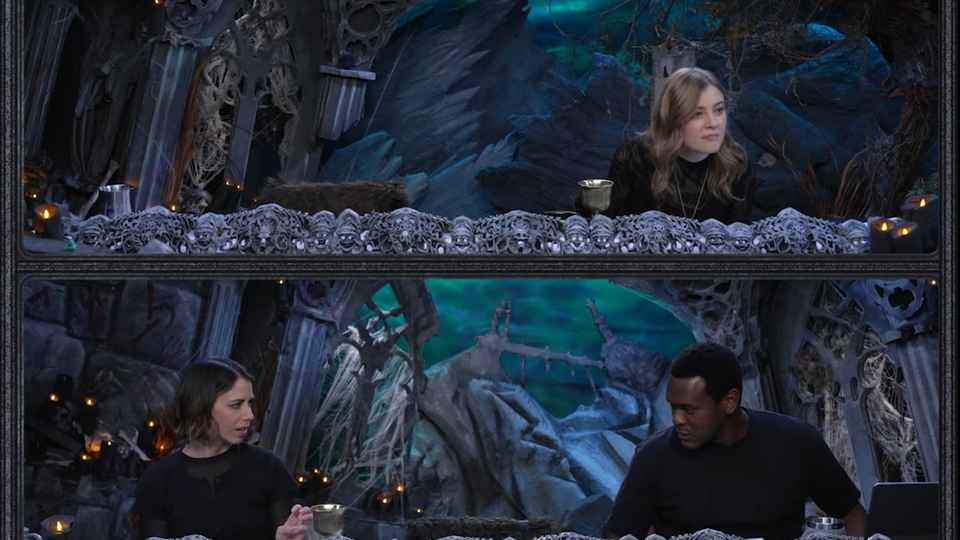
The visual production supports that approach. The table, miniatures and lighting present the Sallowlands as a physical place without making the players compete with the set. The bounty-hunter battlefield communicates open danger; the Rotten Shallows later feel cramped and contaminated.
More importantly, the horror has history. The Tatchra is frightening because it was once a creature of wisdom and protection. Its corruption is not a random monster design. It is evidence of what the Apostasy has done to something beautiful.
Daggerheart makes survival collaborative
The premiere is a useful showcase for Daggerheart when it keeps the rules attached to decisions.
Mercy spends Hope to help Dillywin guide the group out of Rustsaw Wood. His assistance is not a numerical bonus added after the fact; Salim describes Mercy breaking and shifting trees to cover the group’s path. Dillywin then creates noise elsewhere to pull the pursuing creatures away. The mechanics ask each player how their character contributes.
The journey countdowns work for the same reason. A difficult landscape becomes a shared problem rather than one survival check made by the person with the highest modifier. Successes move the group forward, while Fear gives Mercer material for the next complication.
Hope and Fear also suit this setting. The players can succeed while still giving the GM currency, so progress rarely means safety. That keeps the pilgrimage uncertain without requiring every danger to become combat.
There are moments when playtest explanations slow the scene. New class features, adversary abilities and action-economy questions sometimes require the table to stop and establish how a rule works. That is understandable in a premiere using fresh material, but for a moment the scene feels more like a rules demonstration than a dangerous situation.
The first battle is too long
The choice that begins the bounty-hunter sequence is exactly right.
Badger reports that several people are chasing someone. Sister immediately says they should help, and Mercy’s attempt to draw the hunters away is driven by memories of being pursued without anyone coming to his aid. The decision reveals the party before Alphonse has even reached the table.
Zachery Renauldo then introduces Alphonse as a battered survivor in a skull-marked helmet, while Vico Ortiz brings Cagauma into the fight from the surrounding brush. The battle serves a clear purpose in the episode: it brings the full cast together through action rather than placing five strangers around a campfire.
It still occupies almost fifty minutes.
The bounty hunters are cruel enough to justify intervention, but they are not interesting enough to support that much combat. Several turns are spent clarifying ranges, reactions, damage thresholds and new abilities while adversaries try to escape. The encounter shows what everyone can do, but its outcome is clear well before the final enemy falls.
A shorter fight would preserve every important introduction. Alphonse would still reveal his endurance and rifle. Cagauma would still choose to intervene. Mercy would still become a terrifying protector. The party would simply reach its first real conversation sooner.
The quieter middle builds trust but repeats itself
After the break, the five characters finally have room to explain why they are travelling.
Alphonse doubts the promised city exists and suspects it may be a death trap, but he continues because other pilgrims are still heading towards it. Sister seeks an answer to the magical decline affecting her community. Mercy and Dillywin are following the same rumour. Cagauma carries memories of the Old World and a promise made to Osha.
These exchanges give the group an unusually convincing reason to remain together. Nobody declares a permanent party. They recognise that their separate losses point in the same direction.
The material is strongest when it stays personal. Cagauma and Sister share the strange isolation of people connected to a world that is disappearing. Mercy’s physical monstrosity sits beside a gentleness that others learn to trust. Alphonse’s suspicion prevents the city from becoming an uncomplicated quest marker.
The pacing weakens when another long journey sequence follows. The first countdown has already shown how the group works together against the environment. Repeating the structure across the approach to the Rotten Shallows adds useful lore, but it delays the episode’s strongest encounter without changing the relationships as much as the earlier journey did.
Cagauma turns the climax into something special
The final encounter begins like another fight.
The Tatchra is enormous, corrupted and capable of acting repeatedly during a GM turn. Its humanlike face pushes through a broken beak, and the party has every reason to treat it as a monster that must be killed.
Cagauma tries something else.
Ortiz asks what ails the creature from within rather than without. A critical Presence roll stops its violence long enough for Cagauma to recognise a consciousness seeking connection. What follows is not a safe or sentimental exchange. The Tatchra pulls Cagauma towards its mouth while the rest of the table struggles not to intervene.
The scene works because compassion remains frightening. Cagauma is not rewarded for identifying a harmless creature. They choose vulnerability in front of something that may still consume them.
Cagauma speaks about Osha, the family built through care and the promise to help beings that once lived full lives. When the Tatchra shares a glimpse of its former beauty, Cagauma leans close and tells it, “You are beautiful.”
That is the episode’s defining moment. The party survives not because it discovers a stronger attack, but because one character recognises the self still buried inside the corruption. It completes the theme established when Sister first mistook Mercy for a threat: appearances are dangerous in the Sallowlands, but so is assuming that horror has erased everything worth saving.
The Tower of Oxudos reveal then gives the party a clear destination for Episode 2. It is a simple cliffhanger after an emotionally complicated victory, and that restraint is welcome.
Verdict
Scattered Pilgrims is vivid, funny and more compassionate than its grim setting initially suggests.
Its cast is immediately distinctive. Mercy, Dillywin and Sister establish a warm, strange foundation; Alphonse adds necessary suspicion; Cagauma gives the episode its emotional conclusion. Mercer’s Sallowlands feel hostile without becoming monotonously bleak, and Daggerheart’s shared resources encourage the players to solve danger together.
The premiere is also uneven. The bounty-hunter fight is much longer than its enemies or outcome justify, and the repeated travel challenges make the post-break middle feel slower than the opening and ending.
An exceptional final encounter restores the episode’s purpose. By turning a legendary monster into a test of empathy, Sallowlands shows what kind of story it wants to tell: one where survival matters, but so does recognising the beauty that corruption has not completely erased.
Sources
Enjoyed this article?
Supporting Rolling Realm helps fund more independent reviews, lore guides and spoiler-aware coverage. Every article remains free.
Age of Umbra: Sallowlands — Cast, Schedule and Where to Watch
Matthew Mercer leads a new standalone Daggerheart story through six weeks of dark fantasy in the Halcyon Domain.
A spoiler-free guide to the cast, characters, weekly schedule, UK release times and viewing options for Critical Role’s six-part Daggerheart miniseries.
Hope, Fear and the Long Road: What Sallowlands Episode 1 Shows About Daggerheart Travel
The premiere turns survival into a shared problem, but repeated countdowns sometimes make the process more visible than the danger.
Sallowlands Episode 1 shows Hope, Fear and progress countdowns at their best when several players turn one journey into concrete shared action. Across repeated travel legs, however, the same visible resolution cycle can begin to flatten the danger it represents.
Friends Before Answers: How Sallowlands Builds a Party Through Compassion
Episode 1 makes five alarming strangers feel like a party by showing them choose care before certainty.
Episode 1 turns mistaken attacks, rescue choices and battlefield trust into a clear pattern: the travellers become believable friends because they care for one another before they have complete answers.