Hope, Fear and the Long Road: What Sallowlands Episode 1 Shows About Daggerheart Travel
The premiere turns survival into a shared problem, but repeated countdowns sometimes make the process more visible than the danger.

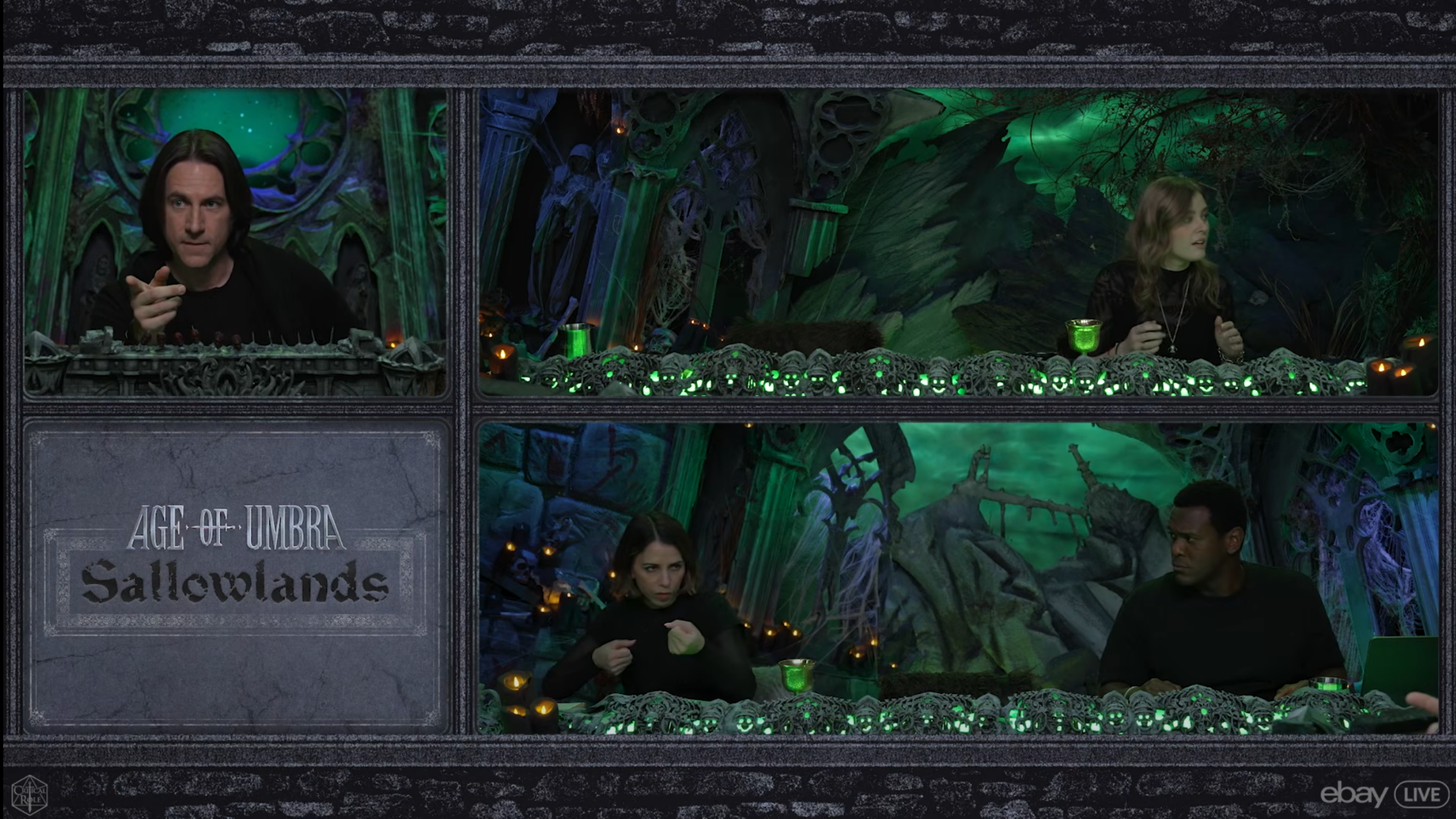
Age of Umbra: Sallowlands Episode 1 is strongest when a journey stops being one character’s navigation check and becomes a shared scene.
A player spends Hope to support someone else. The helper describes what their character is physically doing. A progress countdown gives several members of the party a reason to contribute. A successful roll with Fear lets the group move forward while the landscape produces a new problem.
Those ideas work. They make survival feel collaborative rather than administrative.
The premiere also shows the cost of putting the same resolution structure on several stretches of a long road. By the time the group reaches another travel countdown, the audience has already heard similar explanations, watched another die move towards zero and followed several rounds of proposing a skill, building a dice pool and resolving Hope or Fear. The danger remains vivid in the narration, but the procedure becomes increasingly visible.
Our Episode 1 review briefly identified both sides of that experience. This feature looks more closely at the actual rolls and distinguishes the design of the mechanics from how often the table uses them, how much explanation they require and how the finished programme presents them.
One classification matters before going further. Critical Role says Sallowlands uses some material from the forthcoming Daggerheart: Hope & Fear expansion, but Episode 1 does not identify these travel rules as expansion content. The current official Daggerheart SRD opens in a new tab already defines Help an Ally, Hope and Fear outcomes, reaction rolls and dynamic progress countdowns. Those mechanics already appear in the current core SRD, so this article does not treat them as expansion-exclusive. The episode does not provide enough evidence to classify its prepared environments or challenge stat blocks as core, Hope & Fear, playtest or table-specific material. The journey sequences use separate action rolls to advance shared countdowns; they are collaborative, but they are not presented as the formal Group Action Roll procedure.
Assistance works best when the bonus becomes action
The escape through Rustsaw Wood is the clearest demonstration of what Help an Ally can add.
Dillywin is trying to guide the group out of the forest while large predators close in. Mercy spends a Hope, rolls a d6 and adds the result to Dillywin’s action roll. The bonus lifts the total to the exact difficulty needed for success.
That is the mechanical exchange: one resource becomes one advantage die.
The more important part comes next.
Mercy explains that he is carrying Sister, keeping Dillywin in sight and pushing dead timber behind the group to cover their path and slow whatever is following. The GM turns that description into a fallen tree whose impact draws the predators away from the travellers’ immediate route.
The assistance does not remain a number supplied by a player sitting elsewhere at the table. It changes what exists in the scene.
Dillywin then adds her own layer, shaking branches, dropping hard fruit and pulling vines across another path. Her successful roll with Fear still helps the group escape, but it also gives the GM more Fear to use later. Several characters are solving the same problem in different ways: navigation, strength, distraction and watchfulness.
This is collaborative survival at its most convincing. The lead roll belongs to Dillywin, but the escape does not feel like her private test. Mercy’s Hope matters because Mercy does something. Sister remains alert over his shoulder. Dillywin creates a second trail of noise. The party leaves the wood because its members combine actions rather than because one explorer has the highest modifier.
The sequence also contains a small sign of the premiere’s onboarding burden. Before Mercy can help, the table pauses to establish that he began with two Hope and to explain the d6. That clarification is useful for players and viewers learning the game. It briefly interrupts a chase that had already gathered momentum.
The issue there is not Help an Ally itself. It is the understandable cost of teaching the rule at the moment of maximum pressure.
A countdown turns the landscape into a group problem
After the forest, the GM places a four-step countdown for crossing the Crust of the Lake Tomb. Each successful action moves the group closer to completing the journey, and the table is asked who will handle each leg.
A countdown gives a long task a visible amount of remaining work. The GM initially explains the four-step Crust counter in simplified terms: each successful action reduces it by one. When the same counter resumes after the intervening scenes, a Success with Hope reduces it by two and completes it. That later application matches Daggerheart’s core dynamic progress countdown, where Success with Fear advances one step, Success with Hope two and a Critical Success three.
Its value in Sallowlands is not merely measuring distance. The countdown distributes authorship.
Dillywin suggests using Badger and a rope. Badger fails to secure it properly. Mercy climbs the broken ground, fixes the rope and turns the failed idea into a usable route. Dillywin later disperses circling carrion birds before their presence can advertise the travellers to larger predators. The scene allows a companion, a climber and a quick improvised attack to matter to the same journey.
That is different from making everybody roll the same survival skill. The countdown asks for progress, not one prescribed solution. Players can offer the abilities, memories and possessions that make their characters distinctive.
The structure also gives the GM a clean invitation to move the spotlight. “Who takes the next leg?” is a practical way to stop one confident navigator from solving an entire crossing alone.
It is important not to call this a Group Action Roll simply because the whole party participates. In the core rule for a Group Action Roll, one character leads while the others make reaction rolls that modify that single attempt. Here, the characters take separate action rolls over time and each success changes a shared progress countdown. The result is group participation through a different core tool.
Fear lets progress and danger happen together
Mercy’s climb on the Crust succeeds with Fear. He reaches the anchor point and secures the rope. Then the ground gives way beneath him.
That is a strong “yes, but” result. The roll does not erase Mercy’s achievement. The route remains available. The complication creates a new reaction roll as he catches himself above a dark crevasse.
The distinction matters for survival play. If every dangerous result simply cancels progress, a journey can feel like repeatedly trying the same door. Success with Fear lets the party gain ground while the world demonstrates why that ground was difficult to win.
The episode then pauses to confirm that reaction rolls do not generate Hope or Fear. The official SRD also states that other characters cannot use Help an Ally on a reaction roll. It keeps a reaction focused on the character facing the immediate hazard, but the explanation arrives just after the sinkhole has produced one of the sequence’s sharpest shocks.
Again, there are separate questions here.
The complication is effective. The rule is coherent. The live explanation slightly softens the dramatic impact. Editing or a more compressed table reminder could change the viewing experience without changing either mechanic.
Fear also works on a longer delay.
During the crossing, the GM spends Fear to introduce circling carrion birds. Much later, in the Rotten Shallows, Sister succeeds with Fear while using memories of a receding wetland to find firmer ground. The party advances, but a large winged hunter becomes visible above the marsh.
This is another clear success with Fear. Sister’s knowledge protects her companions from the hungrier pools. The same result changes the next part of the journey by forcing the group to move quietly under a tightening circle in the sky.
Dillywin then succeeds with Fear at guiding the group unseen. They remain hidden, but the slower pace allows the hunter to draw closer. Fear does not merely add a generic penalty. It changes the situation around the next decision.
The GM eventually spends banked Fear after the party has passed the thickest part of the swamp.
The resulting violence ahead is not evidence that every point of Fear maps to one predetermined event. It shows the broader economy at work: rolls with Fear give the GM a resource, and the GM can later spend that resource to make another move. The episode uses that delay to let the road feel watched before the pressure becomes immediate.
Hope can combine several kinds of contribution
The Broken Coast provides a compact example of two different Hope spends working together.
After other scenes interrupt the crossing, the progress counter still sits at two. One player reacts, “we’re still going on the little triangle?” The remark is funny, but it also captures the pacing risk of a visible travel tracker. The characters have experienced danger, conversation and a major encounter. The mechanical journey is still waiting to be finished.
Alphonse takes the next leg. He wants to keep the party on higher ground and reach a safer descent before night. He spends Hope to apply an Experience to his roll. Caguama separately spends Hope to Help an Ally and supplies the d6.
The result succeeds with Hope, advances the progress countdown twice and ends the crossing. In the fiction, Alphonse’s familiarity with the region finds the flatter route, while the group moves with more confidence in one another. The GM compresses the remaining distance into less than two hours.
This is a useful contrast with the earlier climb. Hope does not always make a journey longer by inviting another narrated action. A strong result can close the scene quickly.
It also shows why the system can become arithmetically visible during a premiere. The table identifies the trait, invokes an Experience, spends Hope for that Experience, spends another Hope to help, rolls the additional d6, totals the pool, confirms Hope rather than Fear and then applies the countdown rate.
Every step has a purpose. Taken together, they briefly draw attention away from the high ground and towards the assembly of the roll.
The Rotten Shallows show both sides at once
The Patchy Expanse countdown is the episode’s fullest travel demonstration. It starts at six, and the GM explicitly explains the dynamic progression: one step for a success with Fear, two for a success with Hope and three for a critical success.
The sequence gives several characters meaningful ways to contribute.
Mercy connects with the death and decay around him to identify sleeping parts of the marsh rather than hungry ones. Caguama spends Hope to assist his roll. Sister applies memories of her former wetlands to find dry fungal paths. Dillywin uses silent movement, Badger’s aid and an Experience to guide the group beneath the hunter. Mercy later throws a severed arm away from the route as bait.
The fiction is varied. The mechanical rhythm is not.
A player proposes an approach. The GM chooses a trait. The table builds the dice pool. The result is identified as Hope or Fear. The countdown moves. The GM narrates progress and, where appropriate, a complication. Then the next player is invited to helm another leg.
From the countdown’s introduction at 2:29:32 to the GM’s Fear spend at 2:44:11, more than fourteen minutes pass. Much of that time contains strong atmosphere and character-specific problem solving. It also repeats a pattern the episode has already used on the Crust and Broken Coast.
That repetition can flatten danger even when each individual complication is good. The audience begins to anticipate the next procedural beat before it knows what the landscape will do.
The rules explanations add to that effect. Dillywin’s final navigation roll requires the table to separate advantage from an Experience, confirm the Hope spend, assemble the two d12s and d6, remember the trait modifier and recalculate the total several times. The conversation is friendly and understandable for a group using unfamiliar material. In the finished programme, it makes the mechanics more prominent than the creature circling overhead.
That does not prove dynamic countdowns are poorly designed.
Four other possibilities remain:
- A premiere naturally contains more teaching than a settled campaign.
- The table may become faster once the players know their sheets and shared procedures.
- The same mechanic may feel sharper when used once rather than across several connected landscapes.
- A different edit could preserve the character descriptions while shortening repeated arithmetic and reminders.
Episode 1 demonstrates the pacing issue. It cannot isolate which of those causes matters most.
What players and game masters can reasonably take from it
The strongest lesson is not “use more travel rolls” or “skip travel”.
Use a countdown when each contribution can change the journey in a different way. Mercy’s fallen tree, Sister’s remembered paths and Dillywin’s silent route all leave distinct marks on the fiction. If every success would only mean “you walk farther”, the countdown is measuring time without creating much play.
When somebody uses Help an Ally, ask what the help looks like. The Rustsaw escape works because the bonus becomes a physical obstruction behind the group. An unexplained d6 may still be mechanically useful, but it contributes less to the shared story.
Let Fear alter the next decision rather than merely punish the current roll. The sinkhole demands an immediate response. The hunter changes the party’s pace and route. Those complications make the road feel dangerous without taking successful progress away.
Once the procedure is understood, compress it. A visible countdown does not require every stage to receive equal screen time. A strong success can finish a leg, and several low-risk advances can become a short montage if no new choice or consequence is emerging.
Most importantly, distinguish a mechanical problem from a presentation problem. A rule explanation can slow a scene even when the rule creates a good outcome. Repeating a mechanic can make it feel flat even when one use is excellent. An edit can expose or conceal arithmetic without changing what happened at the table.
A promising demonstration that occasionally becomes too visible
Scattered Pilgrims makes a persuasive case for collaborative travel.
Hope allows one character to improve another’s chance while contributing something of their own. Progress countdowns invite the whole table to solve a landscape rather than leaving survival to one specialist. Fear lets the party advance without making the road safe.
The premiere is less persuasive when it asks those ideas to carry several similar travel legs in succession. The middle slows not because the characters lack meaningful actions, but because the audience repeatedly sees the structure used to process them.
That is a limitation worth recognising, not a verdict on Daggerheart.
Episode 1 shows a system capable of turning distance into shared fiction. It also shows that the system works best when the table and programme know when the road has made its point—and let the travellers move on.
Sources
- Scattered Pilgrims | Age of Umbra: Sallowlands | Episode 1Critical Role
- Daggerheart System Reference Document, version 1.0Darrington Press
- Age of Umbra: Sallowlands Is HereCritical Role
Enjoyed this article?
Supporting Rolling Realm helps fund more independent reviews, lore guides and spoiler-aware coverage. Every article remains free.

Age of Umbra: Sallowlands Episode 1 Review: Beauty in the Ruins
A grotesque, compassionate premiere builds an instantly memorable party, even when its first battle and repeated travel challenges slow the episode.
Scattered Pilgrims introduces a vivid dark-fantasy party and ends with an exceptional act of compassion, although its long first battle and repeated travel challenges weaken the middle.
What We Learned from Age of Umbra: Sallowlands Episode 1
The Enduring, a dead ancient lake and the uncertain promise drawing five pilgrims west.
Scattered Pilgrims introduces the Enduring, the dead lake bed of the Sallowlands, the fragile protection of the Pyres and a rumoured city whose promise has drawn five very different travellers together.
Age of Umbra: Sallowlands — Cast, Schedule and Where to Watch
Matthew Mercer leads a new standalone Daggerheart story through six weeks of dark fantasy in the Halcyon Domain.
A spoiler-free guide to the cast, characters, weekly schedule, UK release times and viewing options for Critical Role’s six-part Daggerheart miniseries.