Friends Before Answers: How Sallowlands Builds a Party Through Compassion
Episode 1 makes five alarming strangers feel like a party by showing them choose care before certainty.

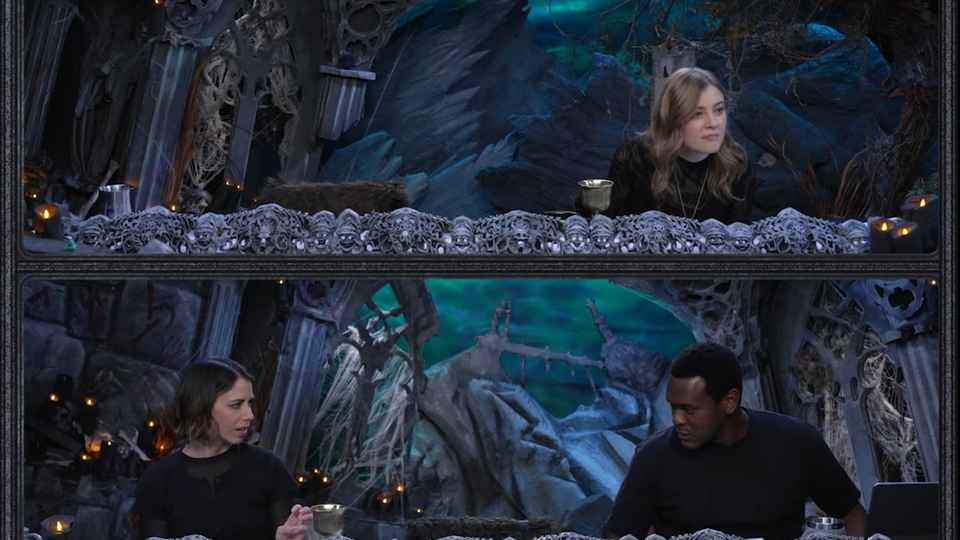
Scattered Pilgrims does not make its new party believable by quickly explaining everyone.
It does almost the opposite.
Each new arrival looks dangerous, strange or difficult to read. The episode repeatedly places its characters in situations where they must decide what to do before they possess a full account of who someone is. Again and again, they choose care.
That choice does not make them universally trusting. Sister attacks first when a huge shape rushes from the trees. Alphonse remains guarded after being rescued. Caguama trails Alphonse from hiding before deciding to intervene. These are suspicious people in a world that rewards suspicion.
Our Episode 1 review notes that the cast chemistry works almost immediately. The repeated pattern of care before certainty explains why.
A mistaken attack becomes a repair
Sister meets Mercy as a threat before she recognises him as family.
A massive figure charges through Rustsaw Wood. Sister has already demanded that the unseen presence show itself, and she has only a moment to react. Her critical strike leaves Mercy’s jaw hanging loose while the fungal threads in his body begin sewing it back together.
The scene is grotesque, but its emotional turn is gentle.
Mercy does not accuse Sister of cruelty. He says the mistake was his because he should have warned her he was coming. Sister answers that she did tell him to show himself, then welcomes him as a brother.
The exchange does not pretend that nothing happened. Mercy is badly hurt, and Sister is not wrong to have been frightened. Instead, both characters make room for the other person’s point of view.
Abubakar Salim plays Mercy’s damaged body for dark comedy without turning his forgiveness into a joke. His apology arrives while the injury is still visibly painful. Laura Bailey keeps Sister dry and firm rather than suddenly sentimental. Her response preserves the fact that she had a reason to defend herself.
Later, after the trio escapes Rustsaw Wood, Sister places an enchanted talisman around Mercy’s neck and asks for forgiveness. Mercy grants it, then seems confused about why forgiveness is needed at all.
On screen, that moment repairs the mistake with both words and practical care. Editorially, it establishes the rule that will guide the rest of the premiere: the group does not require a flawless first impression before choosing to protect one another.
Dillywin gives the first trio its emotional rhythm
Dillywin arrives as another alarming silhouette.
She drops from the canopy with huge glowing eyes, long limbs, black nails and clothing made from old wings, skulls and animal remains. She should make the scene feel less safe. Instead, her arrival gives the first trio its warmth.
Dillywin already trusts Mercy, and Mercy looks to her before assuring Sister that they can be trusted. When Sister explains that she is following rumours of a welcoming city, Dillywin does not offer proof that the journey or the traveller is safe.
She smells Sister, decides that she smells like her best friend and notices that she is sad.
“I think we can trust her” is Dillywin’s belief, not an objective answer supplied by the episode. That distinction matters. The first trio is not formed because one character possesses a magical test for moral goodness. It forms because Dillywin reads emotion quickly and is willing to act on affection.
Jennifer English makes that instinct feel active rather than vague. Dillywin darts between trees, directs movement, sends Badger ahead and fills danger with blunt comments. Her humour gives the group permission to be tender without requiring any of them to become solemn or openly confessional.
Mercy supplies patience. Sister supplies caution and purpose. Dillywin turns those qualities into a social rhythm.
She names sadness, celebrates help and treats friendship as something that can begin before a biography is complete. That does not close the trio to danger. It makes them emotionally available when the next stranger appears.
They choose the stranger before the safer route
The clearest test comes when helping someone requires the trio to abandon the sensible path.
A message through the fungal network warns Sister that one person is surrounded. Badger then reports that several people are chasing someone who is trying to escape.
The group still does not know the hunted stranger’s name. They do not know why he is being pursued or whether joining the conflict will threaten their own journey.
Sister says they should help. Dillywin asks the same question as if the answer is already obvious. Mercy immediately begins planning a distraction.
This is not a discussion about whether the stranger deserves rescue. The characters respond first to the reported imbalance: one person is being hunted by many.
Mercy’s response also carries personal history. He explains that the chase reminds him of being pursued and needing aid that did not come. The episode does not use that memory to prove the stranger’s innocence. It explains why Mercy refuses to wait for certainty while someone else experiences a fear he recognises.
The decision is what gives the party its first shared value.
They have already travelled and escaped danger together, but the rescue turns companionship into a moral action. The trio risks its route, draws attention to itself and enters a fight for someone whose story remains unknown.
That is more persuasive than a quick speech about loyalty. The characters learn what the others will do when helping has a cost.
Alphonse is accepted before he is understood
The hunted stranger is Alphonse, but rescuing him does not immediately explain him.
He is masked, armed and being pursued by bounty hunters. The group learns fragments during and after the fight, yet Episode 1 does not pause for a complete account of his past or settle whether every detail of his story should be trusted.
Belonging begins anyway.
Alphonse fights alongside the people who interrupted his capture. Mercy, Sister and Dillywin protect him before they know him, and he protects them in return. Shared danger provides enough evidence for the next decision even though it does not answer every question.
After the battle, Alphonse gives his name. Dillywin notices the skulls he carries, compares them with her own and asks whether they are friends.
“I’ll take it,” he replies.
The humour makes the acceptance feel light, but not empty. Dillywin does not ask Alphonse to prove that he fits the group. She finds one strange point of connection and offers him a place.
Alphonse does not suddenly become open or uncomplicated. His answer keeps the acceptance provisional. That makes the moment more believable. The party is not claiming complete knowledge of him. It is offering friendship on credit, based on what they have just done for one another.
The characters do not need every mystery resolved before they can travel in the same direction. They need enough reason to take the next step together.
Caguama joins through action
Caguama’s arrival repeats the pattern from the other side.
They have been quietly trailing Alphonse and remained out of sight. When the battle becomes dangerous, Caguama is visibly nervous about revealing themself. Their first intervention is not a grand entrance or a detailed explanation. It is encouragement.
Caguama sees Dillywin struggling, invokes the memory of Osha and calls out: “You got this.”
The mechanical help allows Dillywin to reroll and turn failure into a critical success. Jennifer English immediately converts that rules interaction into character feeling. Dillywin spots the stranger, celebrates “a new friend” and declares affection while the fight is still underway.
The speed is funny, but the logic is consistent.
Dillywin has already shown that she treats help as evidence of possible friendship. Caguama has risked exposure to support her. The episode allows that action to introduce the character before any formal conversation can.
After the fight, Caguama admits that travelling alone has become difficult and asks for company. Mercy gives the group’s simplest statement of membership: Caguama helped his friend, so Caguama is a friend too.
Vico Ortiz plays the approach with hesitation, awkward sounds and visible nerves. That performance keeps the acceptance from feeling like effortless confidence. Caguama wants company but must first cross the fear of being seen.
The party meets that vulnerability with a practical answer. No one demands credentials. They recognise what Caguama did under pressure.
Alphonse was helped before he was understood. Caguama is accepted because they helped before they were understood. Together, those arrivals complete a party built through reciprocal action rather than matching backgrounds.
The final encounter expands the same principle
The final creature encounter is not another recruitment scene.
The Tatchra does not become a sixth member of the party, and the episode does not establish that compassion cures its corruption. The creature remains dangerous, damaged and difficult to understand.
What the scene does is expand the habit that formed the group.
The episode has already identified the Tatchra as a creature once associated with magical wisdom and protection. Caguama remembers it as wise and knowledgeable, and after seeing its violence and the pain it draws from Alphonse, they ask what ails it from within rather than treating its present behaviour as the whole of what it is.
Caguama cannot know exactly what remains inside the creature. Their belief that a fuller life once existed within it is supported by remembered history, but the episode does not confirm a separate intact identity waiting to be recovered.
The critical attempt to comfort it stops the immediate feral violence. Caguama then speaks about Osha, care and the promise to help beings that once lived full and beautiful lives. The later mental connection contains beauty, warmth, sorrow and overwhelming pain, but its exact meaning remains uncertain.
When Caguama says, “You are beautiful,” the words do not solve the encounter. The Tatchra appears to sigh, recoils and eventually flies away.
Our dedicated Tatchra lore article examines what that connection confirms and what it only suggests. For this feature, the important point is narrower.
Caguama responds to a frightening and damaged being without first receiving a complete explanation of it.
That is the same principle that has shaped every arrival, taken to its most difficult limit. The episode does not argue that every threat is secretly safe or that care always produces a clean outcome. It shows compassion as a way of deciding how to act when fear and incomplete knowledge exist together.
Why the party feels convincing
Near the end of the episode, a surviving Twilight Exemplar asks who these strange travellers are.
Dillywin answers: “We’re friends.”
The line is funny because the group has existed for only a short time. It is convincing because the episode has spent that time showing what the word means to them.
They forgive a mistaken blow. They notice sadness. They leave a safer path to help someone being hunted. They accept aid given during danger. They offer company without demanding complete histories. Finally, they carry the same willingness to look beyond a frightening appearance into an encounter where understanding remains incomplete.
None of this proves that every member is inherently good, fully honest or naturally trusting. The group still contains caution, secrets and sharp differences.
What they already know is how the others behave when there is not enough information.
They choose care often enough, and at enough personal cost, that friendship becomes believable before explanation is complete.
That is how five alarming strangers become a party in one premiere: not answers first, but friends. Readers looking for the wider setting and mystery context can continue with our Episode 1 lore guide; newcomers can begin with the spoiler-free cast and viewing guide.
Sources
Enjoyed this article?
Supporting Rolling Realm helps fund more independent reviews, lore guides and spoiler-aware coverage. Every article remains free.
Age of Umbra: Sallowlands — Cast, Schedule and Where to Watch
Matthew Mercer leads a new standalone Daggerheart story through six weeks of dark fantasy in the Halcyon Domain.
A spoiler-free guide to the cast, characters, weekly schedule, UK release times and viewing options for Critical Role’s six-part Daggerheart miniseries.

Age of Umbra: Sallowlands Episode 1 Review: Beauty in the Ruins
A grotesque, compassionate premiere builds an instantly memorable party, even when its first battle and repeated travel challenges slow the episode.
Scattered Pilgrims introduces a vivid dark-fantasy party and ends with an exceptional act of compassion, although its long first battle and repeated travel challenges weaken the middle.
What We Learned from Age of Umbra: Sallowlands Episode 1
The Enduring, a dead ancient lake and the uncertain promise drawing five pilgrims west.
Scattered Pilgrims introduces the Enduring, the dead lake bed of the Sallowlands, the fragile protection of the Pyres and a rumoured city whose promise has drawn five very different travellers together.